














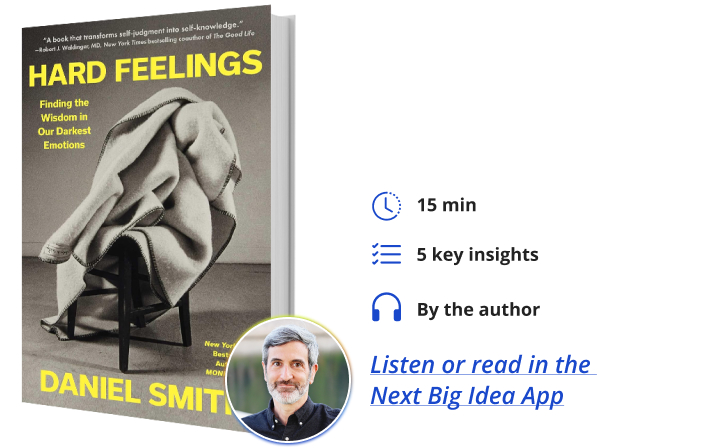
Below, Daniel Smith shares five key insights from his new book, Hard Feelings: Finding the Wisdom in Our Darkest Emotions.
Daniel is a psychotherapist and journalist. His writing has appeared in The Atlantic, The New York Times Magazine, and The New Yorker, among other publications.
What’s the big idea?
What if the emotions we try hardest to avoid—shame, anger, envy, regret—are trying to teach us something? Instead of labeling feelings as “negative,” we should learn to understand them, because our darkest emotions can become powerful teachers.
Listen to the audio version of this Book Bite—read by Daniel himself—in the Next Big Idea App, or buy the book.

1. Emotions aren’t real.
Obviously, that’s not true in any lived sense. Emotions exist. After all, we feel them all the time—every moment, in fact. They influence us. They drive us. They hold us back. They cause us pleasure and excitement, confusion and anguish. Without emotions, our lives wouldn’t have any color or texture, and maybe have no meaning at all.
And yet, emotions aren’t real in the way we’ve been taught to think of them as real. They aren’t what philosophers call “natural kinds,” which is to say, things in the world, things with solidity and structure. But that’s exactly how we’ve been encouraged to think about our emotions—as natural kinds.
These days, when people think about emotions, they tend to think of those adorable cartoon characters in the Inside Out movies—little independent features of our minds that are “triggered” by events out in the world. You see a rattlesnake on the path, the part of your brain called “Fear” pops up, and you feel scared. This is a very clear and understandable view, and over the past 40 or 50 years, a lot of psychologists have endorsed it. It just turns out that it isn’t true.
Our emotions aren’t essences or programs in our heads. If they were, scientists would be able to find those essences. And they haven’t. Not one. Dozens of studies, with thousands of subjects, have tried to pinpoint the location of specific emotions in our brains, and they’ve failed. The real picture of what our emotions are turns out to be a lot weirder and more complex. Emotions are tied up with culture and learning and human differences, and with the way our brains are always trying to make sense of what’s going on both outside and inside our bodies. To understand ourselves better, it helps to understand this richer view of our emotional lives.
2. There’s no such thing as a bad emotion.
We’ve been absorbing the message for so long, from so many different places, that we almost take it for granted now: Some emotions are good for us, and some are bad. Aristotle said something like this 2,300 years ago. The Greek and Roman Stoics wanted us to avoid pretty much all emotions.
“The real work isn’t sorting emotions into good or bad.”
Then came the rise of Christianity, and things got dark. According to the Church Fathers, there are some human emotions that aren’t only bad for us, they’re demonic. Some of the famous Seven Deadly Sins, like anger and pride, are basically just emotional states. And this isn’t ancient history. The Catholic Church still denounces greed, envy, and a form of boredom known as acedia as contrary to God’s purpose. In 2016, Pope Francis related envy to the workings of the devil. “How ugly envy is!” he said. “[It] grows in the heart like a weed…It is a tormented heart, it is an ugly heart!” It isn’t hard to understand what he was getting at.
Emotions like envy and anger are often tormenting. They do lead people to act in dangerous and destructive ways. We do need help coping with our most painful and difficult emotions. As a therapist, I believe this. But I also believe that to call any emotion sinful, evil, ugly, bad, or even just negative is a dangerous and destructive act. It suggests that certain emotions shouldn’t be part of you. It is to make that emotion separate from what it means to be human. It is to get moralistic about aspects of our experience that, like it or not, aren’t going anywhere. These emotions are part of us. The real work isn’t sorting emotions into good or bad. It is to get curious about what our emotions are trying to tell us—to listen and learn.
3. Avoid the second arrow.
One of the problems with thinking about some emotions as good and others as bad is that when we feel the so-called bad emotions, we tell ourselves that we shouldn’t be feeling them—and then we feel worse! We feel bad about feeling bad.
Thanks to my own therapist, I now think about this phenomenon in terms of the Buddhist concept of the “second arrow.” Life is hard. Difficult things happen, and in response, we feel painful emotions: anger, fear, guilt, resentment, regret, boredom, despair. This is the first arrow, and you can’t avoid it. What you can avoid is the belief that it is somehow wrong, a sign of ugliness or weakness, to feel “negative” things. This belief is the second arrow, and it’s self-inflicted. All it does is deepen the wound and double the pain.
“Your darkest emotions aren’t sins or character flaws.”
The path to greater contentment isn’t one of stern self-discipline or emotional censorship; it is one of exploration and understanding. Your darkest emotions aren’t sins or character flaws. They just are. They are part of you. Reject them, and you reject yourself.
4. It’s okay to find your kids annoying.
The act of raising children is rife with difficult emotions, and if we try to deny this fact—if we strive for some elusive, consistent positivity—we might just stumble on our own efforts and end up serving no one. In recent years, there’s been a movement toward what’s known as “child-centered parenting.” This is parenting in which the needs and interests of the kid take precedence over the needs and interests of the parent. This may or may not be an improvement over the alternative, but it breeds perfectionism—a kind of emotional self-vigilance. The child-centered parent feels pressure to be cheerful and caring, loving and entertaining, all the time. I tend to think this isn’t helpful for anyone, child or parent.
We need to be limber and forgiving in our emotional lives, and we should want our children to be exposed to the full range of emotional experiences so that they, too, can learn to handle difficult feelings. This doesn’t mean that we allow ourselves full rein emotionally. Of course, we should try to be patient and mindful rather than yelling or storming off. But we’re not always going to be. We’re human beings with complicated feelings, and our kids need to see and understand that.
One way or another, you’re probably going to lose it at some point, and in the aftermath of losing it everyone gets the chance to heal, repair, and learn. That’s how people get wiser and more resilient. To paraphrase Hemingway, you can’t avoid getting broken; you can just try to get stronger at the broken places.
5. Life is boring; deal with it.
Of everything I read while researching this book, my favorite is probably a speech that the poet Joseph Brodsky gave at Dartmouth College in 1989. This was a commencement address for 1,100 students. It was called “In Praise of Boredom.” It’s a pretty unforgiving speech.
Brodsky tells the assembled students that once they leave college, they will be facing a “psychological Sahara” of tedium and ennui. No matter what they did, no matter the careers they chose or the families they started, no matter the luxuries and distractions they collected along the way, they would all ultimately experience the gnawing malaise of boredom. This was, Brodsky argued, because life is made of repetition—of patterned events—and repetition is “boredom’s mother.” There was just no escape from it. Life was going to get dull.
“We need to be limber and forgiving in our emotional lives.”
It sounds bleak, but Brodsky meant it to be helpful. He wanted those students to know the truth. And he had a very deep view of boredom. He saw the emotion as the voice with which time, with a capital T—the true meaning of Time—speaks to us. Boredom was the messenger that whispers in our ear, as Brodsky said, “You are finite…and whatever you do is, from my point of view, futile.” Not futile, full stop. Futile from the perspective of infinity. Boredom exists, Brodsky said, to teach us the full lesson of our insignificance.
But this lesson is also why he praised boredom. Because once you accept your own insignificance in the grand scheme of things, you can stop trying to distract yourself at every turn and come to accept, love, and glory in your own impermanence—your own finite, time-limited nature. Only the finite is “charged with life.” Only the impermanent leads to real passion. So don’t run from boredom. Make your credo that great line from Robert Frost: “The best way out is always through.” This is true of boredom, and it’s true of all our difficult emotions.
Enjoy our full library of Book Bites—read by the authors!—in the Next Big Idea App: