












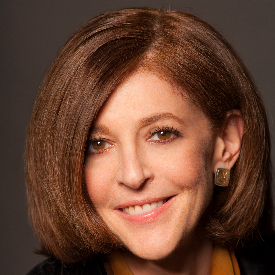
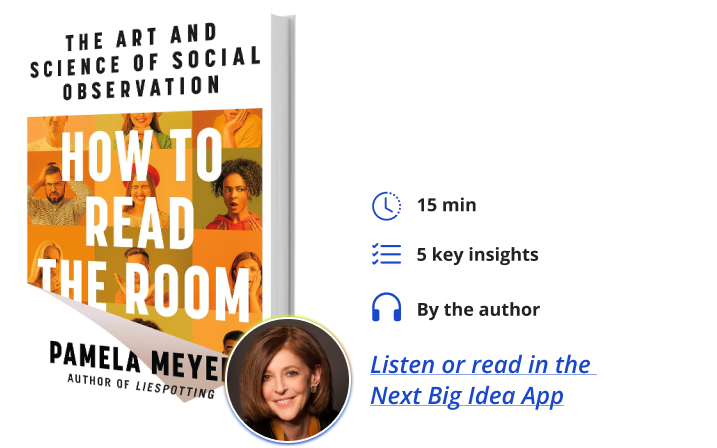
Below, Pamela Meyer shares five key insights from her new book, How to Read the Room: The Art and Science of Social Observation.
Pamela has been studying human behavior for decades. As a Certified Fraud Examiner and the founder and CEO of Calibrate, she trains executives, institutional leaders, and everyday people in getting to the truth, spotting lies, and reading the room.
What’s the Big Idea?
Reading a room is a skill, not an instinct. Stress, fatigue, and misleading body-language myths can distort what we see, while strong observers rely on preparation, patterns, and context. As AI gets better at capturing social signals, human judgment about what those signals actually mean will become even more valuable.
Listen to the audio version of this Book Bite—read by Pamela herself—in the Next Big Idea App, or buy the book.

1. The more consequential the room, the worse we are at reading it.
You’d probably expect the opposite. You’d think that when the stakes climb, so does your attention. A job interview or key negotiation—I bet you think those are the rooms that you read the most carefully. But they’re the rooms you read the worst.
The moment a situation really matters to you, your body treats it as a threat. Your heart rate climbs, adrenaline moves, and attention, which felt wide and easy just a minute ago, suddenly becomes a narrow tunnel. Psychologists have known this since the 1950s, when James Easterbrook showed that arousal shrinks the range of cues someone can take in. When we’re under pressure, we get sharper at seeing the one thing that we’re braced for, and we get blind to everything else around it.
That’s a problem in a busy room where small but very crucial signals can be missed. Usually what gives a room away are the little things that leak around the edges: the board member who stopped taking notes, the client who laughed a half second late and then smirked.
“The moment a situation really matters to you, your body treats it as a threat.”
On top of that, if you put people under acute social stress, they stop shifting their attention flexibly from one cue to another. The fast automatic read still fires, but that slower judgment, the part that weighs nuance, just drops out. You start running on first impressions at the exact moment when your first impression is likely to be wrong. What’s worse, that pressure and self-consciousness you feel makes you feel very certain. So, people furthest from an accurate read are often the most confident that they nailed it. And that confidence climbs as observational accuracy fails.
The high-stakes room hands you two problems at once: it shrinks what you see and it convinces you that you saw everything. In these moments, we feel focused. That’s how we trick ourselves. That sensation of being fully present is close to the sensation of your field of view collapsing. So what do you do with a system that betrays you precisely when you need it most? You need to bring your own temperature down before you walk in.
The photographer Dorothea Lange had a brilliant view on this dilemma. She said that when she was working well, she would “annihilate” herself. The nervous question, How am I coming across?, would go silent. What was left was room for the actual person in front of her to photograph. She did the inner work first so she could essentially forget herself in the moment and absorb what surrounds her.
Before your next consequential, high-stakes room, try three things:
- Treat room reading as a meditative practice. Make this a mode that you settle into before walking in.
- Make it your job to put everyone else at ease. Worry about their comfort. This takes your attention away from self-monitoring.
- Do the hard work ahead of time. Name the fear underneath the meeting. This stops you from guarding your own performance and opens the path to true social observation. Stakes will still be high, but that will no longer distort your view.
2. High-performing professionals don’t improvise.
Reading people is not a spontaneous act. We imagine the master negotiator, the fabulous interviewer, the legendary diplomat waltzing into a room with extraordinary instincts. They read faces, trust their gut, and size people up in minutes.
For more than 80 years, psychological profiling has been one of the quiet advantages of intelligence agencies. During World War II, the OSS commissioned Harvard psychoanalyst Walter Langer to build an extensive psychological profile of Adolf Hitler. Decades later, before the Camp David Accords, President Jimmy Carter relied on psychological profiles of Menachem Begin and Anwar Sadat. Carter wanted to understand how each man interpreted risk, status, conflict, trust, and concession before either one entered the room.
Everyone has patterns that were built over decades. Someone who spent a childhood moving from school to school may have learned to study the unwritten rules of a group before speaking. A leader raised in a boom-and-bust household may hear financial risk before anyone else does. Formative experiences teach people what to notice, what to ignore, whom to trust, and what danger looks like.
That’s why I developed the Triple B method: background, behavior, and beliefs. The goal is to identify recurring patterns so you can ask better questions and understand people more deeply. If I know you immigrated to this country as a teenager, I may ask about adaptation instead of achievement. If I know your company nearly failed 10 years ago, I can better understand why you’re cautious about expansion. If I know a teacher changed your life, I have a much better chance of understanding why you invest so much energy in mentoring.
Understanding someone is a tremendous advantage, because behavior that once seemed irrational can suddenly become predictable. Reading the room doesn’t begin when the meeting starts. By then, the top professionals have already done their homework.
3. A full mind cannot read a room.
You might know the old joke among lawyers that a case comes down to what the judge ate for breakfast. In 2011, researchers actually tested this. They tracked more than a thousand parole decisions, and the joke turned out to be somewhat true. First thing in the morning, judges granted parole about 65 percent of the time. As the hours wore on, that number slid until it hit almost zero. Then the judges took breaks, had a snack, came back, and the rate popped right back up. Same crimes, same files, same seasoned judges. Yet the judges’ blood sugar seemed to be influencing a human being’s chances for freedom.
That famous study has received some fair criticism. Researchers have pointed out that the cases weren’t randomly ordered and lawyers with weaker cases sometimes went last, which could explain part of the decline. But the deeper idea underneath it has held up: a depleted brain makes worse calls than a fresh one, and it rarely recognizes the difference.
“Our judgments can be weirdly physical.”
A tired, overloaded brain pulls back from heavy cognitive processing and reaches for shortcuts. It can revert to stereotypes and snap judgments, which require less mental effort. Our judgments can be weirdly physical, too. Give people a bitter drink and they may judge others more harshly. Sit them in a hard chair and they become less flexible in a negotiation. Hand them a heavy clipboard and decisions suddenly feel more consequential.
Now put yourself in that judge’s shoes at 11:45 a.m.: five meetings deep, no lunch, phone buzzing in your pocket. You may interpret the person holding back or looking down as hostile. The nervous one, you deem shifty. Anyone with real complexity can get flattened into a type.
We severely underestimate the role cognitive load plays in how we misread rooms. So before you enter a room that matters, do the unglamorous things—like eating or answering that text—to prepare yourself. The sharpest thing you can bring to a hard interaction is a mind with a little room left in it.
4. Much of what we know about reading body language is wrong.
Leaping to conclusion is for louts. That’s what I tell my students. And with body language in particular, it’s what everybody does. We see crossed arms and assume defensiveness. We see averted eyes and think deception. We treat gestures as if they carry fixed meanings, but they don’t.
A gesture only becomes useful once you know three things:
- Baseline: What’s normal for that person.
- Cluster: Whether several cues are changing altogether at the same time.
- Context: What’s happening around them.
Experts begin with the baseline. They learn how someone usually speaks, moves, gestures, and makes eye contact. Without that reference point, behavior is remarkably easy to misread. What looks anxious in one person may be entirely ordinary in another. If someone starts tapping their foot, for one person that could be a sign of anxiety, while for another it’s simply their norm.
Then experts look for clusters. One cue is very weak evidence. Several changes appearing at once and pointing in the same direction deserve more attention. A faster voice, tightened posture, and sudden shift in gaze can mean much more together than any one of them does alone.
And even then, experts don’t declare a verdict. They hold a working hypothesis and consider the context. Crossed arms may mean resistance. They may also mean someone is cold, concentrating, or in pain. The surrounding circumstances help determine which explanation fits.
The real skill isn’t memorizing more tells. It’s learning how little a tell means by itself. If you want to read body language well, focus instead on the person’s baseline, changes that appear in clusters, and the context surrounding them.
5. AI will commoditize social signals.
Human judgment is going to become a scarce resource. AI is excellent at extracting signals from what it has already captured: words, faces, messages, calendars, transcripts. But rooms are messy. They’re full of signals that never arrive in clean form.
A pause might signal caution. It might mean anger, confusion, deference, or strategy. A smile may mean agreement, but it may also mean containment. Silence might mean consensus, fear, calculation, or simply that everyone is tired. AI can label the signal. It is far less reliable at judging what the signal costs the person sending it, what power relationship shaped it, or what history sits behind it. Knowing context is the human advantage.
“Human judgment is going to become a scarce resource.”
A machine can tell you that someone stopped speaking. But the perceptive leader asks why. Was speaking so risky that silence became the safer choice? This distinction matters because automated summaries can create the illusion of social knowledge. A meeting report might tell you who spoke the most, where sentiment fell, and which topics produced disagreement. But it will miss the most consequential fact in the room: no one challenged the chief executive because everyone had learned what dissent costs.
The more automated our summaries become, the more valuable it will be to have a leader who keeps asking, What did the room actually tell us? Reading the room becomes more important in the AI era because while social signals will be cheap and plentiful, human judgment about meaning, power, history, and consequences will remain scarce.
Enjoy our full library of Book Bites—read by the authors!—in the Next Big Idea App: