











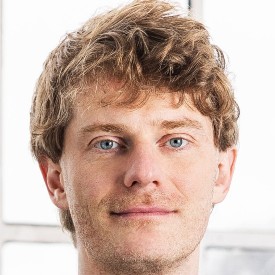
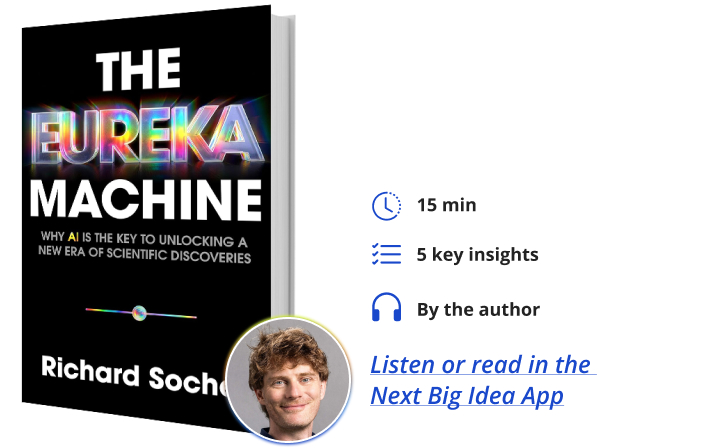
Below, Richard Socher shares five key insights from his new book, The Eureka Machine: Why AI Is the Key to Unlocking a New Era of Scientific Discoveries.
Richard is a pioneering AI researcher and serial entrepreneur who spent nearly two decades at the forefront of natural language processing. He is the CEO and cofounder of Recursive, a company building self-improving superintelligence to automate knowledge discovery, and the CEO and founder of You.com, a web search infrastructure provider for AI. He is also the founder and managing partner of AIX Ventures, an AI venture capital firm. Previously, he was an adjunct professor of computer science at Stanford and chief scientist and EVP at Salesforce.
What’s the Big Idea?
The most meaningful application of AI won’t be chatbots or productivity tools. It will be the automation of scientific discovery itself: a Eureka machine that combines all human knowledge, simulates billions of experiments, and generates the breakthroughs that end disease, extend human life, and solve the hardest material problems facing our civilization.
Listen to the audio version of this Book Bite—read by Richard himself—in the Next Big Idea App, or buy the book.

1. AI’s historical significance will be realized in science, not in chatbots.
In October 2024, two AI pioneers won Nobel Prizes. Demis Hassabis won the chemistry prize alongside John Jumper and David Baker; Geoffrey Hinton shared the physics prize with John Hopfield. That surprised many because neither Hassabis nor Hinton was a trained chemist or physicist. Yet it made sense, because the neural network work they had done with their teams was making a profound impact in those sciences.
This is not what dominates the headlines. Doomsday scenarios do. People love thinking about the Terminator. But while that is a fun science fiction story, it is important to focus on the incredible and positive impacts AI is having on science. Science leads to technology, and technology drives human flourishing. Amplifying human intelligence with AI will ultimately have an extremely positive outcome for humanity.
2. Everything has a language, and AI can learn to speak it.
Consider the sentence: “I drove south from Berlin to __.” If you’re a language model, you have to predict the next word. To do that well, in this instance, you have to know a little geography. The striking thing is that just by learning how to predict the next word, the model acquires geographical knowledge. Given enough scale, it builds something like a mental map of the world—distances, sizes of cities, the relationships between countries and regions. None of that geographical understanding was explicitly programmed. It emerged from the task itself. And the same principle extends far beyond human language.
“What calculus did for physics, AI will do for biology.”
Consider biology. By predicting the next amino acid, the basic building block of proteins, a model can eventually learn the language of biology. At Salesforce, my colleagues and I built a project called ProGen, in which we trained a large language model on 280 million protein sequences across 19,000 different protein families. Then we asked it to create new kinds of proteins. It generated millions of artificial sequences, including ones in the lysozyme family—enzymes that break down bacterial cell walls. 73 percent folded correctly and showed the antibacterial properties we were hoping for.
What calculus did for physics, AI will do for biology. It is a new language for complex systems that transforms a field concerned with understanding what nature has already done into a programmable science.
3. The next breakthrough may already be sitting in the literature.
In the early 1960s, two researchers at Bell Labs, Arno Penzias and Robert Wilson, could not get rid of a persistent hiss in their antenna. They spent a year trying to eliminate it, placing duct tape on every rivet and scrubbing pigeon droppings off. No matter where they pointed the telescope, the hiss remained. They were actually hearing the afterglow of the Big Bang. Two decades earlier, a Russian cosmologist had suggested that the heat of creation might still be detectable. A team at Princeton was chasing that theory, unaware that Penzias and Wilson were sitting on the answer. It took a mutual acquaintance, Bernard Burke, to suggest they pick up the phone and talk. That collaboration led to a Nobel Prize in 1978. Their story is about scale and serendipity.
Today, 23 million researchers publish in more than 54,000 journals. No human can see all the pieces at once. In the 1980s, an information scientist named Don Swanson noticed that one body of literature described the effects of fish oil on blood vessels, while another described Raynaud’s syndrome, a condition involving vascular constriction. Nobody had linked them. Swanson did, and he was right. He was pointing at undiscovered public knowledge—findings already published but connected to nothing.
“No human can see all the pieces at once.”
AI removes that bottleneck because it can actually digest all of the different literature and spot the connections. James Evans and his colleagues at the University of Chicago used AI to map nearly 20 million biomedical papers and the nine million researchers who wrote them. The system models not just what science knows, but where scientists are looking—and then inverts the map to analyze the cold, unexplored regions where the next connection might be waiting. Evans calls these alien hypotheses. The biggest breakthroughs stand on the shoulders of giants. AI can now combine and recombine all existing knowledge.
4. What comes next is the Eureka machine.
The Eureka machine will be the culmination of several converging streams of AI development. It may be the last organic invention we need before it will solve almost any material or scientific problem for us. This Eureka machine rests on four pillars:
- A living map of all human knowledge: what large language models already approximate, having been trained on the internet, millions of books, and vast scientific literature.
- A unified model of physical reality: all the scientific measurements humanity has ever collected, from satellites, space probes, microscopes, and sensors, infused into the machine so it can perceive far beyond what human senses allow.
- High-fidelity digital twins: simulations precise enough to run billions and billions of “what if” experiments that would otherwise be too dangerous, too costly, or physically impossible to repeat at that scale. Anything that can be simulated, AI can systematically explore.
- Fully autonomous physical laboratories: robotic facilities with AI vision, capable of pipetting, running experiments in biology, chemistry, and physics, and connecting simulated predictions to verified real-world results.
On top of these four pillars, millions of AI agents will coordinate like a scientific community. They will critique each other’s ideas, producing an evolutionary process that yields ever-better results.
5. We are astronomically far from the upper bounds of intelligence.
How far can AI go? We are a long way off from finding out. When it comes to the upper bounds of intelligence, we are astronomically far away. But when I talk about upper bounds, I don’t mean ceilings. I mean them as horizons so distant they reveal how much room there is to grow.
Take computer vision. We build it around the narrow band of the electromagnetic spectrum that human eyes can see. We grade our AI algorithms based on how well they identify objects the way we do. That is one of many anthropocentric constraints we have imposed on AI. But AI can have more than our binocular vision. In principle, it could have trillions of sensors connected across the full electromagnetic spectrum—from gravitational waves down to the probability distributions of subatomic particles at the quantum limit. The true upper bound on perception is the speed of light. We are nowhere near it.
“That is one of many anthropocentric constraints we have imposed on AI.”
Vision is just one of 10 dimensions of intelligence that I define in the book. Similar vast frontiers exist in knowledge, communication, social intelligence, and survival.
Richard Feynman left a line on his blackboard: “What I cannot create, I do not understand.” Building a machine that generates inventions should teach us something about the nature of intelligence, and therefore ourselves. I can’t tell you exactly what the coming decades will look like, but I expect a world more human and more humane than this one. Healthier, wealthier, running on cleaner energy, and caring less about the zero-sum scarcity mindsets that have shaped much of our history. A big part of that vision comes directly from the Eureka machine.
Enjoy our full library of Book Bites—read by the authors!—in the Next Big Idea App: