















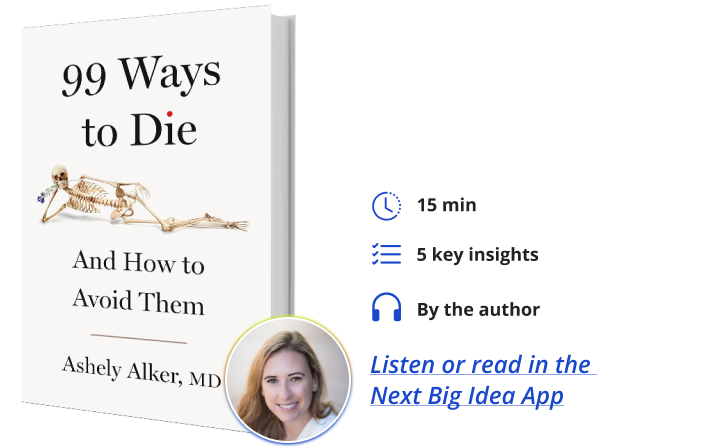
Below, Ashley Alker shares five key insights from her new book, 99 Ways to Die: And How to Avoid Them.
Ashely is a death escapologist. As an emergency medicine doctor, she has seen it all—from freak accidents and rare diseases to the kind of horror stories we all hoped only existed in movies. But before she ever put on a white coat, she worked in public health education. She was a technical consultant and medical screenwriter, improving medical accuracy on over twenty shows, including TV and film for Netflix, Hulu, HBO, and Disney. Her nonprofit, Meaningful Media, connects creators and journalists with certified public health experts to develop scientifically accurate messaging.
What’s the big idea?
Staying alive often comes down to knowing the right things at the right time. 99 Ways to Die uses storytelling to cut through medical jargon and misinformation, revealing the everyday dangers we miss and the science that can save us.

1. You can’t see it, you can’t feel it, but it’s the leading cause of rabies deaths in the U.S.
I was first introduced to rabies as a child when my parents chose to enlighten me through the classic book-turned-film Old Yeller. The story’s canine heroin, Old Yeller, is bitten by a rabid wolf while protecting his human family. Old Yeller survives the initial bite but develops rabies, foaming at the mouth and attacking, forcing one of the children to shoot and kill the beloved dog. This was a formative moment for me, and you better believe I became a tiny rabies vaccine czar, requiring proof of vaccination in all our pets.
Rabies is transferred through the saliva of mammals, often through bites. Without post-exposure preventive treatment, rabies is 100 percent fatal. Well, 99.999999 percent. There is one individual in the U.S. who survived rabies without prophylactic treatment: A 15-year-old girl from Milwaukee who was treated with a sedation technique that has since shown limited success in others.
Dog bites account for 90 percent of human deaths from rabies worldwide, due to a lack of vaccinations, especially in stray dogs. However, in the U.S., most human rabies deaths are due to bat bites. As if bats aren’t creepy enough, bat bites are painless and commonly leave no marks, so if you ever wake up in a room with a bat or find one in your home, you need post-exposure preventative treatment for rabies immediately at your local emergency department.
2. Serial killers aren’t who you think they are.
I should know, I met one. It’s a long story, but I cover it in the book.
“There is a common misconception that serial killers are reclusive and socially inept.”
The U.S. holds just over four percent of the world’s population but is home to an estimated 66 percent of the world’s serial killers. Given that most of the world’s serial killers live next door, imagine my surprise when I moved to an island on the other side of the world, only to encounter its one and only serial killer.
There is a common misconception that serial killers are reclusive and socially inept. The FBI found that this is often not the case, as many serial killers are gainfully employed, with families, and socially engaged. I met one at a nightclub, so clearly he wasn’t an agoraphobe. Hollywood often casts the serial killer as a diabolical genius, but the FBI has found no association with intelligence level; rather, killers often have associated personality disorders.
3. Children are exotic creatures, and you are a labradoodle.
The physiology of children is wildly different from that of adults; this means their bodies work differently. They have little hummingbird hearts and don’t even breathe the same way. Also, the presentation of diseases in children differs from adults.
What that means is that when you get strep throat, you have a sore throat, but when a kid gets strep throat, they have stomach pain and are vomiting everywhere. Adults get pneumonia from COVID-19; kids get sniffles and then a weird inflammatory disease. The common causes of diseases, treatments, and proper medication doses are different in children.
Babies are especially special, and because of this, those under one year of age cannot have honey, as it could cause botulism. Those under six months should not be given water or diluted formula because it can cause brain swelling.
4. When it comes to science and medicine, who you are matters.
The same test on two different people can indicate completely different medical conditions. A positive hCG pregnancy test on a woman usually indicates pregnancy, while in a man it indicates cancer.
When it comes to your health, you might think the most important number is your blood pressure, cholesterol, or age, but in the U.S., it’s your zip code. Dr. Melody Goodman’s research at Harvard School of Public Health found that “your zip code is a better predictor of your health than your genetic code.” Social determinants of health determine when you are born, the food you eat, the medical care you have access to, and even when you die.
Sex also matters. For instance, women are more likely to die in car accidents of similar severity, in part due to historical crash testing exclusively considering male anatomy.
“Social determinants of health determine when you are born, the food you eat, the medical care you have access to, and even when you die.”
Race and ethnicity also matter. In the U.S., maternal mortality is much higher in African American and Hispanic populations. And 80 percent of these deaths were determined to be preventable by the U.S. Maternal Mortality Review Committee.
We often fail to recognize the bias inherent in the systems we build, particularly when we have been shaped, educated, and socialized within these systems. In healthcare, this is becoming especially dangerous because as we build artificial intelligence in our likeness, our systemic bias could cost us lives.
5. Vaccines save lives.
In the last 50 years, vaccines have saved an estimated 154 million lives, most of which were children. This is equivalent to six lives every minute. Enough said.
Lastly, some rapid-fire insights:
- Never ignore chest pain.
- Don’t pull out penetrating objects if stabbed.
- Get treated for strep throat.
- Get checked for Sexually Transmitted Infections.
- Always finish the full course of antibiotics.
- Tylenol and iron supplements are deadly in overdoses.
- Get a carbon monoxide detector.
- Don’t run in an earthquake.
- Stay in your car during a lightning storm, but don’t touch the doors.
- And this last one won’t save your life, but don’t pee on your friends—urine will not help a jellyfish sting.
Enjoy our full library of Book Bites—read by the authors!—in the Next Big Idea App: