













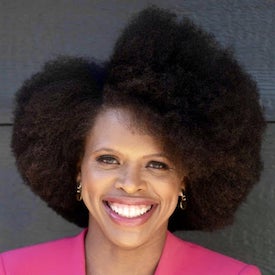
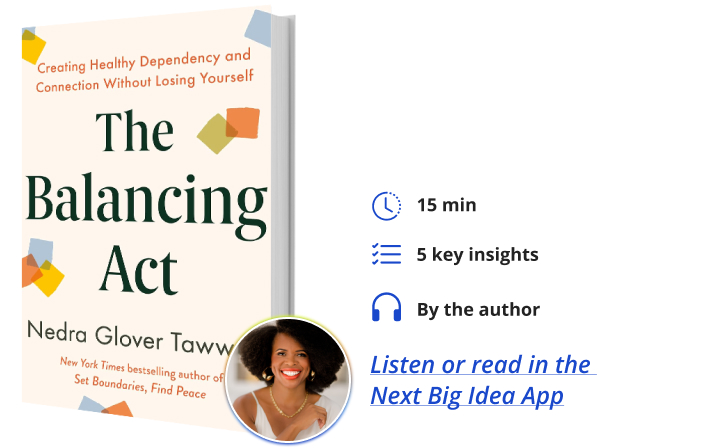
Below, Nedra Glover Tawwab shares five key insights from her new book, The Balancing Act: Creating Healthy Dependency and Connection Without Losing Yourself.
Nedra is a licensed therapist and author of the instant New York Times bestseller Set Boundaries, Find Peace. She has practiced relationship therapy for almost 20 years and has over 2.5 million followers across her social media platforms. Nedra has appeared as an expert on multiple news shows, such as the CBS Morning Show, and has had her work highlighted in publications such as the New York Times and Vice.
What’s the big idea?
Healthy relationships are built on flexibility, not fixed labels or rigid patterns. By setting better boundaries, challenging your default behaviors, and expanding your support network, you can reshape how you show up and create more balanced, fulfilling connections.

1. Codependency exists on a spectrum.
Codependency is not entirely bad. Much of what we hear about codependency frames it as a bad thing that we should get rid of or avoid at all costs. But it’s possible to be in a codependent relationship without needing to leave it.
At times, codependency is a way that we are trying to help someone or show love. But importantly, with codependency, we must monitor our actions so that we’re not overwhelmed by our level of output. We have to be flexible in saying yes sometimes and no at others. So, we need to make sure we build better boundaries if we have a tendency for codependency.
The biggest thing, however, is that we need to have healthy relationships in other spaces. Just because you have one scenario where you are over-giving doesn’t mean that you need to recreate that in all your relationships. Perhaps there is someone who you feel needs a level of support that is codependent. How are you showing up in your other relationships with people? What relationships pour into you? If you don’t have those, it may be time to seek them out.
2. Do the opposite of what feels natural to get better results.
We are often biased toward believing that the concepts we already use are working. Even when evidence shows they aren’t, we keep trying to meet people in the same way, using the same relationship skills that have landed us in unhappy positions before. Sometimes the best thing to do is the thing that feels the most uncomfortable. For example, maybe you’ve gotten used to thinking, “Gosh, I don’t like inviting people to my party. I’m just going to wait for them to ask if I’m doing anything for my birthday.” If that has been your go-to and every year you are disappointed that you never get the gathering you wanted, then it’s time to do the opposite. In this case, the opposite would be to issue the invites.
“Don’t stick to a bad thing.”
The choice that feels cringey or makes you uncomfortable might just be the thing that could work for you in your relationships. Don’t stick to a bad thing. Even if you feel like your default mode should work with someone at some point, if it hasn’t, it’s okay to change the way you show up.
The same goes for your relationship type. If you have a certain type of person you like to date and it never works out the way you want, you should change your type. If you have an argument style that always leads to explosive interactions, it is time for you to do the opposite of the thing that you’ve been doing. It’s a tough concept, but it can be extremely helpful for many of us.
3. Attachment styles are not fixed information.
When we started speaking about attachment styles in clinical settings, it was in relation to children and their parents. This concept of attachment styles has broadened to include dating partners, how we show up in our families, and how we show up as friends. And it can be really good information, but it’s not a fixed term that you have to hold onto.
If you’re avoidant with your partners, that doesn’t necessarily mean you are an avoidant friend. And just because you’re avoidant with one partner does not mean you have to be that way in all your dating relationships. What’s important is knowing the types and figuring out what you want to practice differently.
If your type is not secure, then maybe it’s anxious, avoidant, or a little bit of both. What do you want to do in your relationships? When people ask you to hang out, do you want to be avoidant or do you want to practice the opposite? Do you want to do something different because you desire closeness?
“What’s important is knowing the types and figuring out what you want to practice differently.”
You don’t have to latch on to the information that you have about yourself simply because you’ve taken a test or because it was true in other relationships. You have the opportunity to practice something different. You can heal beyond the label you’ve been given. I want you to think about all the instances within your relationships. Perhaps even if you’ve been avoidant in most of them, there were certain times when you were secure. Maybe there were specific people who gave you that. Attachment styles can be flexible.
4. We need more people.
Sometimes we can overburden our support system because we don’t have enough people in our support network. We need more people. We need neighbors. We might need seven friends. We might need our siblings, our parents, and our grandparents. We need more people. Start to notice and then fill in the gaps. For instance, if you take on new dietary habits and want someone to talk to about them, use it as an opportunity to curate a new relationship. It could be a time for you to build a new bond with someone who’s already in that space.
We can do a lot of damage to our existing relationships when we expect those connections to share enthusiasm for new things in our lives that they are not interested in. To have full relationships with everyone, we need to accept that everybody doesn’t change at the same pace. When we notice new changes in our selfhood, we might need new people.
When we notice that there are gaps, it is an opportunity for you to deepen a relationship or find a person who you can have that sort of connection with. You don’t need to get rid of the old people. Perhaps there’s nothing wrong with those relationships, but it could be very valuable to look at what you need now and who could fill those gaps in your relationships.
5. Interactions, at all levels, are valuable.
Whether going to the same post office and seeing that familiar face, or meeting with your best friend who you have a deep connection with—both experiences are valuable. We need people at all levels. It’s not just about having as many close relationships as you can manage. You need those loose social contacts, too. Maybe that’s knowing the person delivering your mail or the barista at your local coffee shop. Having those connections matters.
“We get so much from those small connections, as well as the big ones.”
I recently heard a story where a woman passed away, and guess who held a special celebration in her honor? Her bank. They were so used to seeing her every week that, when she no longer came, not only did they contact her family, but they also had so many kind things to say that they had their own little celebration for her, because she would be missed.
We get so much from those small connections, as well as the big ones. Having friends is important, but so is having associates, having coworkers, and just knowing a person every day as you go on your walk and waving to them. All of those things are important for our relationships.
Enjoy our full library of Book Bites—read by the authors!—in the Next Big Idea App: