















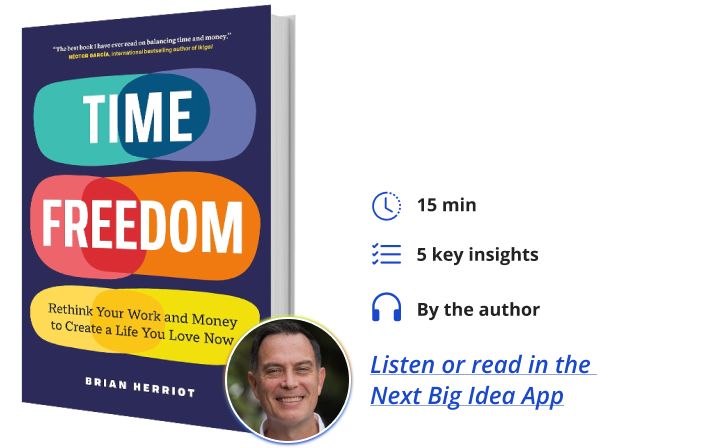
Below, Brian Herriot shares five key insights from his new book, Time Freedom: Rethink Your Work and Money to Create a Life You Love Now.
Brian is an author, speaker, and financial advisor. After founding three business, he has learned that true success means building a life that works for you.
What’s the Big Idea?
Time freedom offers a more practical alternative to waiting decades for financial freedom. By combining flexible, meaningful work with smart saving and investing, we can gain control over our time much sooner, taking extended breaks without giving up work we enjoy or jeopardizing our financial future.
Listen to the audio version of this Book Bite—read by Brian himself—in the Next Big Idea App, or buy the book.

1. Summers off aren’t just for teachers.
My love for summer stems from early childhood experiences vacationing at my grandparents’ cabin on Big St. Germain Lake in the Northwoods of Wisconsin. We’d spend hours upon hours hiking, swimming, fishing, and—the most fun of all—waterskiing. I have vivid memories of waterskiing alongside my two cousins. We called ourselves the “triple duets” and even had a song we’d sing together, at the top of our lungs, as we skied by the dock. (I realize now that triple duets is technically six skiers, but hey, we were kids.) We skied behind a tiny aluminum fishing boat that my grandpa rigged with an oversized 20-horsepower motor.
Grandpa never could get the motor-sizing right, because on the other boat—the one the adults skied behind—sat a 65-horsepower motor that was completely undersized. The 65-horse, as we called it, could never quite pull my 200+ pound father out of the water when he tried getting up on one ski. You see, my dad is the kind of dad who has to prove to himself that he can still do things. His infamous one-ski start was a summer event we enjoyed for years. My cousins and I would pile into the big boat to witness the event. We kids would scream and cheer from the boat which pulled him—nearly drowning—halfway across the lake until he finally let go of the rope.
It’s been my life’s mission to find a way to take summers off and maximize time at the cabin with my family. Time freedom was the answer.
I’ve chosen to arrange my life into periods of intense work followed by periods of extended time away (for me, in the summer) because both are important to me. I like work. And I like long breaks. It’s an unconventional way to live, but I’ve found that it’s attractive to many. I call myself a freetimer. Freetimer is a word I’ve coined, and it has nothing to do with being a freeloader or two-timer. A freetimer is someone who has complete control over their time. We must work, but we can do it by choice and on our timeline. If you choose to optimize your life around freedom instead of wealth alone, it’s possible for many of us to take summers off, or whatever seasonal schedule you prefer.
2. Financial freedom is too slow for most.
I handle the “money stuff” in my family because I enjoy it. But I did not enjoy April 2020, in the midst of the COVID stock market crash, when I had to tell my wife, Claire, that our portfolio was down about 35 percent. We were both 43 and had been diligently saving and investing since our early twenties. This meant that in April 2020, we had investment losses in the hundreds of thousands of dollars. I ran the numbers and was stunned to learn everything we’d done to accelerate our savings was for naught, and true “financial freedom” was still about 20 years away.
“Retiring to a beach and never working again didn’t appeal to me.”
In the moment, my wife—always the wiser one in the relationship—asked me what financial freedom meant to me. I’m embarrassed to admit I hadn’t considered that before! After a couple of days thinking about it, I realized that retiring to a beach and never working again didn’t appeal to me. I loved my work and wanted the opportunity to dip in and out of it. Claire asked why we couldn’t do that now. And though we couldn’t do it immediately, over three years, I figured out how to balance our investments and my work so we could take summers off and be freetimers.
Financial freedom is absolute freedom. It can take decades to save and invest your way there. Or it requires a lot of luck to cash in on a huge business you’ve built as an entrepreneur. You need to be patient or fortunate. But even then, you might realize that absolute freedom is boring.
Financial freedom is important, but it’s an interim step to what we really want: control over how we live and how we spend our time. Instead of spending years achieving financial freedom only to take back control of our time, I suggest switching the order: Since time freedom is our ultimate goal, we should pursue it first. And then let financial freedom happen in the background. Time freedom is meaningful freedom and achievable for most of us in just three years.
3. Working longer is more freeing than retiring early.
Financial advisors speak with a lot of people about their retirement plans. We know what many do not. Those who can’t afford to retire would give anything to do so as soon as possible. Conversely, and interestingly, many who can afford to retire aren’t in a rush to do so. Why is that?
Over time, some people have been able to shape work into something enjoyable, well-paying, and flexible. For them, work isn’t just about money. When enjoyable, work is intrinsically rewarding. It provides ongoing status, social benefits, structure, and purpose. If you can achieve all these things with work, you won’t want to give it up either. This is what the freetimer aspires to.
“When enjoyable, work is intrinsically rewarding.”
Say you’re an internationally respected trademark attorney. You have deep skills and an active network. You fly all over the world (with your family) to share your expertise with clients. Your average work week is just 20 hours, and you take long vacations. Yet you still make $500,000 per year. You’ve organized your work and life in the most symbiotic of ways.
I advocate that we never retire, which to some is a bold statement. Instead, I advise that you continue refining your work as different stages of your life evolve. If you knew you’d work later in life and that you didn’t need to fit your savings goal into a compressed career timeline, how might that change your view of time off from work? If you know you won’t “get behind” on savings, it becomes easier to choose to take longer periods of time off. In a strange way, choosing to work longer is more freeing than retiring early.
4. Magic happens when your money and work are aligned.
Achieving time freedom does not require extreme and heroic changes in your life but rather is a balancing act. The breakthrough for me was in formulating how the money and the work parts of life best fit together. Or as I sometimes ask of my clients: Imagine what might be possible if only your financial advisor and business coach worked together on your behalf?
The solution is the time freedom formula, which builds on the financial freedom formula—more commonly referred to as the Four Percent Rule. If you examine a single year in your new life as a freetimer, the expenses to support your lifestyle must equal your investment income (or four percent of your total savings, as defined by the Four Percent Rule). If you live in a high-cost state or have big, inescapable living expenses, the amount you need can be very large and take a long time to accumulate. For example, to live on $160,000 each year, you’d need an investment portfolio worth $4 million.
The time freedom formula adds one more variable. Your lifestyle expenses must equal your investment income plus flexible work. Flexible work can take many forms, from a more flexible arrangement inside an employed position to a side hustle to full self-employment. In our example, if you have been able to save a $1 million nest egg, it will support $40,000 of living expenses. To cover the remaining $120,000, we’ll create work that is flexible, fun, and full of choice. Time freedom is achievable more quickly because we balance our money and how we work. Yes, balance is boring, but a balanced approach is also doable.
5. With time freedom, you can think bigger.
My son, Theo, is a natural-born salesman. Years ago, when he was seven, Claire and I begrudgingly hosted a big yard sale. Our extroverted first grader convinced us to pay him a 10 percent commission on all the sales our family made that day. He held his own! Theo started the day off by selling his bike, then my bike, and then an entire living room set of furniture.
“Time freedom is an opportunity to think big and take some grand bets on ourselves.”
Later that morning, I was busy selling an elderly gentleman a $2 bowl when I realized Theo was nowhere to be found. As I bounded up the front steps of our home to look for him inside, I heard the familiar “beep beep” of our car’s key fob. I had moved our car for the sale, parking it in front of the neighbors. When I looked over, I found Theo chatting up a woman and showing her our car… he was actually showing her our car to sell it to her. He had overheard us two nights earlier when we had discussed selling it…eventually (a fact that was evidently lost on him).
Long story short, Theo ended his day selling (yep!) our used 2009 Toyota Corolla which accounted for 90 percent of what we made that entire day and netted him a hefty $700 commission. (Claire and I are holding it in his college fund.)
When we craft a lifestyle with time freedom—away from the daily grind for months at a time—we have opportunities to make creative connections and find what I call a “catalyst.” It’s the one thing only you can do to grow a side hustle or self-employed business exponentially. This is not doing 10 more things to grow by 10 percent, but rather one thing only you can do to grow by 10x, like Theo did at the yard sale. Time freedom is not just for kicking back and relaxing, though doing that is fine by me! For those of us who are even a little bit entrepreneurial, it’s also an opportunity to think big and take some grand bets on ourselves.
Enjoy our full library of Book Bites—read by the authors!—in the Next Big Idea App: