














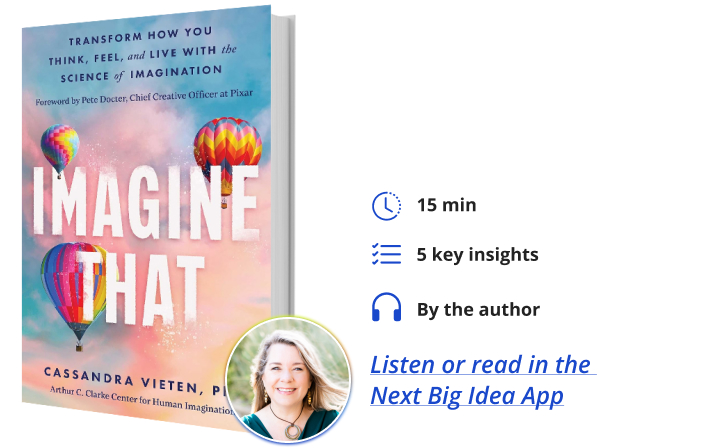
Below, Cassandra Vieten shares five key insights from her new book, Imagine That: Transform How You Think, Feel, and Live with the Science of Imagination.
Cassandra is a clinical psychologist, a clinical professor in the Department of Family Medicine, and director of research at the Arthur C. Clarke Center for Human Imagination at the University of California, San Diego. She also directs the UCSD Center for Mindfulness and serves as clinical psychology director at the Center for Psychedelic Research.
What’s the Big Idea?
We tend to think of imagination as something extra, useful for artists or kids but not a daily necessity. In reality, it’s woven into how we solve problems, relate to others, respond to stress, and even influence our health. The trouble is that modern life gives us fewer and fewer chances to use it. The good news is that imagination isn’t something you either have or you don’t. It’s a capacity we can strengthen, and doing so can expand our possibilities in life.
Listen to the audio version of this Book Bite—read by Cassandra herself—in the Next Big Idea App, or buy the book.

1. Imagination is a working tool of the brain.
When people hear what I study, I sometimes get a version of the same reaction: imagination, isn’t that a little soft for a scientist? Shouldn’t real science be curing diseases and solving the climate crisis? But from my perspective, I struggle to come up with anything more important than figuring out how humans generate original ideas and creative solutions.
Imagination isn’t frivolous daydreaming. It’s a working tool of the brain, integral to learning, foresight, empathy, and problem-solving. Cognitive scientists consider it a core component of intelligence itself.
Early in my research, my team ran into a wall trying to define it. We kept mapping imagination against memory, against creativity, against plain old thinking, and it never quite fit. It wasn’t memory, but it was tangled up in memory. It wasn’t creativity, but it overlapped with creativity. Finally, one of our students said: what if it’s like an octopus, with tentacles reaching into every other cognitive process? Or a utility infielder—the player who can be plugged in anywhere the team needs. That’s how imagination works.
Imagination is not one isolated skill sitting in a corner of your brain. It’s woven through memory, planning, creativity, and problem-solving. Every time you recall the past, plan tomorrow, or empathize with a friend, you’re quietly using it. When your imagination is well-exercised, it doesn’t just make you more creative, it makes nearly everything else you do better too. Repeated practice strengthens and rewires the neural connections behind it. What you imagine shapes what you’re capable of.
2. We’re living through “The Great Flattening.”
A lot of people I talk to—across ages, professions, every walk of life—describe feeling stuck, burned out, and disempowered to do anything about it. I call part of what’s driving this “The Great Flattening.”
Technology was supposed to make life easier. Instead, many of us feel like we have to plug in at daybreak and stay logged on until bedtime. We’re constantly asked to receive, synthesize, and manage information, but rarely to create anything new. Search engines and AI save us time, but they also rob us of the time we used to spend wondering, mind-wandering, and speculating before landing on an answer. Sitting in not-knowing now feels like a waste of time, when it’s actually the place where new ideas come from.
“Imagination is a muscle that can be rebuilt.”
Alongside this, I speak of “diseases of disenchantment.” A colleague of mine, Dr. Lisa Miller at Columbia, has written about “diseases of despair”: the anxiety, depression, addiction, and loneliness tied to a narrowing of imagination, where people believe there are only one or two possible outcomes for their lives. It’s worth remembering that the word despair literally comes from the Latin for “without hope.” I’d add that we’re also suffering from an atrophied imagination, one that has stopped stretching toward wonder, mystery, and possibility. Life starts to feel routine, flat, and a little gray.
Fortunately this isn’t a permanent condition. Imagination is a muscle that can be rebuilt. I don’t think the answer is throwing out our phones or swearing off AI. The answer is about intentionally protecting a little space every day during which we’re not seeking, receiving, or managing information. We need to give ourselves space to just wonder.
3. Imagination has a fingerprint.
Imagination neurodiversity is the idea that each of us imagines differently, and that our particular pattern of imaginative strengths isn’t something we’re stuck with. It’s not an inborn trait. It’s something we can identify and deliberately grow.
I can trace exactly where my imagination profile came from. My parents had a nearly complete set of National Geographic magazines on our shelves, and as a kid I’d get lost for hours in photographs of bioluminescent creatures deep in the ocean or the aboriginal art of Australia, worlds that stretched what I believed was possible. My dad was a biochemist, and he used to bring me into his lab, boost me up on a stool, and let me look at pond microbes under a microscope, so I learned early that even the invisible world was full of mystery. My mom was a Jungian-inspired counselor who introduced me to dreams, myths, and symbols—a different kind of truth, not measurable, but real all the same.
Those three influences, the outer world, the microscopic world, and the inner world, shaped a very specific kind of imagination in me. I lean toward visual, sensory imagining, and toward using story to make sense of hard things. But give someone else that exact same childhood, and they might come out of it an entirely different kind of imaginer.
“Imagination neurodiversity is the idea that each of us imagines differently.”
There’s no single “right” way to be imaginative. Some people are strong visualizers but weaker at generating new ideas from scratch. Some can conjure vivid sensory details but struggle to picture their own future. Once you understand your own profile, you can stop comparing yourself to somebody else’s version of “creative,” and start working with the imagination you have.
4. Imagination doesn’t just live in your head.
Your brain doesn’t distinguish nearly as much as you’d think between something you imagine and something you actually experience. Imagined experience registers in the body and brain in ways that are strikingly close to physical experience, and that happens both in the moment and cumulatively over the long term.
That cuts both ways. It means the mental images you rehearse—worst-case scenarios, old grudges, imagined confrontations—aren’t neutral. Your nervous system responds to them almost as if they’re really happening. But it also means the reverse is true: deliberately imagining a calmer version of a hard conversation, or vividly picturing yourself moving through a challenge, can shift your physiology in real, measurable ways before you ever act.
Imagination is a genuine health practice, not just a creative one. What you rehearse in your mind, you’re quite literally rehearsing in your body. Picture, in detail, walking into a hard conversation feeling calm and clear. Visualize the way you’re standing, the tone of your voice, how your shoulders feel, and then your nervous system starts laying down some of that groundwork before you ever walk through the door. That gives you an enormous amount of leverage, because unlike a lot of things that affect your health, this one is available to you anywhere, for free, anytime, no equipment necessary.
5. Imagination can be trained like a muscle.
Pete Docter, Pixar’s Chief Creative Officer, wrote the foreword to my book, and he tells a great story about how he became an animator. As a kid, he was dragged to long classical concerts and told to sit still. Out of sheer boredom, he started grabbing programs and drawing cartoons of what he imagined: what if the violinist’s string snapped mid-solo, or what if someone fell into the tuba? Boredom is where his imagination, and eventually Pixar characters, came from.
Imagination isn’t a gift some people have and others don’t. It’s a practice. A set of tools I call VISTA offers concrete ways to exercise imagination:
- Visualizing: picturing something vividly.
- Ideating: generating options without judging them too fast.
- Sensing: tuning in to sensory detail.
- Transforming: playing with alternate versions of a story.
- Applying: applying what you find back to your real life.
Just as important as actively practicing imagination is protecting the unstructured time, boredom, and mind-wandering that lets imagination arrive on its own.
The antidote to despair isn’t just hope. It’s the skill of generating hope. And the antidote to disenchantment isn’t just wonder; it’s the ability to re-enchant your own world, on purpose, using a capacity you already have.
Enjoy our full library of Book Bites—read by the authors!—in the Next Big Idea App: