














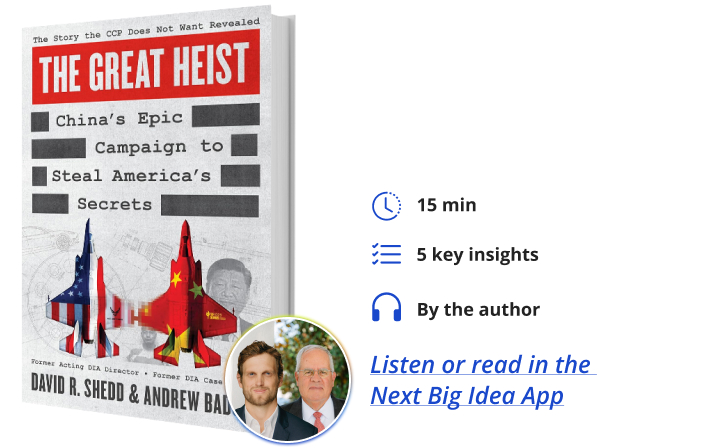
Below, co-authors David Shedd and Andrew Badger share five key insights from their new book, The Great Heist: China’s Epic Campaign to Steal America’s Secrets.
David is the former deputy director and acting director of the Defense Intelligence Agency (DIA). He also served as chief of staff for the director of national intelligence and National Security Council senior director and as special assistant to the president for intelligence under George W. Bush.
Andrew is a former DIA case officer and graduate of the CIA’s elite training program, The Farm. He served on the front line of human intelligence operations, including a 2014 deployment to Afghanistan in support of U.S. military operations. In the private sector, he has advised global firms such as McKinsey & Company and Deutsche Bank on geopolitical risk.
What’s the big idea?
China has executed a massive, coordinated campaign to steal technology and know-how, changing the balance of global power. It affects every American—from jobs to industries—and shows that economic security is now national security.

1. The Great Heist is the largest covert operation in modern history.
When people hear “espionage,” they think Cold War spy swaps. But the Great Heist is entirely different in scale and ambition. It is the biggest coordinated theft of technology, IP, and know-how in human history.
China has operationalized espionage as a whole-of-society strategy: students, startups, insider threats, forced tech transfers, lawfare, venture capital, and programs like Thousand Talents. We wrote this book because we realized no one had pulled all these pieces together into a single, coherent story—and the true magnitude of the operation has gone unrecognized. This is statecraft built on “Cage, Raise, Kill” tactics with one goal: fuel Xi’s national rejuvenation and lock in CCP power.
2. This hits every American in the wallet and in the future.
These aren’t abstract spy stories when IP is stolen, factories close, jobs disappear, and shareholders lose billions. Every sector has been hit—from paint formulas and nanotech to nuclear secrets, agricultural seeds, and aerospace breakthroughs. And “power” has shifted: today’s decisive weapons aren’t tanks or bombers; they’re algorithms, source code, trade secrets, and chips. The Great Heist has tilted the global balance of power, enabling China’s breakthroughs in hypersonics, carrier-killers, and nuclear modernization. This challenge defines the 21st century.
3. China pulled this off because we let them.
The Heist wasn’t inevitable. It was enabled by U.S. hubris, wishful thinking, and a bipartisan refusal to see China clearly.
China’s entry into the World Trade Organization in 2001 opened the door. Then came our own self-inflicted wounds: shutting down key CIA units, the complacency of corporate America, and later the scrapping of the China Initiative.
“We still have time to act, but only if we start now.”
Meanwhile, Beijing planned decades ahead. Made in China 2025 was a strategic plan launched by China in 2015. It was effectively an espionage blueprint disguised as an industrial policy. Under Xi, the Ministry of State Security (MSS) became a global juggernaut with no legal limits and a “crowdsourced espionage” model that rewarded operatives without direct oversight. They were playing Sun Tzu; we were playing quarterly earnings.
4. The stories that reveal the Heist’s true impact.
The Heist comes alive through real cases. For Andrew, it’s Tesla—the insider threats, the supply-chain vulnerabilities, and how China used the EV sector to reshape a global industry.
For David, it’s the financial side—how U.S. venture capital inadvertently funded Chinese tech giants, and how PRC-backed funds quietly embedded themselves in Silicon Valley’s earliest innovation cycles. These aren’t isolated incidents; they are windows into how deeply the Heist penetrated our economy.
5. The Counter-Heist starts with reframing national security.
The takeaway is not despair; it’s action. Economic security is national security now. America needs its own whole-of-society response across government, industry, and academia. We lay out concrete steps, including the creation of an Economic Security Council within the National Security Council.
Crucially, AI is the new crown jewel—it’s already a top espionage target, and whoever controls the AI era will shape global power. And the threat is evolving: from Volt Typhoon cyber intrusions to compromised supply chains to early signs of agro-sabotage. The next phase of the Great Heist could be kinetic. We still have time to act, but only if we start now.
Enjoy our full library of Book Bites—read by the authors!—in the Next Big Idea App: