














Below, Dr. Bradley Onishi shares five key insights from his new book, American Caesar: How Theocrats and Tech Lords Are Turning America into a Monarchy.
Bradley is a scholar of religion who has spent two decades studying American Christianity and the intersection of religion and politics. A former evangelical minister, he is the co-host of the Straight White American Jesus podcast and co-founder of Axis Mundi Media, a podcast network dedicated to bringing public scholarship about religion to a wider audience.
What’s the Big Idea?
We’ve moved beyond the politics of “taking America back for God.” An emerging alliance of Christian nationalists and technocratic thinkers believes Western civilization itself needs to be saved, and increasingly sees democracy as standing in the way. Their answer is a Caesar: a strong leader empowered to impose order, enforce conformity, and decide who truly belongs.
Listen to the audio version of this Book Bite—read by Bradley himself—in the Next Big Idea App, or buy the book.

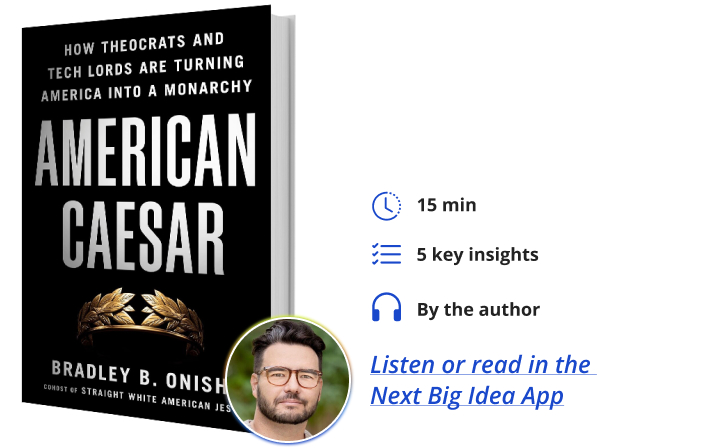
1. There is a desire for a strongman to take control of the United States.
We’ve reached a startling point in American history where the American Right—including technocrats, Protestants, and Catholics—are willing to say out loud that we need a monarch. Be that a tech king, Christian prince, a Protestant Franco, or an unbound executive. They believe that we need a Caesar-type figure to take the reins and put America back in order.
There’s a sense that “we the people” have run amok and a big daddy needs to come in to spank the children and put the women in line. It’s a scary and disgusting vision. But what strikes me is that it’s now an acceptable part of our political discourse. And it didn’t start with Donald Trump. It started much earlier. Figures going back to the beginnings of the Religious Right, like Brent Bozell Jr. and Paul Weyrich, set the stage for this understanding of how to renew Western civilization and the United States.
Trump did not invent the desire for a stronger leader who could bypass democratic constraints; he became a vehicle through which older intellectual and religious projects could acquire political power. Presumably, only an American Caesar is capable of imposing the order that democratic institutions supposedly cannot provide.
2. Western civilizationism.
We’ve gone past a call of basic Christian nationalism—a desire to take America back for God. Those impulses still exist, and those tropes are still present in many corners of Protestant and Catholic Christian nationalist spaces. But there’s a larger sense that what is needed is to “save Western civilization.”
We see this across the Protestant, Catholic, and technocratic domains. They often disagree on family, technology, and IVF, but there’s widespread agreement that we need to rescue Western civilization from outside invaders—people who are deemed inferior to this country and other Western countries across the world. People who are Muslim, from “third world” countries, or who, just by dint of the cultures in which they were raised, are unable to fully assimilate to our way of life. There’s also a sense that domestic infidels are enemies on par with the outside invaders.
“The goal of civilizationism is isolationist purity.”
We are left with something akin to Samuel Huntington’s “Clash of Civilizations” model, wherein different groups across the world hold competing values that can never be reconciled. Moreover, American citizens who promote anti-American, anti-Christian, or anti-capitalist views are suspected of being linked to Islamist or communist foreign networks. They are deemed foreign enemies cosplaying as real Americans. The goal of civilizationism is isolationist purity. The strategy to achieve it: civilizational warfare.
3. We are in a post-libertarian conservative era.
The season of limited government is past. The idea of Reagan economics and “government as the problem” has gone away. We now live in a world where Catholic, Protestant, and technocratic thinkers have come to the same conclusion: the invisible hand of the market is not sufficient to save Western civilization and the U.S. from foreign invaders and domestic infidels. There’s a need for the strong hand of a ruler to produce the moral and cultural order they consider necessary.
Government becomes not merely an institution to be constrained, but an instrument for cultivating particular conceptions of family, morality, religion, and social order. In this worldview, state power can legitimately be used to cultivate virtue, suppress perceived threats, restrict individual autonomy, and impose a particular conception of the common good on everyone.
When I was growing up in the 1980s, it would have been unthinkable for conservative thinkers to claim that government was the solution and not the problem. But we’ve reached a point where they feel they are demographically a minority. They are threatened when they look around the United States and see the growing number of non-religious people, the forecast of this country becoming minority-majority in a few decades, and the identification of more and more people as queer. Those demographic changes are existential threats in their minds.
“The season of limited government is past.”
Therefore, limited government won’t do the job. They see a need for a government that will override civil liberties, regulate what people do in the bedroom, how they form families, and even how they spend their money. The government becomes a totalitarian answer to every question of the human condition.
4. Democracy is the problem, not the solution.
We the people stand in the way of saving Western civilization and restoring the U.S. We the people are the problem, according to many Catholic, Protestant, and technocratic voices. We the people have run amok. The children have become unruly; the women have become autonomous and no longer willing to abide by a patriarchal system.
There is a sense that it is the people who have created the mess, and the strong hand of a ruler—a big daddy figure—is needed to save everyone. Rather than saving Western civilization in the form of Athenian democracy or the Roman Republic, what is longed for by this alliance is a Caesar who will reorder everything, even if it means overriding civil liberties, taking power away from the people, and ruling with an iron fist and the totalitarian decision-making of an autocrat, rather than an executive who shares power and serves at the behest of the citizenry.
5. The idea of King Christ.
When I was growing up as an evangelical in the ’90s—a teenager who was devoted to God—we understood ourselves to be missionaries in a culture that was increasingly less Christian, godless, and secular. We were taught to swim upstream as missionaries in our own country, to convert as many people as we could.
Things have changed. The idea of a missional Jesus who is a public servant has gone by the wayside. We now have the idea of King Christ. This is what you hear from Pete Hegseth at the Department of Defense, or his theological icon, Doug Wilson. It’s what you hear increasingly online from theobros and ardent, militant, rude, disgusting social media accounts that claim over and over again, “Jesus is King.”
The idea among the Protestant and Catholic voices is that what is needed is not to be missionaries to their own culture, but to create a Christian society in which faith and religion are imposed on everyone. In which their version of Jesus sits on the throne of the U.S. as an imperial monarch—someone who demands that his emissaries across the country rid his land of outside invaders like Muslims and immigrants, who puts domestic citizens in line and ensures that they are living how he desires.
“Religion here becomes a tool of social order and conformity.”
This is a model of Christianity in which the state attempts to manufacture moral conformity, where faith becomes inseparable from the coercive authority enforcing it, where religious institutions can ultimately become subordinate to the strongman they helped empower. Religion here becomes a tool of social order and conformity. It becomes something that you have to adhere to in order to show your devotion to nation and leader.
We are now at a place where it is part of acceptable political discourse to think about the end of American democracy as somehow the path to saving the country. But there is hope in the power of “we the people.” This is not the first time that a few have tried to impose themselves on the many. When “we the people” band together, demand that we share power, hold everyone accountable, and do not allow for the mistreatment of any human being, we have enormous strength and the ability to overthrow tyrants.
There’s a need to reexamine the story we’re telling about democracy, liberalism, and freedom. We don’t need a smaller story like the ones that the religious extremists and technocrats are telling. We need a bigger, more humane story. In order to counter insidious narratives of what Western civilization and the U.S are, we need to dream together about what our new vision for the future can be.
Enjoy our full library of Book Bites—read by the authors!—in the Next Big Idea App: