












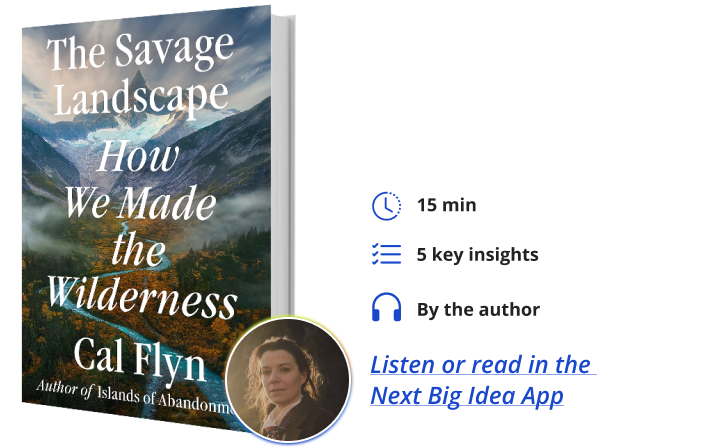
Below, Cal Flyn shares five key insights from her new book, The Savage Landscape: How We Made the Wilderness.
Cal is the current Distinguished Writer-in-Residence at Wesleyan University, deputy editor of the literary recommendations site Five Books, and has written for publications including The Guardian, Granta, National Geographic, and The Wall Street Journal.
What’s the Big Idea?
We’ve spent centuries imagining wilderness as the opposite of humanity. But when we recognize that people and wild places have long shaped one another, wilderness stops being somewhere we have to escape to and becomes something we can learn to notice.
Listen to the audio version of this Book Bite—read by Cal herself—in the Next Big Idea App, or buy the book.

1. Wilderness is a place of epiphany.
Humans have been thinking and talking about the wilderness for thousands of years. The Sumerians were writing stories in the form of wilderness quests as early as the fourth millennium BCE. In the Epic of Gilgamesh, our hero, unhinged by grief, journeys to the ends of the earth, facing monstrous beings and perilous seas in search of immortality. In the story of Inanna, a warrior goddess traveling through mountain regions turns upon a summit she perceives to be insufficiently respectful and obliterates it completely. “I’ve killed you, ” she declares, “and brought you low.”
Most wilderness tales are allegories that serve as metaphors for something else: triumph over natural forces or a reckoning with external threats. Sometimes these confrontations become the source of spiritual or religious transformation.
In the Ramayana, the Hindu prince Rama journeys for 14 years through the Dandakaranya, the “Jungle of Punishment,” where he battles shape-shifting demons. Jesus faced down the devil in the wilderness after fasting for 40 days and 40 nights. The Buddha abandoned his wife, child, and royal court in favor of remote jungle thickets that aroused fear and dread, where he would ultimately be purified and attain enlightenment. We can trace the idea of the wilderness back through human history as far as the written record allows.
2. Wilderness is hard to map.
Despite the general acceptance that wilderness exists, it’s hard to tie that label to real places in the world. In the early days of geography, when maps were more impressionistic, the problem was not obvious. A cartographer might roughly crosshatch a region where travel was difficult and knowledge of the landscape was scarce, then simply label it: Wilderness of the World, the Wilderness of Paran, or the Wilderness of the West. Just as they filled blank spaces on maps with sketches of shipwrecks, chimeras, and mythical creatures, they also added words of warning. “Here be dragons” was a phrase used once, meant to warn people of lions.
Today’s maps serve different purposes. They’re spatially precise. We use them for navigation, planning, land administration, and environmental management. Those working in environmental policy often draw maps in which the world’s wildernesses are demarcated, delineated, or legally defined. But these maps are drawn from cultural assumptions and are often contested.
“Despite the general acceptance that wilderness exists, it’s hard to tie that label to real places in the world.”
A few years ago, I met a man who lived in one of the wildest and most beautiful regions of Scotland. His land had been designated part of an official Wild Land Area, a land classification in the UK that confers a status one step below true wilderness. The landscape certainly looked wild to me, but he was annoyed. “It isn’t anything like a wilderness,” he said. He kept livestock there, and so did his neighbors. It might not look like a farm to outsiders, but he saw it for what it really was: common pasture. What bothered him was that the land, and the way people had lived on it for generations, had been so thoroughly misunderstood.
Not everyone would agree with him. The common grazing land has no roads, only a few rough tracks. It’s mountainous, rugged, and picturesque. You could walk without seeing more than a handful of buildings.
But is that what it means to be wild? What of its long history of use by local farmers? What of the ruined villages at the foot of the glen? It is possible to generate maps algorithmically, using road networks and satellite imagery to identify the least accessible places on Earth or the largest expanses of closed-canopy forest. Is that what it means to be a wilderness? It depends on who you ask.
3. Wilderness is a home to other people.
The United States has taken the lead in attempting to pin wilderness down to a working definition. The U.S. Wilderness Act of 1964 defines wilderness as “an area where the earth and its community of life are untrammeled by man, where man himself is a visitor who does not remain.” It’s a very beautiful, haunting idea, and one that’s expressed with remarkable lyricism. But in practice, it’s very difficult to find true examples.
Almost every place on Earth that could be populated has been populated. Mountain regions are home to mountain people, forests to forest people, and so on. They might not live in cities and build tarmac roads, but they use the land around them as they see fit.
“Almost invariably, if the land is habitable, it is inhabited.”
Explorers arriving in unfamiliar climates and landscapes have often believed they were discovering some pre-fall Eden, where humanity lived in harmony with a pristine nature. The first Europeans to arrive in Australia in the 18th century frequently remarked on how much the landscape resembled an English country estate. “How lucky the Aboriginal Australians are,” they exclaimed. “The land is so fruitful, so fertile. They didn’t need work.”
In reality, the landscape of well-spaced trees and abundant edible plants was the result of centuries of careful land management and forest farming. It just wasn’t obvious to an outsider’s eye.
Almost invariably, if the land is habitable, it is inhabited. And that means whenever we decide to set aside land for environmental reasons, whether as vast nature reserves or a national park, the fundamental question is always the same: whose land is it?
4. Militant conservation has made millions homeless.
Generally speaking, there’s a growing movement among conservationists to move away from a model that’s been dubbed fortress conservation: the strict policing of so-called wilderness areas because of the controversy, and even conflict, it tends to provoke.
In many parts of sub-Saharan Africa and Asia, it became relatively common for wildlife rangers to be equipped with automatic weapons and trained in militarized tactics. Some reserves even adopted shoot-to-kill policies for dealing with suspected poachers. Elsewhere, Indigenous communities have been forcibly removed from their ancestral homelands after their presence was deemed harmful to the natural environment.
The colonial history of the U.S. national park movement is now discussed much more openly, and important work is being done to recognize and acknowledge the painful history of Indigenous dispossession in some of America’s most iconic landscapes. What’s less widely recognized, however, is that these same dynamics continue to play out all around the world. Depending on how the term is defined, there are thought to be around 10 million conservation refugees worldwide.
“That these same dynamics continue to play out all around the world.”
Across the Congo Basin, tens of thousands of Batwa and Baka Indigenous forest people have been violently displaced from rainforest regions earmarked as new national parks. The Virunga Mountains were made internationally famous by Dian Fossey’s Gorillas in the Mist. Since her time, strictly policed reserves have allowed gorilla populations to rebound, but at a profound human cost. I met dozens of Batwa men, women, and children living in makeshift encampments on the edge of these parks. They have been trapped in a legal limbo since their eviction in the early 1990s. “It might look like a wilderness to you,” they told me, “but to us, it looks like home.”
5. Wilderness can come to you.
It is increasingly accepted that conservation must work with local communities rather than against them. But this can be trickier than it sounds. Many Indigenous communities have their own religious, spiritual, or cultural ways of relating to place that do not fit neatly into evidence-based models of conservation.
I traveled to Nepal to speak with the people of Dolpo, a high Himalayan community on the border with Tibet whose religious beliefs have long shaped their relationship with the natural world. If they want to build a new house, they must barter with the deities believed to inhabit the surrounding landscape by making offerings. In this way, they reduce their impact on the land and slow the use of natural resources in a region where those resources are scarce.
I spoke with a lama who lived high among the ragged peaks. He told me that chasing wilderness was the wrong approach. He lived there, in that lonely place, and the wildlife and the wilderness, he said, came to him. It made me think differently about what we are really talking about when we talk about wilderness, and what it might mean to accept that most of the world’s wildernesses are inhabited places.
If we understand the world not as a duality of us and them, or humanity and nature, but instead as a vast web in which we are just one of many interconnected parts, then perhaps the wilderness is always with us. I’ve taken to going down to the riverside and simply waiting, waiting for the wilderness to make itself known. It’s always much closer than I realize.
Enjoy our full library of Book Bites—read by the authors!—in the Next Big Idea App: