












Below, Roderick Beaton shares five key insights from his new book, Europe: A New History.
Roderick is a professor emeritus at King’s College London. He has written several books on Greek and European history, including The Greeks and Greece: Biography of a Modern Nation, which was shortlisted for the Cundill History Prize. He is the four-time winner of the prestigious Runciman Award, and in 2024 was knighted by King Charles III “for services to History.”
What’s the big idea?
In Europe: A New History, historian Roderick Beaton takes on one of the most urgent and contested questions of our time: What is Europe, really? Part history, part political reckoning, the book traces how Europe evolved not just as a place on the map, but as an idea shaped by war, migration, democracy, empire, and identity over the past 2,500 years. Drawing connections between the ancient world and today’s geopolitical tensions—from Russia’s invasion of Ukraine to debates over nationalism and democracy—Beaton argues that understanding Europe’s past is essential to understanding the future now unfolding on both sides of the Atlantic.
Listen to the audio version of this Book Bite—read by Roderick himself—in the Next Big Idea App, or buy the book.

1. Why does Europe matter, if I’m an American?
We all like to know who our parents are and how we’ve become the people we’ve become by the time we grow up. For an awful lot of Americans, that means looking back across the Atlantic to Europe. If your ancestors came not from Europe but from Africa, I’m afraid the chances are that Europeans were responsible for that. Many things happened in Europe’s history that no one would be proud of today. That’s all the more reason to try to understand how and why they happened, so that we can learn from them.
Looking on the brighter side, I’d also argue that one of Europe’s greatest success stories is the Constitution of the United States. Throughout the 18th century, political thinkers and philosophers across Europe had been trying to find the best ways to organize society so as to make everyone better and happier. But in the political conditions of the Old World, there was no chance of putting those ideas into practical effect; it was the Founding Fathers on your side of the Atlantic who did that.
And something else the Constitution made possible: once Europeans crossed the ocean and landed on American shores, they seemed almost at once to have left behind the rivalries and ancestral hatreds that had caused so much bloodshed in Europe. If only we Europeans on our side of the pond had learned that lesson, perhaps we could have avoided two world wars. And in the 80 years since the end of World War II, we have been learning…
2. Europe is both a real place on the map and an idea created by people like us.
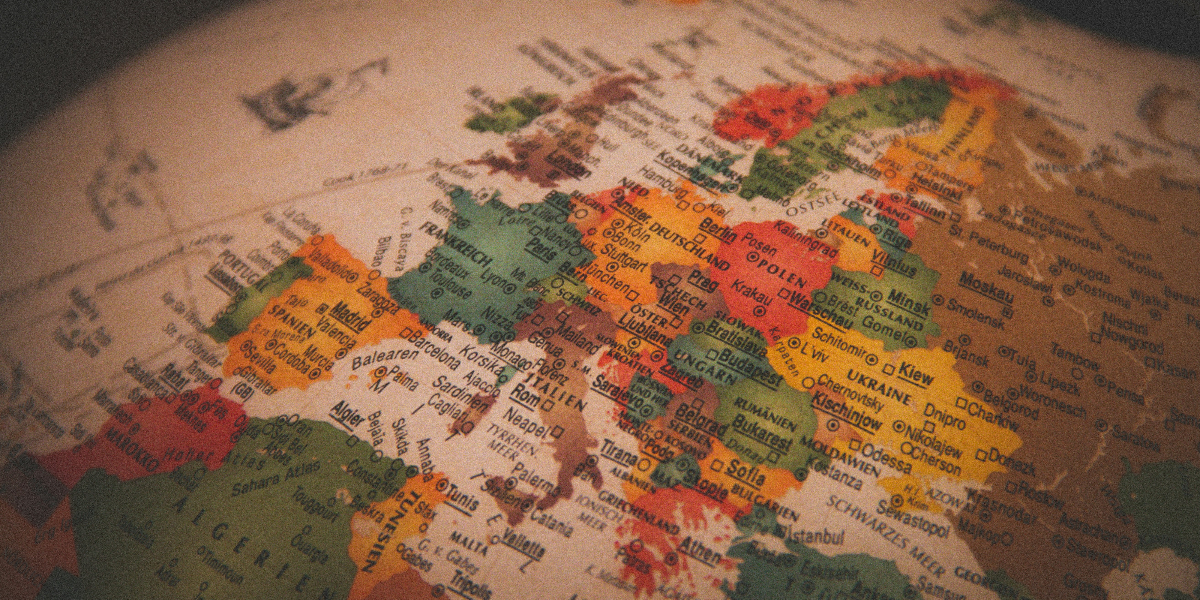
We’re taught in school that Europe is one of the world’s five—or is it six?—continents. But if you were looking at our world through a telescope from the moon or Mars, you’d struggle to find it. On the map, there’s just one huge continent that stretches from the Atlantic to the Pacific: we call that continent Eurasia, a way of combining the names of Europe and Asia. Asia is vastly bigger than Europe. Europe is just a long promontory that sticks out from Asia into the seas that surround it on three sides. So why call it a separate continent at all?
It’s not geography that divides the vast landmass of Eurasia into Europe and Asia—it’s how people have chosen to think about themselves and the places where they live. The ancient Greeks were the first to talk about Europe, and they gave it its name, too. The name stuck and we still use it today because, two and a half thousand years ago, those ancient Greeks had to fight off an invasion from Asia, from a huge empire ruled from what is now Iran. When the fighting was over, and against all the odds, the Greeks had won their battles, they weaponized the idea that they—the Greeks—belonged to one continent, and their Persian enemies to another.
“The ancient Greeks were the first to talk about Europe, and they gave it its name, too.”
That’s how the idea was born that Europe was something different. It was an idea invented by people, and it existed—it still exists—in their minds, not objectively on the map at all. But an idea that’s lasted for 2,500 years must have something going for it!
3. Be afraid of armed Russians, not unarmed migrants.
We’re constantly being told, in Europe and America today, that our civilization is at risk from uncontrolled “waves” of immigrants from other continents coming to our shores. But history tells us that the greatest threat we face is actually quite different.
It’s easy to draw parallels between today’s migration patterns and the last days of the Roman Empire, some 1500 years ago. But what’s happening today could hardly be more different from the movements of people that helped bring down ancient Rome. For one thing, the direction of travel today is from south to north; in ancient times, it was from east to west. But the key difference is that the assorted tribes from Asia that successfully invaded Europe from the 5th to the 10th centuries came in organized bands, even armies. Displaced migrants and refugees in those days were accompanied by formidable warriors mounted on horseback, who escorted them. Happily, we’ve seen nothing to compare with that in recent times.
Today’s migrants, refugees, and asylum seekers arrive in dispersed groups or as individuals, not as an organized threat. Where there is an organized threat in Europe, it comes from where it always has – not across the Mediterranean from the south but across the open steppes of Central Asia, where there are no natural barriers or defenses. It’s Russian tanks and the authoritarian ambitions of Vladimir Putin that we need to fear in Europe, not scattered groups of hapless refugees.
And make no mistake—that’s true for America almost as much as it is for Europe. We’re so used to thinking in terms of the Atlantic that it’s easy to forget that the distance from eastern Russia to the US state of Alaska is only about 50 miles, and Alaska belonged to Russia before it ever became part of the United States. What happens if President Putin decides he wants it back, as he did with Ukraine? Putin’s Russia, unlike the demonized migrants, has nuclear weapons, tanks, and drones behind it. We need to get our priorities straight.
4. How does our understanding of the past help shape our future?
I believe that studying history is about looking for patterns. It’s how we try to make sense of the things that happen and the actions of our fellow humans that affect all our lives. When things change, when new and unexpected events suddenly reshape the world we thought we knew, the effect is like a kaleidoscope turning—the whole pattern changes. We look at both the present and the past, and what we see lines up differently than before. History can’t tell us what will come next, though none of us can resist trying to read it as though it could, but our perception of the present and our understanding of the past are both essential to how we prepare for the future.
“We look at both the present and the past, and what we see lines up differently than before.”
To take a very concrete example, once Russia sent its tanks into Ukraine in February 2022, it soon became clear that this wasn’t just a war in Europe; it was also a war for Europe. That, in turn, forced politicians and commentators—just about everybody watching these events—to start thinking in new ways about what Europe was being fought over. In Britain, when we narrowly voted to leave the European Union 10 years ago, many people talked about Europe as somewhere else, even as the enemy.
Ten years on, it’s a very different story. Now the United Kingdom has become one of the loudest cheerleaders for Europe and for the European values at stake on the battlefields of Ukraine. And the kaleidoscope is still turning. We don’t know how that conflict will end. But we do know that any lasting peace will have to be built on a deep understanding of the forces that brought us to where we are now.
5. Why we need to protect democracy and the rule of law.
Democracy began in Europe some two and a half thousand years ago. From my studies of Europe’s long history, I’ve come to the conclusion that what we call the rule of law today is even more important than democracy. This idea, born in the ancient Greek city-states even before democracy, holds that laws can be made by humans (not handed down by God or the gods), that every member of society is equally bound to obey them, and that every member is equally protected by them.
Of course, it hasn’t always worked that way in practice. The ancient Greeks and Romans were as capable as anyone of violating these principles. And democracy itself scarcely existed for about 2000 years, from when the Roman Republic became an empire ruled by one man to the end of World War I in 1918. It’s worth reflecting that, at the end of that war, just over 100 years ago, it was the U.S. president, Woodrow Wilson, who did more than any other individual to bring democracy back to Europe as a more-or-less universal system of government.
But democracy, by its nature, is fragile. When you look at the long history of Europe, from the end of the Roman Republic to the twentieth century, it’s all too clear how easily democracy can become its own worst enemy. Throughout history, democracy has all too often handed power to its own worst enemies, who then suppress it: Napoleon, Hitler, and Putin, to name just the most obvious examples, were all elected on a democratic mandate. Now there’s an urgent lesson from history for every American in the era of your 47th president.
Enjoy our full library of Book Bites—read by the authors!—in the Next Big Idea App: