















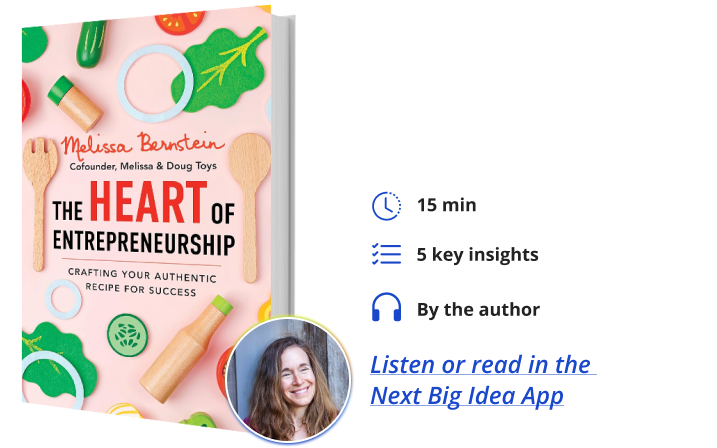
Below, Melissa Bernstein shares five key insights from her new book, The Heart of Entrepreneurship: Crafting Your Authentic Recipe for Success.
Melissa founded a toy company, Melissa & Doug, with her husband, in 1988. In 2021, they launched their second company, Lifelines, a wellness brand offering sensory products to manage stress and enhance well-being. She is the Entrepreneur in Residence for the Inner MBA certification program created by Sounds True, LinkedIn, and Wisdom 2.0. She is also cofounder of Duke University’s Melissa & Doug Entrepreneurs program.
What’s the big idea?
As we age, many of us lose touch with the child-like curiosity and wonder that once came so naturally. Yet, those are the very ingredients that fuel entrepreneurship. Everyone has the capacity to think creatively, solve problems, and innovate. But like any recipe, it requires a deliberate process.

1. Develop a start-from-scratch mentality.
Imagine walking into your kitchen each morning and seeing a completely empty pot—no leftovers, no old recipes, just a blank slate. That’s what I face every day as a creator: the daunting but exhilarating task of starting fresh.
This mindset is essential for innovation. We can’t rest on yesterday’s ingredients. We must embrace a beginner’s mind, a state of utter un-knowing, like a child who can see infinite possibilities and the extraordinary in the ordinary.
This means letting go of ego, which is filled with fear and rigidity, and leaning into curiosity and exploration. Here’s the litmus test: Are you truly passionate about what you’re doing? If not, maybe it’s time to empty the pot, clean it out, and stir something entirely new.
2. Become an indiscriminate gatherer of ingredients.
I love the word indiscriminate because it means ‘at random and without careful judgment.’ To cook something new, you need a pantry overflowing with diverse ingredients. In entrepreneurship, those ingredients come from your life experiences.
Follow your curiosity wherever it leads. Yes, wherever it leads, even if it seems odd and offbeat. Try new hobbies. Strike up conversations with complete strangers. Explore unfamiliar places, even within your own town. Every new experience is like a spice or herb that goes in your pantry and expands the creativity within it.
“Follow your curiosity wherever it leads.”
At some point, one of those ingredients will spark something profound in you. It’s called a crystallizing experience, coined by Howard Gardner. These moments will make you want to dive deeper and learn more. Curiosity is not about rushing to an outcome. It’s about patience, confidence, and enjoying the process of discovery.
3. Let your ingredients simmer.
This is the most challenging part of the creativity process because most people want to rush to the finish line. We have this tendency to want to reach the end goal—to get to the noun instead of live the verb. Often, we throw all the ingredients into the pot too quickly. We don’t allow it ample time to simmer and allow all those ingredients to combine and recombine. Because of that, the recipe is exactly the same as all those recipes in the past. It tastes the same every time.
One of my favorite definitions of creativity is by an amazing researcher, Paul Torrance. He describes creativity as the imaginative recombination of elements from the past into new configurations needed in the present. The ingredients need time and space to recombine in new ways. So, we must give those ingredients time to simmer in the unconscious.
What does this mean? You put ingredients in the pot, place the lid tightly, set the burner on low, and step away to allow the unconscious mind to do its magic. This simmering process is essential for new revelations. You must stop thinking about the problem and focus your mind on other things—completely. Our minds are so magical that even when focused elsewhere, we are still doing the work unconsciously of solving other problems.
The process is personal, and what you choose to do depends on the problem you’re solving and who you are. For me, nature is my muse. Being in nature when I have a complex problem to solve frees my mind from thinking about the problem, because I focus on the beauty around me. This is my gateway to that unconscious work.
But for you, it may be something entirely different. Certain people may choose to listen to music, others drive, and some read. After minutes, days, or sometimes weeks of allowing your ingredients to simmer, that chef’s kiss recipe emerges in a flash of intuition.
“The ingredients need time and space to recombine in new ways.”
However, sometimes that chef’s kiss recipe never arises. Why? Because a key ingredient may still be missing. And that’s okay. It’s not meant to arise if it doesn’t arise. We cannot rush the process without risking bland, derivative results. Allow the process and see what magic unfolds.
4. Invite others into your kitchen.
Once you have a crystallized prototype of your idea—and only then—do you invite others to come into your kitchen and try it out. They’re your taste testers, so to speak. But too often people seek feedback much too early, before their idea is crystallized in their own mind. This is a problem because then their unique idea or original take on an existing idea gets watered down by other people’s opinions and turns into something generic. Protect your vision until it’s strong enough to stand on its own, its roots deep.
When you are ready to invite tasters into your kitchen, make sure they are your target audience. These are the people who would actually choose your restaurant and purchase items on your menu. If you choose those who are not your target audience, you will get feedback that is not helpful to your particular concept.
The feedback from your target market is invaluable, but it doesn’t mean you take every piece of feedback they give you and use it to change your recipe. In fact, you must filter every bit of feedback through your vision. Remember, no one with a clear vision ever uses all the feedback they receive. They pluck out those most relevant and salient pieces. Use those to iterate on and improve the recipe, then get rid of the rest.
5. Embrace imperfection and evolution.
I am a perfectionist and had a very hard time, early in my career, letting anything leave my brain or our office and go out into the world. To overcome this, I created the 80 percent rule. Basically, when something feels about 80 percent ready, I release it into the world. If I waited for it to achieve 100 percent, I would never have launched a single product because nothing is ever 100 percent ready.
“Every idea, every product is a continual work in progress, constantly evolving and improving.”
I realized that I just had to do my best. I had to put everything I could into my product, allow ample simmering, let testers into my kitchen, and then—when I could think of nothing more to do—I had to close my eyes, hold my breath, and release it into the world, recognizing that it’s not at 100 percent.
Without releasing it into the world, I could never get closer to that 100 percent: Let my consumers try it out, test it, and give me feedback. Then, I continue to hone, improve, and perfect it so that over time, every product gets closer to 100 percent. Does it ever get there? I don’t think so. I’ve had some that maybe are at 98 percent, but there is always something that can be improved.
Every idea, every product is a continual work in progress, constantly evolving and improving. And isn’t that the joy of life? That mindset keeps innovation alive. So, whether you are inventing a toy, a service, a company, or simply reigniting your own sense of wonder, the recipe is completely the same and something we all can engage in time and again, in the following order:
- We start from scratch. As Buddhist monk Shunryu Suzuki said, “In the beginner’s mind there are many possibilities, but in the expert’s there are a few.”
- We gather ingredients. We follow our curiosity wherever it leads and stock the pantry in our mind with disparate ingredients, not knowing yet how they’ll be used.
- We simmer those ingredients that captivate our attention most. If have the right ingredients in the pot, in a matter of time, that amazing chef’s-kiss recipe will emerge.
- We invite taste-testers into our kitchen. These people should be part of your target audience. Listen to their feedback and filter it through the lens of your vision, incorporating the ones that make sense and letting go of the rest.
- We set it free. We share it with the world before it’s perfect.
The heart of entrepreneurship is about reconnecting with the spark we all once had and realizing it’s still within, waiting to be rekindled.
Enjoy our full library of Book Bites—read by the authors!—in the Next Big Idea App: