











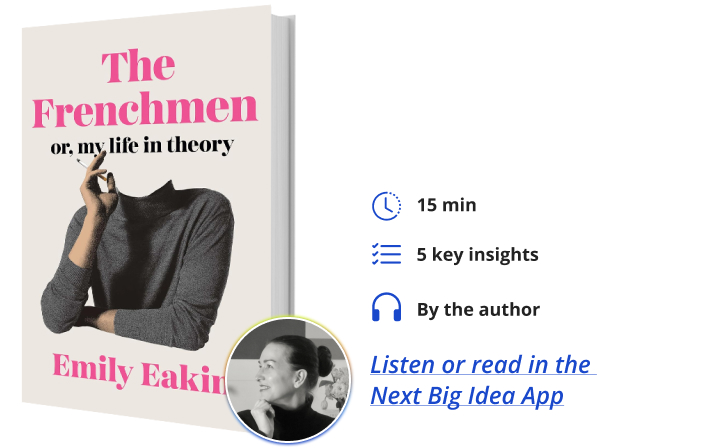
Below, Emily Eakin shares five key insights from her new book, The Frenchmen: Or, My Life in Theory.
Emily is a senior editor at The New York Times Book Review.
What’s the Big Idea?
The way the French philosophers saw it, language is a vast, impersonal system, one that has a lot more power over our lives and identities than many people recognize. The French philosophers changed the way we think about the world in large part because of the way they thought and wrote about language.
Listen to the audio version of this Book Bite—read by Emily herself—in the Next Big Idea App, or buy the book.

1. In defense of difficulty.
Jacques Derrida, Michel Foucault, and the other French philosophers who became household names on U.S. campuses were notorious for the difficulty of their writings. This made them easy targets for critics, who sounded the alarm: These French thinkers are a threat to impressionable American students whose heads they are filling with meaningless jargon! (That the philosophers’ American disciples sometimes published articles that read like meaningless jargon did not help.)
But the French thinkers’ work was hard for a reason: They were attempting a rigorous critique of language from within language itself—often via close readings of literary or philosophical texts that were pretty difficult already. In trying to show us that language is an unstable medium, never neutral or transparent, they wanted to call our attention to the words themselves. To do this, they resorted to elaborate sentence structures, wordplay, and neologisms.
As one Harvard English professor explained about deconstruction, Derrida’s signature theory, “It’s hard to do it well. What it wants is a kind of intense struggle with a text to dig out things the text doesn’t know it’s saying…You have to be really smart.” Reading the work of the French philosophers is a strenuous but rewarding experience.
2. Language is power.
Derrida famously wrote, “il n’y a pas de hors-texte”—literally “there is no outside text.” This has often been taken to mean that he believed there was nothing but language, that reality was a text. What he meant more precisely is that there is no escaping language. It mediates our experience and knowledge of the world and everything else.
In theory, this makes language an extremely powerful tool, even, potentially, a weapon: Control language, control the world! If you look at the current U.S. presidential administration, it has devoted a lot of attention to language. Hundreds of words—including “women,” “racism,” “climate,” and “equality”—have been removed from government documents and websites in an effort to send a political message and exert control.
“Control language, control the world!”
But at the same time that the French philosophers showed how language is shot through with ideology, they also emphasized that language eludes attempts to control it. To cite a current example: Despite an executive order from the Trump administration banning “gender ideology” and decreeing that it is the policy of the United States to recognize “two sexes, male and female,” Americans who use gender-neutral pronouns like “they” are increasingly common. Language is a central site of political contestation.
3. Be skeptical.
Because language so powerfully shapes how we see the world, the French philosophers warned that we should regard words and images skeptically, especially when they come in the form of official pronouncements from government institutions or other centers of power. The philosopher Paul Ricoeur summed up this attitude as the “hermeneutics of suspicion,” a pithy phrase that captures the theorists’ approach to interpretation: There are invariably other, covert, and often contradictory meanings beyond the literal or surface level, and it’s our job as consumers of signs to always be alert to these hidden depths.
When the Department of Homeland Security posts video promoting ICE on its social media accounts with the slogan “We’ll Have Our Home Again,” over an image of a cowboy on horseback crossing a snow-covered plain, white-capped mountains in the distance, viewers should ask themselves who is included in the idea of “our” and “home” and what moment in history the “again” seeks to return us to.
4. The truth is out there.
With their focus on the slipperiness of language, the French philosophers have often been accused of importing relativism or, worse, nihilism to America, their theories reduced to caricatures by critics: Words are meaningless! There is no truth! The French philosophers have also been blamed for the rise of misinformation in American politics, for phenomena like “truthiness,” “alternative facts,” and “fake news.”
“Their point is that there is no objective perspective outside language that we can count on.”
It’s certainly arguable that the skepticism they promoted has contributed to growing distrust of experts and of science, though they would have been dismayed by this development. Instead, what they tried to show is that when it comes to fundamental concepts like truth, reality, and self, all we have to rely on are the best descriptions of these ideas that we have at any given time. Their point is that there is no objective perspective outside language that we can count on. No single person, institution, or political regime has privileged access to truth. Which is not the same thing as arguing that the truth does not exist.
5. Words without authors.
The advent of generative-language AIs has prompted a crisis in linguistics, a field that has coalesced around a view of language as a uniquely human genetic endowment. In 2023, America’s pre-eminent linguist, Noam Chomsky, published an op-ed in the New York Times dismissing ChatGPT as a “lumbering statistical engine for pattern matching” that would never beat the human capacity for creative conjecture, trial and error. Other influential linguists have been similarly critical, describing generative-language AIs as merely, in the phrase of one famous paper, “stochastic parrots.”
But if you conceive of language the way the French structuralists did, chatbots pose no threat. Back in the 1960s, the French thinkers anticipated the production of authorless writing. In a famous 1967 essay, “The Death of the Author,” for example, Roland Barthes pronounced the “author” an attractive fiction perpetuating the false idea that a text could be reduced to a single meaning: the one intended by its author.
To kill off the author, Barthes suggested, is to liberate a text to the multiplicity of meanings available to its readers. Chatbots frighten us to the degree that they make literal the French philosophers’ suggestion that thought does not require a human thinker or writing a human author. Instead of panicking over chatbot output, we might consider that, as one media scholar put it recently, their mode of operation is an accurate reflection “of how languages actually function.”
Enjoy our full library of Book Bites—read by the authors!—in the Next Big Idea App: