















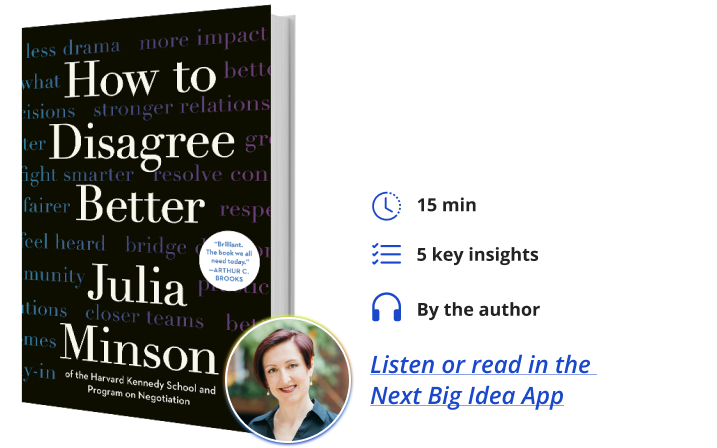
Below, Julia Minson shares five key insights from her new book, How to Disagree Better.
Julia is a professor at the Harvard Kennedy School. She is a behavioral scientist with over twenty years of research experience in conflict, communication, negotiations, and decision-making.
What’s the big idea?
Disagreement doesn’t have to turn into conflict. It can actually be a good thing—energizing and productive, even. The trick is knowing how to handle it. If we use science and put in a little effort, anyone can learn to disagree better.
Listen to the audio version of this Book Bite—read by Julia herself—in the Next Big Idea App, or buy the book.

1. Disagreement is not the same as conflict.
People use the terms “disagreement” and “conflict” interchangeably, but these are two distinct experiences. Disagreement is a difference of beliefs, preferences, or predictions. Two people can disagree about how to sequence a project at work, whether the ending of Stranger Things was a letdown, or the merits of U.S. Middle East policy. All these topics can lead to interesting conversations and a fun, informative exchange of viewpoints. Having a person disagree with us can prevent us from making catastrophic errors or introduce us to entirely new ways of thinking. Disagreement is good.
By contrast, conflict unfolds when two people in disagreement conclude that no intelligent, rational, moral person could hold the view that their counterpart espouses. Surprisingly, people can reach this conclusion about anything: the division of household chores, the meaning of a word, the interpretation of medical data, or the merits of a social policy.
When I was in my early twenties, I once found myself in a screaming fight with my grandfather about the proper method of storing cauliflower in the refrigerator. The topic does not matter. It is the assumptions of ignorance, irrationality, and immorality that can turn any discussion into World War III. Learn to check your assumptions, and life will get easier.
2. Persuasion is a losing game.
Think about the important disagreements in your life: parenting disagreements with your spouse, caretaking disagreements with your aging parents, or the policy battles convulsing our country. Now, think about how many times you have definitively won one of these arguments, with the other person verbally conceding defeat and admitting they were wrong. Your list of wins is probably pretty short.
The problem is not that you are especially bad at arguing. The problem is that persuasion is fundamentally a losing game. When we go in guns blazing, we overlook the fact that the other person has just as much life experience, conviction, and evidence to support their side.
“The problem is that persuasion is fundamentally a losing game.”
Every year over the holidays, my family gathers at my in-laws’ house. Unfortunately, this year, my sister got the flu, precipitating a debate about canceling the trip. My mother-in-law insisted on all of us coming anyway, arguing that everyone gets sick every winter and that her own developing cough was just a “little tickle.” We made the trip. My sister and my mother-in-law wore masks and washed their hands with extra frequency. Everyone in my family got sick. The holidays turned into a blur of high fevers, sleepless nights, and doctors’ visits.
Weeks later, everyone still thinks that they were right. The people who wanted to cancel the trip point to the days of misery and say that we should not have gone. The people who insisted on the trip argue that since a winter virus seems unavoidable and no precautions help, you might as well live it up. After weeks of debate, there remained no resolution in sight.
People see the world through the lens of their convictions and desires. As we give longer, louder speeches, we only give our counterparts more material to refute. Persuasion begets persuasion, and usually little else. People walk away frustrated, annoyed, and hoarse, having lost any opportunity at real, lasting influence.
3. Receptiveness will get you further.
Even the most disagreement-challenged among us can get much, much better. Several years ago, my team and I published a personality scale that measures people’s receptiveness to opposing views—the extent to which they can engage with divergent perspectives rather than avoiding or dismissing them out of hand. It took us years to develop and validate the scale, but now we have a rigorously tested metric of how receptive any given person is. If you go to my website, disagreeingbetter.com, you can take the survey, too.
“Receptive people are more desirable teammates, advisors, and friends.”
People who are more receptive disagree differently. They are less likely to experience negative emotions when others do not see eye-to-eye with them, and, as a result, they are more comfortable learning about opposing views. They think harder about arguments on both sides and appreciate the merits of multiple points of view. Having considered the situation from multiple perspectives, they tend to be better-informed people.
Others appreciate those qualities. Receptive people are more desirable teammates, advisors, and friends. They are seen as better leaders and are more likely to receive help in difficult situations. In a world of conflict, they manage to keep their cool and learn from both sides.
4. It’s not the thought that counts.
Receptiveness is not about becoming a more empathetic person, improving your active listening skills, or mastering open body language. Receptiveness is about words. While most people try to change how they think and feel during disagreements, our research shows that the words we use make the greatest difference in how we are perceived.
The reason? Other people can’t read our minds. To convince our conversation partners of our receptiveness, we need to use simple and repetitive language to ensure that they get the message.
A specific set of words and phrases signals engagement with opposing views. We call this communication style “conversational receptiveness”—language that clearly communicates that you are thinking about your counterpart’s concerns and keeping those concerns in mind, even as you advocate for your own position.
“The words we use make the greatest difference in how we are perceived.”
Conversational receptiveness gets results. People who master this style are seen as more trustworthy, more reasonable, and more intelligent by their conversation partners. Their counterparts want to continue talking with them in the future, allowing for long-term influence and relationship building.
Most importantly, conversational receptiveness is contagious. Experiments show that when you communicate with high levels of conversational receptiveness, others adopt that style as well. Each of us has power over how our conversations unfold. You don’t have to demand that other people listen to you. You can lead by example and set your conversations on a positive loop. Over time, we can reshape how entire families, teams, and communities disagree.
5. Disagreeing well requires work.
You don’t need a new personality or years of therapy to get better at disagreement, but you do need to commit some time and effort to practicing the right skills so that you are ready when the moment of truth arrives. The problem is that most people don’t like to practice their disagreement skills.
Opposing views can be hard to stomach, and the threat of conflict is ever-present. So, most of us avoid disagreement and then feel surprised when our next encounter goes badly. The solution is to think of ways to practice engaging with opposing views and formulating receptive responses that are small and not too painful.
If you don’t learn to swim and somebody tosses you into deep water, you will drown. But if you start by first learning to blow bubbles, then learning to float, and then learning to dog paddle, you will eventually feel completely at ease, even as storm clouds roll in and the waves rise.
Enjoy our full library of Book Bites—read by the authors!—in the Next Big Idea App: