














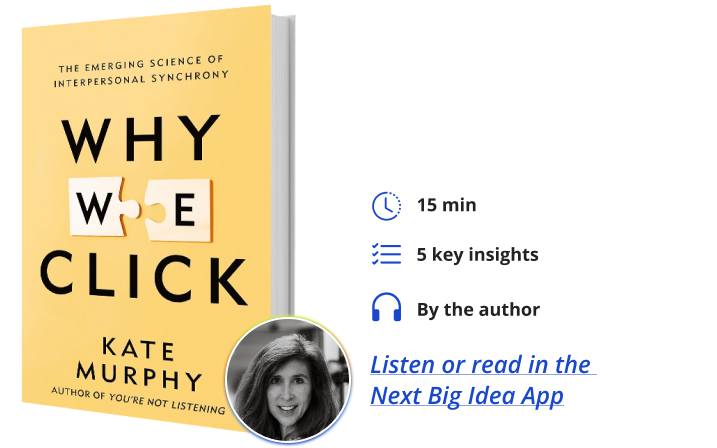
Below, Kate Murphy shares five key insights from her new book, Why We Click: The Emerging Science of Interpersonal Synchrony.
Kate is a journalist whose work has appeared in the New York Times, The Wall Street Journal, Economist, and Texas Monthly, among other publications.
What’s the big idea?
Humans are instinctively wired to sync with one another, and this invisible alignment of bodies, brains, and emotions shapes attraction, trust, and belonging. It can deepen connection and fuel cooperation, but it also makes feelings and behaviors contagious, giving each of us more influence over others than we realize.

1. Human beings have an instinct to sync.
Bring two or more people together and they will immediately begin to synchronize or fall into rhythm with one another. Not only do we tend to subconsciously mimic one another’s movements, postures, facial expressions, and gestures, recent breakthroughs in technology have revealed we also sync up our heart rates, blood pressure, brain waves, pupil dilation, and hormonal activity.
This phenomenon is known as interpersonal synchrony, and it is possibly the most consequential social dynamic most people have never heard of. Interpersonal synchrony is significant because, by subconsciously mimicking even the subtlest twitches of expression and biological rhythms of other people, we can channel their thoughts and feelings. When we reflexively smile upon observing someone else’s joy, we feel their happiness. When we flinch at the sight of someone being hit, we intuit their pain. Syncing with their racing heart gives us a read on their anxiety.
Moreover, the synchronization of brain waves during conversations or during shared experiences aligns beliefs and attitudes. You and the other person, at that moment, are of like minds. The result is that emotions, moods, attitudes, and subsequent behaviors can be as contagious as any disease and can have just as profound an influence on our health and well-being.
2. Sustained synchrony signals attraction and attachment.
Scientists have conducted numerous speed-dating and speed-networking experiments since the early 2000s to find out why some people immediately click while others rub each other the wrong way. Researchers discovered that couples who reported a feeling of connection and wanted to see each other again were literally on the same wavelength. Their bodily movements and internal rhythms were coordinated, and the wavelike neural firing patterns in their brains coupled, or coincided—often in less than 30 seconds.
Moreover, the synchrony occurred even when the other person violated previously expressed parameters of what an ideal partner should be or look like, such as must share the same faith, have a good income, be college-educated, or tall, or blonde, or whatever.
“Researchers discovered that couples who reported a feeling of connection and wanted to see each other again were literally on the same wavelength.”
This might explain the growing dissatisfaction and widespread deletions of dating apps. Someone can check all the boxes of what you or a dating app’s algorithm thinks is a perfect match, and yet, when you meet that person face-to-face, all you can think about is what you’d rather be binge-watching on Netflix.
Conversely, you can be instantly drawn to someone you meet in person whose online dating profile might have made you immediately swipe left. Syncing is a multi-sensory phenomenon and, as a result, you can’t experience it online in its truest, most exquisite form.
3. Synchronized activity promotes bonding.
Not only do you sync with people you like, but you also tend to like people with whom you are in sync. When people do the same thing at the same time, such as marching, dancing, singing, rowing, and even finger tapping, it tends to build feelings of rapport and trust. They disclose more personal information and are more cooperative, kind, and helpful. Even infants strapped into face-forward carriers and bounced in time to music were significantly more likely to favor experimenters who were likewise bouncing in time, compared to experimenters who bounced out of sync or did not move at all.
People engaged in synchronized activities also report feeling a sense of transcendence or oneness with those around them. Think of soldiers marching, religious congregants singing and reciting prayers, protesters chanting, and any kind of dancing. Aristotle was probably onto something when he lectured his students, the Peripatetics, while walking the grounds of the Lyceum. Apple Computer co-founder Steve Jobs was likewise known for inviting people he wished to influence to take long walks with him.
4. The downside of interpersonal synchrony.
Our instinct to sync can make us susceptible to getting mired in other people’s psychosocial muck. There is something called the “bad apple effect,” where one person’s negative or erratic energy can infect an entire group. This is especially true in work situations where you can’t necessarily choose the people with whom you interact. It’s not like speed dating, where you can do a quick sample sync and move on if you don’t like what you feel.
An emergency room nurse told me that the difficulty of her job has less to do with the number of patients who arrive or the severity of their injuries than with who else is on her shift. “There are definitely people who, when you walk in, you see them and you’re like, ‘This will be a good day no matter what gets thrown down,’” she told me. “And there are other days when you walk in and you’re like, ‘Okay, this is going to be a struggle.’” We’ve probably all had the experience where one person coming into or leaving a group totally transformed the vibe for better or worse.
At scale, interpersonal synchrony can tip into social contagion, which is responsible for the best and worst aspects of humanity—from functioning governments, coordinated market economies, cohesive cultures, and scientific advancement to wars, riots, persecutions, and mass hysteria.
“At scale, interpersonal synchrony can tip into social contagion, which is responsible for the best and worst aspects of humanity.”
This is not to say humans are indistinct from schools of fish or murmurations of starlings. On the contrary, individuals potentially have as much power to influence as be influenced. Various techniques can help you recognize and encourage interpersonal synchrony when it’s beneficial, and disengage and reclaim yourself when it is not. A big part is noticing your feelings and questioning where they come from. Are you feeling anxious about something happening to you directly or are you upset because of something someone else is feeling or doing on- or offline? Awareness is key to breaking free of synchronies that are not working for you.
5. Be what you want replicated.
Synchronized phenomena occur throughout the natural and life sciences, but research has only recently revealed the extent to which human beings synchronize and its significance. Synchrony between humans is nothing short of a superpower. Compared to other species, we are not particularly imposing, and our senses are pretty feeble. While capable of astounding feats of cognition and imagination, our brains are nevertheless limited and subject to all kinds of processing errors. But thanks to interpersonal synchrony, we can marshal and coordinate our bodies and brains to communicate, innovate, create, and succeed in ways far exceeding what we could accomplish alone.
We are all tuning forks roaming the planet, picking up vibes, and finding resonance with those we encounter. It’s a truth known on some level since antiquity. Plato wrote that we are all born seeking to reunite with our missing other half, but what we are really seeking are those whose internal rhythms harmonize with our own—the people with whom we effortlessly click. And certainly, turns of phrase like being in sync, in tune, in step, and on the same wavelength have been part of our vernacular long before recent advances in technology revealed that they were true.
Interpersonal synchrony, above all, reminds us that we are not unto ourselves in this world. We internalize one another, even those we may not know well or know at all. We can literally warm people’s hearts and get on their nerves. And we carry others’ vibes and rhythms around with us like catchy tunes that, once heard, continue to play in our heads. The instinct to sync confers a responsibility to try to be what you want replicated. Your thoughts, feelings, demeanor, and behavior do not begin, nor end, with you.
Enjoy our full library of Book Bites—read by the authors!—in the Next Big Idea App: