















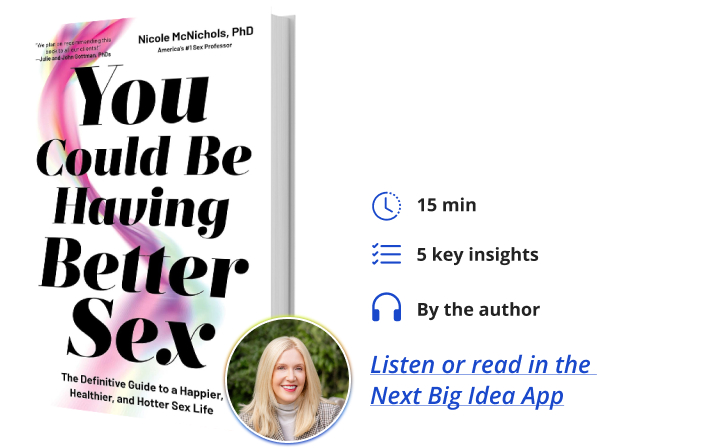
Below, Dr. Nicole McNichols shares five key insights from her new book, You Could Be Having Better Sex: The Definitive Guide to a Happier, Healthier, and Hotter Sex Life.
Nicole is a psychology professor at the University of Washington, where her course “The Diversity of Human Sexuality” attracts more than 4,000 students each year. She writes frequently for various publications, including The Seattle Times and The Conversation, and she has a regular blog for Psychology Today.
What’s the big idea?
A healthy, fulfilling sexual life is built in layers. The McNichols Hierarchy of Sexual Needs offers a three-tier framework for understanding—and strengthening—the foundations of sexual confidence, connection, and pleasure at every stage of adult life.

1. Pleasure is an underleveraged life hack.
When it comes to caring for health and wellbeing, our puritanical culture tends to relegate sex to last place—far below making time for career, family, or even exercise. But studies show that if we prioritize experiencing pleasure on a consistent basis, we will do all those other things better.
Psychologically, pleasure builds ego resilience, lowers anxiety, improves creative problem-solving, increases our ability to cope with stress, and increases our sense of overall happiness.
Physically, sex improves sleep, reduces the risk of cardiovascular disease, decreases the chances of dementia and Alzheimer’s, and strengthens our immune systems. In fact, studies show that men who have more orgasms live longer, and that will likely also be true for women when they conduct that study.
Taking care of your sex life is foundational to your health and wellbeing—and that is the foundation of your sexual needs pyramid.
2. We can all work to close the orgasm gap.
Before you run off to get freaky, let’s start by working to make sure that heterosexual encounters are equally pleasurable for both partners. Despite more widespread knowledge about the clitoris, porn still promotes the myth that women come easily from penis in vagina stimulation. That only works for 15 percent of women. This is why we all need pleasure literacy, a foundational knowledge of the intersection between anatomy and pleasure.
“Asking questions and fostering open sexual communication is the quickest route to a mutually satisfying experience.”
This is about understanding and appreciating that all bodies are different, so what worked for your last partner may do nothing for this one. Asking questions and fostering open sexual communication is the quickest route to a mutually satisfying experience. When people learn what helps their arousal build, when they understand their own preferences, and when partners feel comfortable talking openly, the gap narrows dramatically.
Closing the orgasm gap starts with getting curious about yourself and your partner, not performing according to a script.
3. You can reboot your desire by optimizing your pleasure cycle.
There’s a cultural myth that desire is supposed to be spontaneous and effortless, always and forever. That’s simply not how most people’s libidos work, especially those of us in long-term relationships. For most people, desire is responsive, meaning it relies on context, a sense of emotional safety, and creating your erotic space. In the second tier of the sexual needs hierarchy, we can boost desire by focusing on maximizing the three stages of the Pleasure Cycle.
The three stages of the Pleasure Cycle:
- Wanting: Dopamine levels are at their highest. So go ahead and text your partner to say you’re looking forward to your next encounter. Let anticipation fuel desire!
- Liking: You engage with your partner, feeling pleasure and releasing a flood of natural opioids. You can boost this response by staying present and avoiding habituation, i.e., if you always cycle through the same three positions in the same order, mix it up. Our brains crave novelty!
- Learning: We reflect on what we enjoyed and what we want more of next time, which takes us right back to wanting, creating a virtuous upward cycle.
When we understand the pleasure cycle, we can shift from worrying about whether something is wrong with us to asking, “What conditions help my desire thrive?” The three phases of sex must be nurtured equally to stoke desire.
4. Communicating your needs and honoring your boundaries makes sex hotter.
There is a common misperception fueled by the entertainment industry that a sense of danger fuels desire. It’s actually novelty that fuels desire. Our sensation of pleasure is deeply dependent on feeling safe. This is why communicating and respecting boundaries is so important for hot sex.
We need to normalize checking in with our partners throughout the sexual experience to see if they are enjoying it. It should never be assumed that because consent was given at the beginning of an encounter that the rest is rubber-stamped. If you want to change positions, locations, or orifices, check in!
But it’s also time to expand our definition of consent beyond the physical to include our social and emotional selves. This is where emotional honesty and situational transparency come in. What are you looking to get out of this encounter? Is it just good fun, or are you looking for more? Is there any information you might be withholding that could interfere with someone else’s willingness to have sex with you?
“Our sensation of pleasure is deeply dependent on feeling safe.”
And finally, consent also means committing to mutual pleasure. Nobody wants to feel like a human masturbatory sleeve. There has to be effort, attention, communication, and shared commitment to both people’s experience so that sex feels like a collaboration. You can set the scene for hot, unbridled sex by encouraging and demanding holistic consent.
5. Your sexuality is bigger than you think.
At the top of the McNichols Hierarchy is the freedom to embrace the full spectrum of your desires, fantasies, erotic imagination, and even your evolution over time.
This includes things like sexual fluidity, kink, consensual non-monogamy, and the vast range of what people consider erotic. One of the most liberating truths in sexual science is that there is no single definition of “normal.” Desire is diverse. It’s personal. And it’s allowed to evolve.
When we give ourselves permission to explore in a grounded, self-aware way, then we build a more integrated relationship with our erotic selves. For many people, this transforms not just their sex lives but their sense of identity, confidence, and joy.
Sexual flourishing comes from expanding, not narrowing, your understanding of yourself. The more room you give your sexuality to breathe, the more fulfilling your erotic life becomes.
Enjoy our full library of Book Bites—read by the authors!—in the Next Big Idea App: