













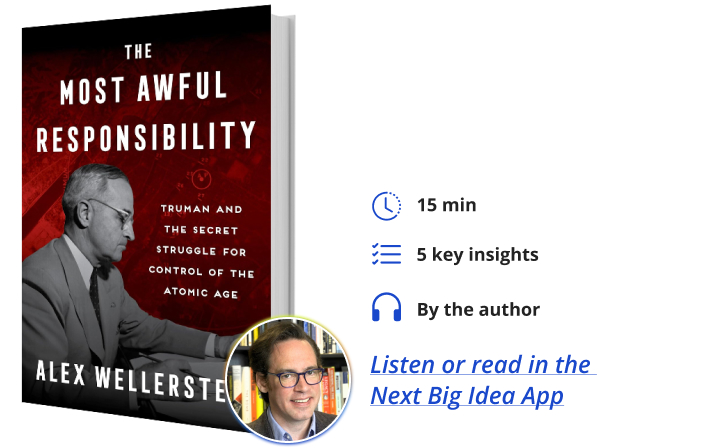
Below, Alex Wellerstein shares five key insights from his new book, The Most Awful Responsibility: Truman and the Secret Struggle for Control of the Atomic Age.
Alex is a historian of science who specializes in nuclear history. He is an Associate Professor in the Science and Technology Studies program at the Stevens Institute of Technology, and a visiting researcher at the Nuclear Knowledges program at Sciences Po, in Paris. His writing has appeared in The New Yorker, Atlantic, Harper’s Magazine, and many other publications. He is known as the creator of NUKEMAP, the world’s most popular online nuclear weapons effects simulator.
What’s the big idea?
During Harry Truman’s presidency, two atomic bombs were dropped on Japan. As the only president to authorize such a devastating strategy, many would be surprised to learn both the limits of his role in the decision and his strong anti-nuclear efforts afterward.

1. An atomic biography of President Harry Truman.
This book primarily covers the years President Truman was in office, from 1945 through 1953. In it, I take a fresh look at everything from the use of atomic bombs on Japan during World War II, through the decision not to use nuclear weapons in the Korean War. This period is one of the most important historical moments of the Cold War, and arguably the most important for establishing that atomic bombs were not going to be used as “normal” military weapons.
2. Truman was more anti-nuclear than he gets credit for.
Truman was deeply horrified by the idea of using atomic weapons, which he associated with the “slaughter” and “murder” of “women and children”—his words when talking about the bomb. He worked very hard, after World War II, to keep these weapons out of the hands of the U.S. military. In a meeting in July 1948, during the Berlin airlift, when the military were pushing hard to get access to atomic bombs, Truman cut them off completely, lecturing the military leaders:
“It is a terrible thing to order the use of something that is so terribly destructive, destructive beyond anything we have ever had. You have got to understand that this isn’t a military weapon. It is used to wipe out women and children and unarmed people, and not for military uses. So we have got to treat this differently from rifles and cannon and ordinary things like that.”
This meeting was classified, and it was in these kinds of secret settings that Truman would frequently let his real opinions be heard clearly. He described the atomic bomb as a weapon that “affects the civilian population and murders them by the wholesale.” He described it, repeatedly, as a “terrible” weapon, and the decision to use it “the most terrible decision that any man in the history of the world had to make.”
3. Truman’s paradox.
So… how does Truman’s anti-nuclear sentiment square with the fact that he was the only president to ever use the atomic bomb in war? There’s an obvious paradox here, and the book goes to great lengths to resolve this paradox.
“For several decades now, scholars have understood that Truman was far from the “decider” on the bomb that he has been depicted as.”
The first third of the book discusses the lead-up and immediate aftermath of the use of bombs over Hiroshima and Nagasaki. Unlike most accounts, I laser in on exactly what Truman did and did not know about the bomb and the plans to use it. For several decades now, scholars have understood that Truman was far from the “decider” on the bomb that he has been depicted as (and even as he depicted himself). His role, as General Leslie Groves—head of the Manhattan Project, and one of the people who was actually doing most of the operational planning on the atomic bombs—put it, was essentially of “one of noninterference—basically, a decision not to upset the existing plans.”
4. Truman did not understand the existing plans.
Truman did not understand “the existing plans” very well. What he believed them to be was quite different from what they really were. More likely than not:
- Truman believed Hiroshima was a military base, not a city full of civilians.
- He came under this misconception because of the one real “atomic decision” he made prior to the bombings, which was to countersign Secretary of War Henry Stimson’s drive to keep the city of Kyoto off of the atomic target list, which Truman mistakenly understood as a choice between a city and a military base.
- Truman did not learn the reality of the situation until August 8, 1945—two days after the attack.
- Truman had no understanding that a second atomic bomb would be ready to use within a few days of the first and had no forewarning at all about the Nagasaki attack, which was already underway the moment he learned that Hiroshima was a city.
- His order to stop atomic bombings the day after the Nagasaki strike, which he told his cabinet was because of his horror at killing “all those kids,” constitutes his first truly informed major decision on the atomic bomb during World War II, and was a result of his fear that he had lost control of this new power.
- These sentiments persisted in his relationship with the bomb throughout his presidency, and led him to largely deny the military access to the weapons, to keep the use of the bomb “off the table” during the conflicts of the late 1940s and early 1950s, and is a major factor in the fact that Nagasaki was not just the second use of an atomic bomb in war, but the last use of one.
5. Truman’s atomic legacy.
While Truman’s atomic legacy must include and be focused on the use of the atomic bomb against cities during the war, he should also be given some credit for the fact that it has never been used in war since then. I am convinced that this is a better way to understand Truman and the bomb than any of the standard narratives.
Enjoy our full library of Book Bites—read by the authors!—in the Next Big Idea App: