














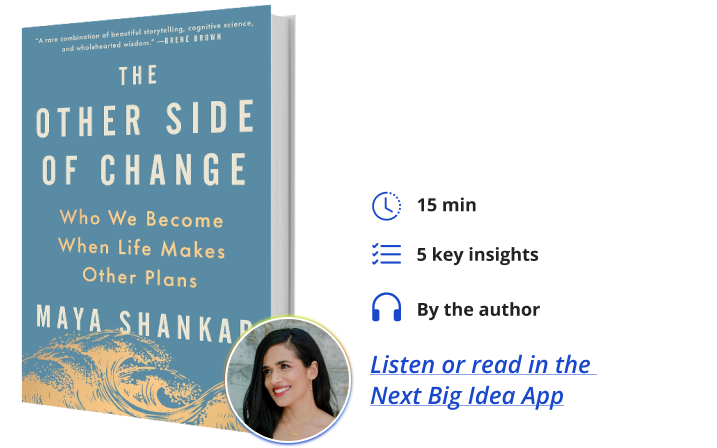
Below, Maya Shankar shares five key insights from her new book, The Other Side of Change: Who We Become When Life Makes Other Plans.
Maya is a cognitive scientist and host of the podcast A Slight Change of Plans. She served as a senior policy advisor in the Obama White House, where she founded and chaired the Social and Behavioral Sciences Team. She was also appointed as the first behavioral science advisor to the United Nations.
What’s the big idea?
What if the life upheavals that shake you most could also be your greatest opportunities? Change can feel like loss, but it can also be the start of a stronger, reimagined self.

1. Our brains aren’t wired to like uncertainty.
We tend to dislike uncertainty, and a big change can inject a whole lot of uncertainty into our lives. There’s a fascinating scientific study showing that people are more stressed when they think they have a 50 percent chance of receiving an electric shock than when they think they have a 100 percent chance. We would rather know that something bad is going to happen than to wrestle with any ambiguity.
Another reason change is scary is because it involves loss of some kind. By definition, change means we’re moving from an old way of being into a new one. We may find that, in addition to feeling fear, we also feel profound grief for what we’re losing. And when a big change happens, we can experience the loss of our self-identity. We might think, Who am I now that change has taken away what I once was?
2. A robust, expansive self-identity can make you more resilient to unexpected changes.
As a kid, I was a budding concert violinist who studied at Juilliard under Itzhak Perlman. A sudden hand injury ended my dreams of becoming a professional overnight. I distinctly remember grieving, not just the loss of the instrument, but also who I was fundamentally.
Fast forward several decades, and I again found myself grappling with an unexpected, unwanted change in my personal life. After years of navigating numerous obstacles and disappointments, my husband and I were finally on the cusp of starting a family together. But life made other plans. I found myself not only grieving pregnancy losses, but also the loss of my identity as an aspiring mom.
“Try to define yourself not simply by what you do—roles or labels—but by why you do those things.”
During these moments, I wish someone had given me this guidance: Try to define yourself not simply by what you do—roles or labels—but by why you do those things. For example, I’ve discovered that a love of human connection was at the root of my musical and parenting aspirations. I am a person who thrives on emotional connections with others. And just because I lost the violin, that didn’t mean I lost what led me to love it in the first place. I now see that it’s just a matter of finding new outlets to express these parts of myself.
For instance, I’ve been able to fulfill my desire for emotional connection through my role as an interviewer for my podcast and through writing this book. It’s been freeing and empowering to reimagine myself in this way. By anchoring my identity to why specific pursuits make me light up, I’m giving myself a softer landing the next time my what is put at risk. My why will still be there and can serve as the compass that guides me toward my next chapter.
Ask yourself, What is your why? And can you anchor your identity to it? Research shows that you can, and engaging in a self-affirmation exercise could help. This takes only five or 10 minutes. Write out all the identities that you value about yourself that are not threatened by the change. Doing so can zoom you out to a perspective that reminds you that your identity and self-worth do not hinge solely on what life has taken away from you.
3. Distraction can be a healthy, productive coping mechanism.
One narrative that has become pervasive, particularly in Western conversations about wellness, is that the only healthy way to move on from a bad experience is to fully confront it and immerse yourself in your negative feelings. Otherwise, you risk having those emotions resurface in the future with greater force. But recent research on resilience reveals a far more complex story.
Individual differences play a big role in determining what makes for a healthy response. If directly and persistently confronting your negative emotions is working for you, stay the course. But if you’re not gravitating toward that method and are doing fine, or if some combination of both approaching and avoiding your negative emotions is your sweet spot, there’s no need to feel guilty or fear that you will pay for it later. If something doesn’t keep resurfacing, it’s unlikely that it will suddenly haunt you with greater intensity years down the line.
On a related note, if, in the wake of a change, you or your loved ones enter a state of denial, this reaction can be for the better in the short term. There is a grace in denial, as grief researchers Elisabeth Kubler-Ross and David Kessler say. It is nature’s way of letting in only as much as we can handle. Denial can give us a powerful feeling of control, motivation, and hope, which is sometimes the lifeline we need to stay resilient during our hardest moments. One research study explored the recovery trajectories of patients with heart problems. Those with high levels of denial in the short term spent less time in intensive care and had fewer heart-related symptoms during their hospital stays.
4. Change can serve as a critical moment of revelation.
When a bad thing happens, it can feel like the world we know has been destroyed and that we’re experiencing a personal apocalypse. But apocalypse comes from the Greek word apokalypsis, which means revelation. This etymology is instructive. Change can upend us, but it can also reveal things to us. The unique demands and stresses of a change can uncover surprising things about who we are. Insights that, once revealed, we can use to challenge our self-limiting beliefs or otherwise guide our path moving forward.
“Many aspects of our self-identity are far more malleable than we might realize.”
Two stories of people I interviewed for my book come to mind. In one, the lingering impact of a biking accident revealed to a woman named Ingrid just how much shame she had been carrying regarding her family’s heritage and indigenous practices. Once she understood this, she was able to rework her relationship with her belief system and challenge her own negative attitudes. In another, a woman named Tara had a deeply insecure attachment style and was forced to confront this aspect of herself when facing a big change in midlife. Dealing with this change gave her the impetus to take slow, deliberate steps toward opening herself up to others and letting them in. Over time, she has built a life that brims with love and is full of deep, secure relationships.
Many aspects of our self-identity are far more malleable than we might realize. Tara’s experience is corroborated by recent research showing that early childhood experiences are far less predictive of adult attachment styles than researchers previously thought. We can take active steps to reshape our attachment styles in adulthood.
5. We are bad at predicting how we will respond to big changes.
When we anticipate how we will respond to a change, we falsely assume that we will be the same person in the future as we are today. This psychological bias is known as the end of history illusion, and it captures the idea that our brains reliably underestimate how much will change in the future, even though we fully acknowledge that we’ve changed considerably in the past.
We are always changing, and a major disruption in our lives can accelerate these internal shifts. Simply put, when a big change happens to us, it can lead to profound change from within. We become different people on the other side of change.
“Simply put, when a big change happens to us, it can lead to profound change from within.”
We become different people because of the experiences we endure. For this reason, you may be able to endure a negative change far better than you think at the outset, and that’s because you’re underestimating your own ability to evolve as a result of that change. The relevant question to ask yourself isn’t, How will I navigate this change? But rather, How will I, with potentially new capabilities, values, and perspectives, navigate this change?
By and large, the people I’ve interviewed over the years have felt profound gratitude and awe for the person they became in the aftermath of what they went through. Personally, I was initially skeptical of this. I like to say that I have two allergies: soy and platitudes. But, amazingly, as I was writing this book and going through my own personal change, I witnessed this evolution within myself on the other side of change.
What if we start seeing big disruptions as a chance to reimagine ourselves? Change contains so much opportunity, and my hope is that you will come to feel the same way.
Enjoy our full library of Book Bites—read by the authors!—in the Next Big Idea App: