













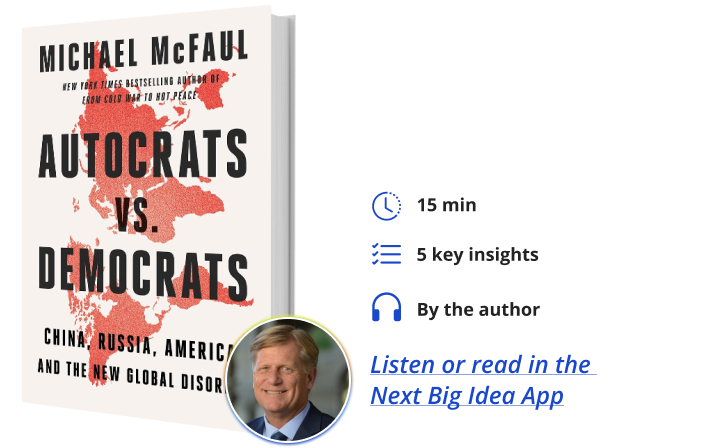
Below, Michael McFaul shares five key insights from his new book, Autocrats vs. Democrats: China, Russia, America, and the New Global Disorder.
Michael is the Director of the Freeman Spogli Institute for International Studies, the Ken Oliver and Angela Nomellini Professor of International Studies at the Department of Political Science, and Peter and Helen Bing Senior Fellow at the Hoover Institution, all at Stanford University. He is also an international affairs analyst for NBC News, and a former U.S. ambassador to Russia.
What’s the big idea?
Autocrats vs. Democrats explains how we got to this confrontational, challenging point in our relations with China and Russia. By understanding the great power competition of today, leaders and citizens can better strategize what to do about it.

1. How did we get here?
In 1991, I was living in Moscow doing fieldwork for my PhD dissertation, and it was an incredibly exciting moment in history. Boris Yeltsin and other Russian small-D Democrats thwarted a coup plot against Mikhail Gorbachev that helped trigger the dissolution of the Soviet Union. The new leadership embraced democratic ideals and pushed for the newly independent Russia to join the Western-led liberal international order. It was a really exhilarating time to be a political scientist, a multilateralist, an American, and a small-D Democrat. It seemed like all of Russia wanted to join the democratic world, and even China was moving in that way. As my colleague here at Stanford, Frank Fukuyama, wrote in a very famous essay, it was the end of history—or so it seemed.
Today, that story looks very different. Russia under Vladimir Putin has become increasingly authoritarian. China has experienced similar shifts toward autocracy under Xi Jinping. And the United States faces new serious threats to its own democracy at home, as well to its security and prosperity abroad, that were unimaginable 30 years ago.
We’re in a period of confrontation because both China and Russia are autocratic and led by powerful leaders. This creates a challenge and a confrontational atmosphere with the United States—another great power in the international system, but which is still democratic.
“It is not inevitable that we will be in a state of competition and confrontation with China and Russia forever.”
But if you go over history, you’ll find that it wasn’t always this way. Sometimes there were greater moments of cooperation, in part because of the different balance of power between the countries, but mostly because of the different ideological regimes that undergirded those systems. When Russia was more democratic, we cooperated with them. Likewise, when China was leaning toward a less authoritarian structure, there was more cooperation. It is not inevitable that we will be in a state of competition and confrontation with China and Russia forever.
2. Are we in a new Cold War?
Yes and no. There are some similarities between the Cold War and today, but there are also important differences. Categorizing it as one or the other is not only analytically wrong, but also makes it difficult for us to construct foreign policies that advance American interests and values.
On similarities, I do think:
- Two superpowers are emerging: China and the United States.
- There’s an ideological dimension to this conflict. It is not just about power. If China were a democracy, I think there would be less conflict with China. The same goes for Russia.
- Both great powers—Russia as China’s sidekick—seek to spread their ideas about governance. These three factors are just like they were during the Cold War.
But there are big differences, as well. The ideological conflict between China and the United States is not as intense as the ideological conflict between the Soviets and Americans during the Cold War. China is not seeking to make the whole world communist. China is not fighting proxy wars against allies of the United States, as was the case during the Cold War. Millions of people died. At present, that is not happening in the Chinese American relationship.
Second, China most certainly is a rising power, but so too is the United States. This image of China rising and America falling is not supported by the data. We’re rising too, just not as fast as China. But they haven’t caught up with us yet. It’s entirely possible they may never catch up with us. And when you add allies into the equation—the democratic world versus the autocratic world—our military, economic, and ideological power is much stronger than that of Russia and China.
The third and most important major difference is the economic relationship between China and the United States, and China and the rest of the world. It is categorically different than the Soviet economic relationship with the United States and the free world during the Cold War. China is deeply integrated into the global economy, including the American economy. The Chinese economy is also more successful than the Soviet economy, and that creates new challenges for American economic interests that we did not face from the Soviet Union during the Cold War. To cut off China from the rest of the global economy (or our own economy), as we did during the Cold War with the Soviets, would likely fail because of that deep integration. We need to be conscious of this difference when developing policies that would successfully deal with China and Russia.
3. Don’t overestimate China, or underestimate Russia.
In the past, we underestimated China’s power. But now, we’ve overshot the target and exaggerate the Chinese threat to our existence. I do believe that containing China must be a central foreign policy objective for the United States in the decades to come. We need to remain competitive militarily, economically, technologically, and educationally. But China is not an existential threat to the United States or the free world. China is not seeking to destroy the United States or our allies. And while highly skilled and advancing in many dimensions, in the aggregate, China is not America’s equal in the aggregate.
“China is not seeking to destroy the United States or our allies.”
Conversely, while we have sometimes overestimated the threat from China, we’ve underestimated the threat from Russia. Russia may not have the same power capabilities—military or economic—that China has, but Putin is deeply motivated ideologically in ways that can threaten our economic, political, and security interests. The ongoing war in Ukraine is tragic proof of that. Putin is a risk-taker. He’s willing to aggressively deploy Russian troops to forward his agenda in ways that Xi Jinping has not yet done. Therefore, we have to maintain a vigilant strategy for containing the Russian threat.
I sat across the table from Putin for many years: first at the White House, next at the National Security Council, and then as U.S. ambassador. I think we have collectively underestimated Putin’s commitment to ideology. He’s not just a transactional leader. He’s more than that, and he’s had some success. Putin’s ideology of illiberal nationalism is popular around the world, especially in Europe and even here in the United States. We’ve ignored this dimension of our competition with Russia for too long.
4. How can we learn from the Cold War to meet today’s challenges?
I used to coach third-grade basketball. When you win a game in basketball, you forget about all the mistakes that happened in the second or third quarter. When you lose, you remember all of them. Because we have won the Cold War, we forget some of our mistakes. There are three in particular that are worth remembering:
- We overestimated the communist ideological threat, which led to disastrous mistakes like McCarthyism at home and the Vietnam War abroad. We didn’t need to fight the Vietnam War to win the Cold War.
- In pursuit of containment, we also embraced horrific right-wing dictators. We didn’t need to do that to win the Cold War. We did not need to embrace the apartheid regime in South Africa, for instance.
- We overestimated the Soviet economy and military. Reports from the 60s and 70s claimed that the Soviet economy would overtake the American economy. That turned out not to be true. That rings of our argument today about the Chinese economy.
But we also had some successful policies during the Cold War that we should replicate:
- President Kennedy created the U.S. Agency for International Development in 1961 so that we would have economic assistance to compete with Soviet assistance. We need to do more of that to compete with China today.
- We created the Voice of America, Radio Free Europe, and later Radio Free Asia. We need these tools of soft power again. The Chinese are investing in them. The Russians are investing in them. We need to do so again.
- We anchored the so-called liberal international economic order during the Cold War and founded organizations such as the World Bank, the IMF, and the World Trade Organization to unite the capitalist world. We all prospered from that strategy during the Cold War. We need to do that again.
- We created powerful alliances in Europe and Asia. Allies were our greatest advantage over the Soviets and should remain our greatest comparative advantage over China and Russia today. We must nurture those relationships to maintain them.
5. The side of the democrats can prevail.
In the long course of history, I believe that democracies are more powerful than autocracies. I believe that democratic ideas have shown that they’re more popular today than autocratic ideas. If we can unite the democratic world again, I am optimistic about our ability to prevail in this new era of great power competition. I’d much rather be on the side of the democrats than the autocrats.
Enjoy our full library of Book Bites—read by the authors!—in the Next Big Idea App: