

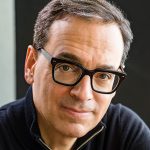












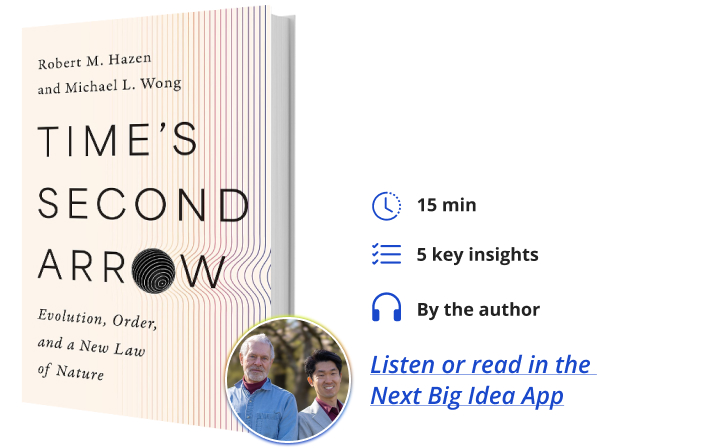
Below, co-authors Michael Wong and Robert Hazen share five key insights from their new book, Time’s Second Arrow: Evolution, Order, and a New Law of Nature.
Michael and Robert are researchers at the Carnegie Institution for Science’s Earth and Planets Laboratory. Robert is a veteran geoscientist who has done highly influential work in mineralogy and the origins of life. Michael is an up-and-coming astrobiologist interested in answering whether we are alone in the universe.
What’s the big idea?
All systems evolve—beyond the biological. A new law of nature helps describe, explain, and predict evolution in phenomena as varied as minerals, life, and technology: the law of increasing functional information.

1. Evolution is everywhere.
Visualize a mental image of five things: a mineral, a rainforest, a city, a favorite piece of music, and AI. What do those five things have in common? They are all complex evolving systems that, over time, become more patterned, interesting, and diverse. Whether it’s the world of music where we started with Gregorian chants and now, after centuries of development, we have a richness of musical genres. Or whether it’s cities that started as a few humble dwellings—even artificial intelligence, which started as some simple computer programs—all these systems are evolving.
When talking about evolution, most people think of Charles Darwin’s theory of evolution by natural selection. But we’re arguing that Darwin’s theory is a supremely important and true special case of a much more general phenomenon. His is the special case that applies to living things when you have genetic information transferred from one generation to the next with mutations, and then those mutations can lead to variations that can be selected for, and that’s how evolution occurs. But minerals evolve too. They also start very simply, and the system becomes more patterned, diverse, and complex.
We are proposing a new law of nature. We see conceptual commonalities across these disparate systems, from a rainforest to AI. Some might point out that the mineralogical world is still part of the natural world, whereas AI and music are part of the human world. But we’re seeing conceptual equivalencies in three aspects of all these systems.
These systems are composed of many interacting components: notes on music sheets, strings of computer code making up AI, different species in the rainforest, atoms that can arrange themselves in different ways within minerals. Those smaller bits can arrange themselves in vast numbers of ways, and there seems to be a selection process going on—what we’ve called function. You’re selecting for those systems that do something better than the other configurations, which are then rejected.
2. There is a natural law of increasing order in a world of decay.
In the natural sciences, there has long been something called the arrow of time. That arrow has been described as an increase in disorder, which we sense every day. You buy a new pair of shoes; they get scuffed. We see people get sick, injured, grow old, die, and then decay. This is a drumbeat of our lives. It’s the second law of thermodynamics, meaning the increase of entropy.
“We see conceptual commonalities across these disparate systems, from a rainforest to AI.”
But we say there may be a second arrow of time. The first arrow of time comes from this increase of entropy, the inescapable fact that things tend to decay when left unattended. Through our natural law, there is a second arrow of time that describes the increase in patterning, order, complexity, and diversity in the universe.
There are many smart physicists who say one arrow of time is enough to describe everything—that the increase in entropy accounts for evolution, too. They say evolution advances higher states of complexity or organization, which therefore disperses energy, accelerating entropy. They identify entropy as a cause of evolution. We say entropy is a consequence of evolution. You’re always going to increase entropy, no matter what you do, but it’s not the cause of evolution. That cause is information, because systems go toward states that are more functional.
We think there are three fundamental sources of selection:
- Static persistence: Being exactly as you are for some time without decaying toward entropy. If you don’t persist for a little bit, you don’t get to play the game and continue to ratchet up in evolution.
- Dynamic persistence: Statically persisting entities can interact and form relationships amongst themselves that form a dynamic system—one that is always intaking new resources, new bits of matter and energy, and exporting things as well. Think of a hurricane maintaining itself, a star maintaining itself, or a human being, all of which import low-entropy fuel and export high-entropy waste while evolving toward more interesting forms.
- Novelty generation: If you’re a dynamic system figuring out new ways of being, you can invent new functions. Things that can generate novelty will find new ways of being and persisting. There is selection pressure to be creative.
3. Information is a vital parameter in the natural world.
How do we measure this common set of characteristics that applies to all evolving systems? That’s where our law comes in. Imagine a simple system with only a trillion different possible configurations. Say you want that system to do something, like hold a cup of tea. There are a trillion different ways you can arrange the atoms, but only a few of them will hold a cup of tea. You can measure the function of it holding a cup of tea through functional information.
This idea was introduced by Nobel Prize-winning scientist Jack Szostak in 2003. He introduced it specifically to talk about genetic material and how much information it could hold—specifically, hold information that does something. It’s based on a fraction built by dividing the number of configurations that actually work (a small number) by the total number of possible configurations (a large number). It’s a very small fraction. Then you take the negative log to the base two of that, and it turns the information into a number of bits.
Under selective pressure, if you keep generating new configurations, trying new things, and select for some function, then you’re going to ratchet up to a level that works even better than the previous one. Then you start modifying that, and so on and so forth, ever improving the system. As things work better, the fraction gets smaller and smaller. The negative log of the base two is taken, meaning the number of bits gets larger and larger. This is called the law of increasing functional information. It’s an arrow of time that says this is how the mechanism by which nature increases the complexity also increases the functionality of systems.
This is true for minerals. It’s true for rainforests. It’s true for cities, music, AI, and all different kinds of systems. The functional information of the systems increases as new configurations are generated, and you select for things that work better. I guarantee that next year there will be a new piece of music that builds on what was released before, and you will call it your favorite.
4. Applying the law of increasing functional information.
In our initial 2023 paper, we only touched on a few conceptual equivalencies, but now we’re seeing an explosion of applications in the literature. People are thinking about evolution through our lens of selection for function, from soil ecology to artificial intelligence.
“Now we’re seeing an explosion of applications in the literature.”
Even cancer studies are being analyzed through our lens. New treatments are being proposed, inspired by the idea of understanding tumor progression as a ratcheting up of functionality. The idea is that a tumor becomes a sort of semi-autonomous entity that becomes isolated from your body, and now your body becomes the environment in which that tumor is evolving through a law of increasing functional information, and ratcheting up from stage one to stage two to stage three, and so forth.
5. Science as a messenger of meaning and purpose.
In an evolving system, if you’re selecting for things that ‘work,’ you have to make a subjective decision. What do you mean by ‘work’? What do you mean by ‘function’? When you start talking about words like ‘better’ and ‘work,’ you start thinking about meaning. What we call a missing law of nature brings us headfirst into the question: Is this a natural law that can address meaning and purpose?
We’ve had people write us emails thanking us for proving the existence of God, which is not at all on our minds here. But for some people, the idea that the universe spontaneously goes from simpler to more complex, from less pattern to more pattern, or from lower-diversity to higher-diversity systems could ascribe some kind of meaning or purpose to the universe. That’s a huge philosophical, theological question which everybody must address for themselves.
It’s wonderful that people are seeking answers to meaning and purpose in the cosmos, and it’s wonderful if natural laws can somehow provide that. But let me stretch this idea. Gravity is a law of nature. Isaac Newton’s idea is that if you have any two masses, then there will be a force between them. That force between them is what allows stars to form. It is what formed planets and the periodic table of the elements. It’s what seeded the universe with the elements of life. Life couldn’t happen without gravity, but it is a stretch for me to say that the purpose of gravity is life, or that the purpose of gravity is stars and planets. Gravity is a mechanism.
In the same way, our law of increasing functional information is a description of a mechanism in the cosmos. It’s how the universe works. If you’re going to ascribe purpose to that, ok. You can say the creator made the natural laws, and the creator made the natural laws in such a way as to lead to us talking about the natural laws. And that gives meaning and purpose. By the same token, if you don’t want anything to do with discussions of theology and whether there’s a God, then these laws of nature are all you got. They are what control your life. So, believe in a creator, or don’t believe in a creator—either way, you still need to understand the laws of nature. You’re going to have to live by those laws. They tell us what’s possible.
“On this second arrow, we can consider different opportunities.”
The goal of science is to understand change in the universe. Understanding the way evolution operates grants us agency to influence the process and determine our future through our imaginings of alternate paths. We can select the ones that are the most promising, fruitful, and prosperous.
Biological evolution is incredibly limited because you can only evolve by mutating what is already there, and the mutations can’t be too radical or the organism will die. It’s a very slow process. But the human mind can imagine things that never existed before, and then you can develop them. The fact is that using AI and some related technologies, we can try millions of different configurations per second because you can calculate how they will behave—whether an airplane wing will work or not, or whether an electric circuit will work or not. We are evolving much faster than ever before.
Life itself is also an evolving system. As we age, it’s easy for us as individuals to succumb to the drumbeat of decay and deterioration that unfolds along time’s first arrow. You can say a mean word to a colleague that will sting that person for the rest of their life. We’ve all said that thing that you can never unsay, but you can also make choices along the second arrow of time.
On this second arrow, we can consider different opportunities. We can choose between paths and imagine futures that will increase function—that will increase our ability. You can just choose to smile at someone. You can help the elderly. You can make choices that build the happiness of those around you. Those choices are not the increase in entropy. Those choices are an increase in order and functional information. You too can be part of this evolving universe. You can be part of the universe in which functional information will continue to increase through time.
Enjoy our full library of Book Bites—read by the authors!—in the Next Big Idea App: