












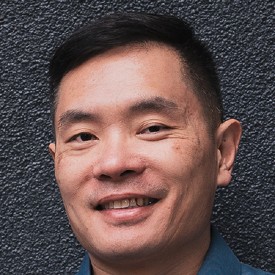
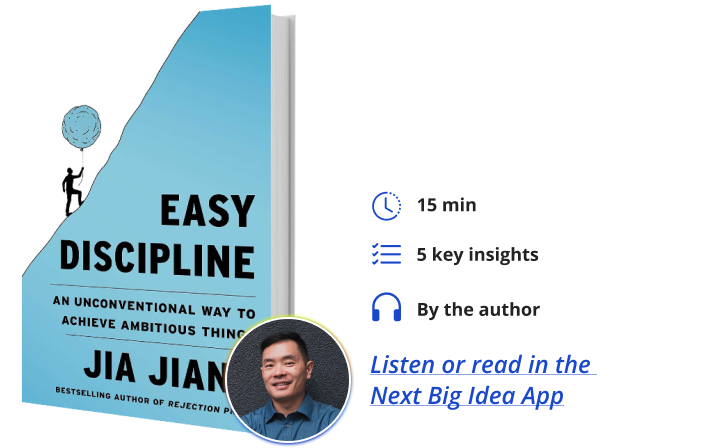
Below, Jia Jiang shares five key insights from his new book, Easy Discipline: An Unconventional Way to Achieve Ambitious Things.
Jia is an entrepreneur and award-winning speaker. His TED talk has millions of views and he is the owner of Rejection Therapy, which helps people develop mental resilience.
What’s the Big Idea?
The life you want isn’t built by obsessing over results. It’s built by learning to love the process so much that success becomes a byproduct rather than the goal.
Listen to the audio version of this Book Bite—read by Jia himself—in the Next Big Idea App, or buy the book.

1. Easy over hard.
In the Greek mythology there is the story of Sisyphus. He was a cunning king who made Zeus angry when he cheated death, so Zeus cursed him to push a rock up a hill for eternity. Every time Sisyphus would near the top, the rock would roll all the way back down. It’s a classic story of futility—effort without reward. Many people in the world feel like Sisyphus. They try but never win. Their lives repeat in a loop.
But does Sisyphus have free will? Was Sisyphus choosing to walk back down and push the rock back up again? If so, Sisyphus must have loved pushing rocks. In that case, Zeus built him the greatest exercise machine ever made. This version of the story would end with Sisyphus becoming the greatest rock pusher alive. There are people in this world who are like my version of Sisyphus. People like my type of Sisyphus are often at the top of their field and have a strong work ethic, and they didn’t hate their way to the top. They didn’t tolerate the climb. Their love of the work is more powerful than a desire for results.
Over a decade ago, I started a company and got rejected for funding. At first, I thought I should quit. Then it dawned on me that successful people don’t give up immediately after a rejection. My problem wasn’t securing an investor. It was my fear. So I fixed my fear. Most people try to fix fear the hard way, but I asked a different question: What if I could have fun with rejection? So I started a project called 100 Days of Rejection Therapy.
Every day I would ask for something absurd on purpose, trying to get turned down, and I would record myself to make a vlog out of it. My only goal was to have fun and laugh. The first day, I asked a stranger to borrow $100. The second day, I asked for a “burger refill” at a fast-food restaurant. Then I went to Costco and asked to use their intercom to speak to customers. Then I went to PetSmart to ask for a haircut—I asked for a German Shepherd cut. They said no, but I had a lot of fun.
“What if I could have fun with rejection?”
But then, people started to say yes to me. I asked to play soccer in someone’s backyard and they said yes. The next day, I asked to drive a police car and the officer said yes. I walked into a Krispy Kreme and asked them to make me donuts shaped like Olympic rings. The woman behind the counter said yes and also gave the creation to me for free. That video went viral. My vlog went viral. Nobody got mad because I wasn’t afraid. I was relaxed and having a great time. So people kept saying yes.
100 Days of Rejection Therapy was a blast. More than 10 years later, people all over the world are still doing rejection therapy. They’re doing it on TikTok or among themselves. If you try grinding your way through hard things, you might succeed, but it’s not sustainable. That’s how people fail. If you aim to have fun and let passion pull the work, then you can keep going for a long time and you will summit one top after another.
2. Think like an artist.
If you have never been to a traditional Japanese tea ceremony, I highly recommend it. It’s not really about tea. It’s a sensual, even spiritual, experience. As the host makes tea, every sound and movement is deliberate. Every word is deliberate. They are completely present with you as if nothing else mattered and nothing else existed in that room. The Japanese have a phrase for it which translates into one time, one meeting. It means that even though you can meet that person again in the future, the meeting you are having now can never be replicated. That’s why it matters to give it your all right there in the moment.
I call this the artist’s mindset because artists take the moment the world hands them and makes the best out of it. They aren’t thinking about the future or results. They’re thinking about the process. They’re thinking about what’s in front of them. The rest of us do the opposite. We worry about the outcome. We get anxious. That anxiety makes us perform badly, so we don’t get the desired result anyway.
I used to have serious social anxiety. I’m a professional speaker, so I had to get on booking calls with potential clients, trying to impress them. Hopefully they would hire me to speak at their event, but I was nervous and a terrible salesperson. I kept trying to decipher every cue that could hint at their expectations and match it. One day, I stopped trying to impress anyone or get anything. I just decided that I want to be my best self: fully present, going deep, and speaking from the heart and with humor.
When I focused on the moment instead of potential results, I became a better conversationalist. I connected better. I sold better. Everything got better. My social anxiety went away. I am no longer afraid of talking to people. That’s the artist’s mindset. Be fully present and give your best so that there is no room left to be afraid.
3. The one action goal.
Jim Collins is one of the most influential business thinkers alive. He wrote books such as Good to Great and Built to Last. He’s wildly creative and prolific. People ask him, “How do you do it?” You’d expect some elaborate answers, but his answer is a stopwatch. Jim Collins figured out that the most productive people spend about 1,000 hours a year on genuinely creative work. Whenever he sits down to that kind of work, he starts a stopwatch. When he stops, he pauses the clock and logs the minutes in a spreadsheet. He checks the running total to make sure that it never drops below 1,000 hours per year. One of the most creative minds in modern business works like an accountant—clock in, clock out. That’s what I call the one action goal.
“Jim Collins figured out that the most productive people spend about 1,000 hours a year on genuinely creative work.”
Take a goal that’s enormous and complicated and vague and reduce it into one single action that you can repeat endlessly. Make sure it is an action that you can actually enjoy. If your goal is starting a business, your one action goal can be to have 500 conversations with potential clients, investors, or partners in the next year. If your goal is sleeping better, maybe your goal is charging your phone outside your bedroom for the next 30 days.
My one action goal for writing this book was a daily drive. My biggest enemy is distraction, so every day I would leave my phone at home, take only my laptop, and drive to a spot called Half Moon Bay on the Northern California coast. There’s no Wi-Fi, no data, just me, my computer, and the ocean in front of my windshield. I would ride in my car for hours. The goal was not to write a great book, just to make that drive every day. As a result, I wrote three to five times more and better out there at Half Moon Bay than when I sat in my office or at home. Whenever I have a big goal, I turn that into one action I can take and control.
4. Use yourself.
In rap music culture, there’s a tradition called beef. Two rappers take turns writing and releasing songs that attack each other. The whole world reacts the way an audience might spectate two boxers, except instead of watching jabs and hooks, they listen to lyrics. The most famous recent one was Drake versus Kendrick Lamar.
By the end of their beef, Kendrick Lamar was writing songs that were so good and vicious that Drake couldn’t answer. One track was so amazing that he won multiple Grammys and performed it at the Super Bowl halftime show. People have argued for years about why Kendrick Lamar won the battle against Drake. Maybe he’s just a better rapper? He probably is, but Drake loves winning. He loves results, charts, trophies, and parties. Kendrick Lamar, on the other hand, just wants to be at home with his wife and kids and writing songs is his passion. If you get in a boxing match with someone who loves boxing more than winning, you’re probably not going to win that fight. The people who love the process tend to get the best results.
I grew up in Beijing, China. I saw Bill Gates speak when I was a teenager, and I decided then that I would be a tech entrepreneur who builds companies that change the world. I chased that dream for more than 20 years. I loved the idea of building a company, but I never loved the actual work of it. Raising money, hiring, firing, and running the operation were not compatible with my personality. What I loved was writing. Every time I wrote an email to customers or teammates, I felt a rush. I didn’t want to stop. It felt like the thing I was meant to do. I finally asked myself: Why am I chasing someone else’s dream? Why did I need to be Bill Gates?
There’s a famous saying that asks, who were you before the world told you who you’re supposed to be? I take it one step further, asking, who were you before you told yourself who you were supposed to be? That person is still inside you. Let your dream be something that comes out of you, rather than something that is installed into you. I stopped trying to build a company. I became a writer and I couldn’t be happier or more fulfilled. Your personality, your affinities, and the things you can’t help loving are your biggest assets. Use them. Use yourself.
5. Tell yourself a better story.
My first car was a 1999 Toyota Corolla. I loved that car. The first day after getting it, I was driving home and approaching an intersection. The light turned yellow. I had plenty of time to go through the intersection. In fact, I was too close to the line to brake comfortably anyway, so I kept going. But a car was coming the other way, wanting to turn left. He started honking, flashing his lights, practically screaming at me through his windshield, telling me to stop so he could make his left turn. I stopped, and he turned, but I sat there stewing. Why was this guy so rude? That was dangerous. He should have waited. It was my right of way. What a jerk. I remember my feelings vividly even though it was over 25 years ago.
“Everything that happens to us happens twice.”
However, when I think about that event nowadays, I tell myself a completely different story. What if he was rushing home? What if someone in his family had a medical emergency? What if he had a terrible day? What if he was scared of getting fired? If any of that were true, then I hope whatever he was racing toward turned out okay. Same intersection, same man, same day, but a different story makes me feel something completely different.
Everything that happens to us happens twice. The first time is the actual event. The second time is the story we tell ourselves about what it meant. The second one shapes your life far more than the first. You get rejected. You can tell yourself you weren’t good enough. That is one version of the story. Or you can tell yourself that your quest will surely take five rejections, so you’re one rejection closer to success.
The stories we tell ourselves powerfully shape how we see our own flaws. I had real ambition, but I also had flaws. I could get nervous, fearful. I couldn’t focus. I had ADHD. I have a speech impediment. I could have told myself those things disqualify me from going after my dreams. Instead, I decided these so-called ‘flaws’ were my assets. If I can build my own system around those flaws, then maybe I can share tools for others to overcome those same flaws. I could write books about those tools, and I just did. My flaws turned out to be my greatest treasures.
Wherever you are, whatever has happened to you, whatever predicament you are in right now, those are just events. It’s the stories you tell yourselves afterward that either diminish or elevate you. So tell yourself a better story.
Enjoy our full library of Book Bites—read by the authors!—in the Next Big Idea App: