















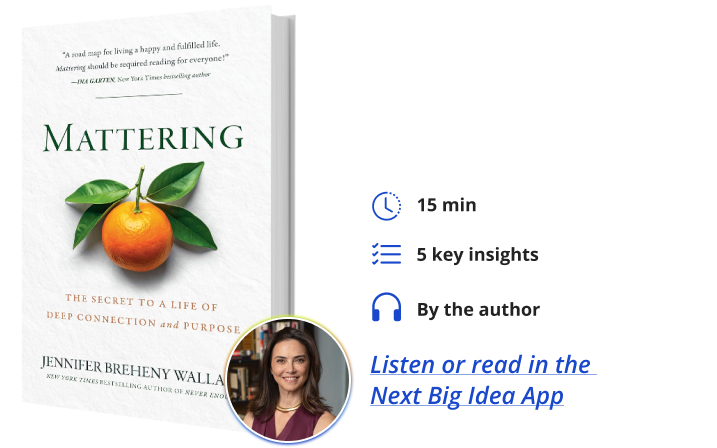
Below, Jennifer Breheny Wallace shares five key insights from her new book, Mattering: The Secret to a Life of Deep Connection and Purpose.
Jennifer is a journalist who began her career at CBS’s 60 Minutes and is now a contributor to The Wall Street Journal and The Washington Post. Her New York Times bestselling book Never Enough was named an Amazon Best Book of the Year.
What’s the big idea?
People don’t just want to belong—they want to know they matter. Feeling valued and needed is a basic human need, and it’s something we can create, lose, and rebuild through small, everyday choices in our relationships, work, and communities.

1. Mattering is a critical human need that is going unmet in our modern world.
You’ve likely never heard about the framework of mattering, but you’ve surely felt it. Mattering can be found in life’s big moments, like being celebrated by family and friends during a milestone birthday. It can be found in everyday moments, like when you’re sick and a friend brings you a pot of homemade soup. That feeling that hits you when you open the door is mattering—you feel deeply valued by your friend.
Simply put, mattering is the universal need to feel valued and have a chance to add value to the world. First identified by sociologist Morris Rosenberg in the 1980s, today, mattering is emerging as one of the most essential—and most overlooked—pillars of wellbeing.
At its core, mattering is the story we tell ourselves about our place in the world, as in: Am I valued? Do I make a difference? Would I be missed if I weren’t here? This need is deeply ingrained. For our earliest ancestors, being valued by the group meant safety and survival, while being ignored or cast out was a death sentence. That ancient wiring continues to guide us today.
“When people feel like they matter, they are more resilient, engaged, and generous toward others.”
Mattering cuts both ways, meaning it’s protective when we feel it and destructive when we don’t. When people feel like they matter, they are more resilient, engaged, and generous toward others. When they don’t, they suffer. We often talk about loneliness, burnout, and disengagement as separate crises, but beneath them lies a deeper one: the erosion of mattering. This is why mattering feels so urgent right now. In a rapidly shifting world, where artificial intelligence threatens to upend our sense of usefulness, feeling valued and knowing how you add value is a stabilizing force. Mattering is how we build a life of meaning and purpose.
2. Mattering is highly actionable, offering both a diagnosis and a cure.
Psychologists describe mattering as a meta-need, an umbrella that encompasses many of our needs, such as belonging, recognition, connection, appreciation, and purpose. But mattering goes deeper than any of these alone—and this distinction matters. For example, you can belong to a group, like a neighborhood or the accounting department, and still feel like you don’t matter to the people in that group.
What makes mattering especially compelling is that it offers both a diagnosis and a solution. After decades of research, four elements consistently show up in the lives of people who feel they matter. Together, they form what I call the SAID framework:
- Significance – the sense of being for who you are as an individual.
- Appreciation – affirms the doer, not just the deed, recognizing the care, effort, and intention that went behind a contribution.
- Investment – reflects the support others offer through guidance and belief in our potential.
- Dependence – the dignity of being needed in ways that feel manageable and energizing.
These elements can be strengthened through everyday actions. For example, a parent builds a sense of significance by asking their teenager to teach them about something their teen cares about. A manager shows appreciation by closing the loop and connecting an employee to the impact of their work. A friend shows investment by checking in with encouragement before a hard moment. A neighbor fosters dependence by asking someone newly retired to take on a small but meaningful role. A sense of mattering is built in small, everyday moments like these.
3. To matter, we must feel valued, but we also need to add value.
In my interviews, I found a simple formula for adding value: notice a genuine need in the world, or your community, workplace, or neighborhood, and use your 3Ts—time, talent, or treasure—to meet it.
Needs reveal themselves when we pay attention to moments of friction, overwhelm, or loneliness, and ask: How can I help make this easier for someone? Once the need is clear, the 3Ts offer multiple ways in.
Time might mean reading to kids at the library every Saturday or committing to a standing phone call with an elderly relative. Talent could be a former accountant offering free tax help or a great listener who becomes the person others confide in. Treasures can include weekly donations of spare groceries or a spare bedroom to host a guest. Mattering is the match between a real need and what you can give to meet it.
4. Mattering at the workplace is the hidden fix for America’s parenting and civic crises.
Workplaces are our most underutilized tool for restoring a sense of mattering. The numbers tell the story. In 2024, U.S. employee engagement fell to its lowest in a decade, with 70 percent of workers reporting they weren’t engaged in their work. Two-thirds of employees worldwide report either “struggling” or “suffering,” with only one in three considered truly thriving, according to Gallup. Workers no longer feel valued, and their contributions are too often unrecognized.
“When organizations invest in a culture of mattering in which people feel valued and relied upon, performance and retention increase.”
Mattering at work isn’t just good for employee wellbeing—it’s good for business, too. According to “Great Place to Work,” companies voted by their employees as the “100 Best to Work For” have outperformed the S&P 500 for nearly three decades, especially during economic downturns. Simply put, when organizations invest in a culture of mattering in which people feel valued and relied upon, performance and retention increase.
What happens at work doesn’t stay at work. Researchers refer to the long arm of the job—the ways work life affects our health, relationships, parenting, and even civic life. The Spillover-Crossover Model confirms what many of us have felt: when we’re depleted by our jobs, it’s difficult to be emotionally present at home, creating a psychological distance that can erode our relationships. But the reverse is also true. A caregiver who feels appreciated and valued at work is far more likely to come home and have the bandwidth to approach a child’s emotional needs with patience and empathy.
Mattering at work also impacts civic engagement. A person who feels empowered to shape outcomes at work is more likely to have the confidence to organize a blood bank during a local crisis. An employee who feels like their voice matters is more likely to speak up at a city council meeting. If we want strong families, thriving kids, and a healthier civic culture, workplace mattering is one of the most powerful levers we can pull.
5. Life transitions can shake our sense of mattering, but we have the agency to rebuild it.
Transitions—becoming a parent, sending a child to college, retiring, losing a loved one, changing careers, or relocating—can shake our sense of mattering to its core. But we have an opportunity, even a responsibility, to make ourselves matter again.
What I have found in interviews with people who have faced challenges like these is that rebuilding often occurs by accepting support (rather than going it alone), finding a new, meaningful way to be relied upon, and staying close to people who see our strengths clearly when we can’t see them ourselves.
“Extending or accepting an invitation becomes a mutual exchange of mattering.”
Many people I interviewed who navigated these transitions well had identified role models—those who have faced similar challenges and found their way through it. Then, they harnessed the power of invitation, either by accepting or by issuing them themselves. An invitation isn’t just about you. When someone reaches out, they’re taking a small risk in their bid for connection. By saying yes, you’re signaling that you value them, too. In this way, extending or accepting an invitation becomes a mutual exchange of mattering.
A young man who recently relocated for work once asked me for a mantra to help him through times when he felt invisible. Instead of a mantra, I offered him a practice: turn your self-focus lens outward by reminding someone else in your life why they matter. What he found was that the fastest way to feel like you matter again is to remind someone else why they do.
Enjoy our full library of Book Bites—read by the authors!—in the Next Big Idea App: