







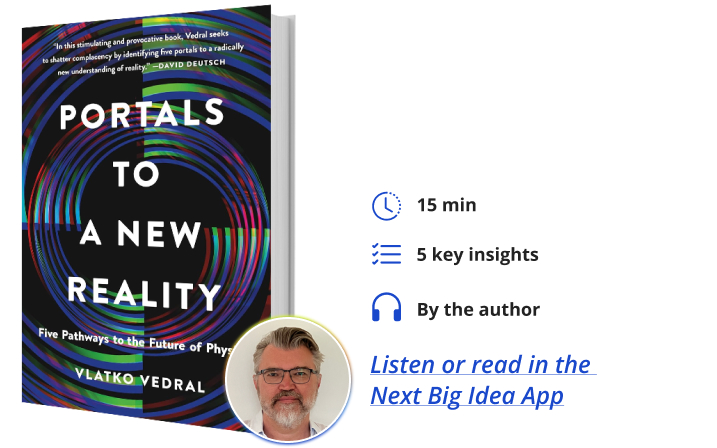
Below, Vlatko Veral shares five key insights from his new book, Portals to a New Reality: Five Pathways to the Future of Physics.
Vlatko is a quantum physicist and a Professor of Quantum Information Science at the University of Oxford. He is known for both his theoretical work and experimental collaborations on quantum information and entanglement. He is also the author of Decoding Reality and several textbooks about quantum physics and general relativity.
What’s the big idea?
What does quantum mechanics mean, and how does it affect everything and everyone around us? We are overdue for a physics breakthrough, and we live in an exciting time of anticipation for a revolutionary new understanding of physical reality.

1. Physics is on the verge of a new revolution.
I keep hearing that physics is becoming boring and that we haven’t had a new fundamental theory in one hundred years. The last two upheavals were Einstein’s relativity, special and general (completed in 1915), and quantum mechanics (discovered in 1925). The moment has now come for a new physics breakthrough.
The lack of the appropriate experimental equipment has been holding us back, but even more so, a plethora of wrong interpretations of quantum mechanics and general relativity. I present an interpretation that will lead us to ask the right experimental questions and open the portals to a new physical reality.
2. It’s all about quantum information.
Classical information is made up of bits (binary digits), but in quantum information, we can have both bit values (1 and 0) at the same time. A quantum bit can be zero and one simultaneously. Quantum physics can account for all phenomena known so far, both in the micro domain (the world of atoms, photons, and subatomic particles) and the macro domain (the world of tables, chairs, and computers).
Ultimately, it’s all about quantum waves and how information arises through their mutual interactions. This leads to quantum entanglement, the famous effect by which quantum objects can become supercorrelated. Contrary to popular belief, with entanglement, there is no longer any need for special observers for collapses of the quantum wavefunction, and there is no need for quantum jumps.
“A quantum bit can be zero and one simultaneously.”
In fact, my thesis is that we encounter problems in our understanding of reality only when we postulate that some parts of the universe run on classical information, instead of all being quantum. The Copenhagen interpretation, the de Broglie-Bohm interpretation, and the Quantum Bayesian interpretation all suffer from this bipolar, half-quantum, half-classical view of reality. Even the Many Worlds view does not go far enough and still contains remnants of classical logic. Only quantum information will lead us to the portals that can lead us to a new physical theory.
3. Gravity is quantum.
Quantizing gravity is the biggest open problem in physics. Several years ago, Chiara Marletto of Oxford and I proposed an experiment, which was independently proposed by Sougato Bose of University College London as well. We are no more than five years away from being able to perform this experiment, and when performed, it could prove Einstein wrong.
It’s a variant of the famous Schrödinger’s cat experiment, where an atom that is in the superposition of decayed and not-decayed interacts with a cat that therefore dies and doesn’t die. Testing gravity, fortunately, does not involve anyone dying. It involves two massive objects being in two different places, each, and gravitationally attracting each other.
There is now an ongoing race between at least six different experimental groups worldwide to implement what’s come to be known as the B-M-V proposal to test the quantum nature of gravity. Here we also encounter bizarre phenomena such as the notion of a single clock being in a superposition of two different times, younger and older at the same time!
4. Chemistry and biology are also quantum.
It’s not just the inanimate world that is subject to the logic of quantum physics, but so is the world of living beings. The founders of quantum mechanics, Heisenberg and Schrödinger, predicted a paradigm shift in biology when living systems would be studied using quantum physics tools. Many exciting questions can be raised in this domain, which we are now able to investigate in detail both theoretically and experimentally.
I designed experiments to entangle a living tardigrade to a superconducting quantum bit. This is one step closer to Schrödinger’s vision of putting a living system in the state of being “dead and alive.” It also shows that living systems do not “collapse” quantum effects but are perfectly in tune with them.
“We can probe whether quantum entanglement is present in biological energy and information flow.”
There are many more questions we can now address. We can probe whether quantum entanglement is present in biological energy and information flow, such as in photosynthesis and magnetoreception. It would be fascinating if nature evolved small-scale quantum computations well before we humans thought about it.
Another question: Can living systems be simulated with non-living matter? And, are there fundamental physical laws of life? We will entertain ideas that life might owe its origins to quantum mechanics. Perhaps the most interesting question of all: Is life inevitable or accidental?
5. The doors of perception could be quantum.
Admittedly, we don’t have a good model of conscious processes. Some people even say that the human brain is possibly the most complicated object in the universe. However, there is no reason to suppose that quantum computers could not be designed to become conscious.
Before we can even embark on this quest, we first need to understand how consciousness works. But there is another goal that we might be able to address before we try to simulate conscious systems. Namely, could quantum mechanics itself solve the problem of why we find it difficult to understand quantum mechanics itself?
I speculate that our biological makeup might be limiting us and that we could technologically modify our own perception to make it more quantum than it currently might be. I was here inspired by Aldous Huxley, who suggested in his famous book, The Doors of Perception, that drugs could alter our consciousness in a way to see reality as it really is. I present an entirely different solution, involving quantum computation, of how this could be achieved much more potently than what Huxley could ever have imagined.
Enjoy our full library of Book Bites—read by the authors!—in the Next Big Idea App: