















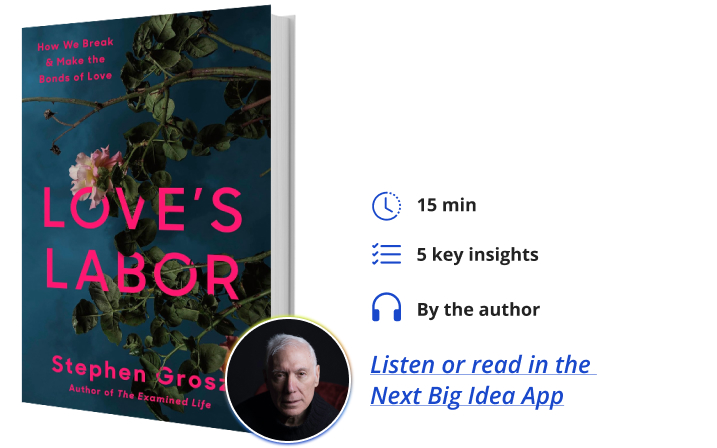
Below, Stephen Grosz shares five key insights from his new book, Love’s Labor: How We Break and Make the Bonds of Love.
Stephen is a psychoanalyst. His first book, The Examined Life, became an international bestseller.
What’s the big idea?
Love is not a flawless or permanent refuge but a demanding process that requires confronting confusion, pain, and loss. This fragility and impermanence give love its power.

1. Go to where the silence is.
There are two quotations I keep in the front of my writer’s notebook. The first is by Kurt Vonnegut: “Find a subject you care about and which you in your heart feel others should care about.” The other is from investigative journalist Amy Goodman: “Go to where the silence is and say something.”
In writing Love’s Labor, I want to say something about love—not love as an abstraction, but love as we live it: in its difficulty, fragility, and joy. We’re surrounded by talk about love, but so much of it traffics in clichés. The real work of loving—the confusion and pain and self-deception, the moments when we must choose between what we want and what we need—there’s a silence around these things.
That’s where I wanted to go.
2. We begin loving from a place of confusion.
Forty years ago—some seventy thousand patient hours ago—when I was thirty years old, I was immature. I was impulsive and quick to fall in love, often confusing intensity with intimacy. I thought I was clear-eyed, but I saw love through the limited and limiting storylines of popular culture. I talked to my friends as if love were a position best filled by a committee. I believed that if I could just find the “right” person, happiness would automatically follow.
There was so much I didn’t understand. I didn’t understand that each of us is responsible for our own happiness. That if I didn’t treat myself with consideration and care, chances are others wouldn’t treat me that way either.
“I didn’t understand that each of us is responsible for our own happiness.”
Most of us begin this way, with distorted ideas about love absorbed from culture, from our families, and from our own anxieties about being alone. The work of love begins with recognizing these distortions in ourselves.
3. Pain is your compass.
Here’s something I wish I’d understood at thirty: I didn’t understand pain. I thought the many kinds of pain we suffer when we love another person—longing, anxiety, grief—were feelings to avoid, symptoms to be removed. I didn’t understand that pain is the finest instrument we possess for knowing what we desire.
Think about that. We spend so much energy trying to avoid emotional pain, to medicate it away, to distract ourselves from it. But pain is information. Longing tells you what you’re missing. Anxiety points to what you fear losing. Grief measures what you loved.
One of my patients once said to me, “I thought if I didn’t feel it, it wouldn’t be real.” She was talking about her grief over her mother’s death. But by refusing to feel the pain, she was refusing to know how much her mother had mattered.
We deceive ourselves about love—the who, what, and why. But we also have the power to undo self-deception. And often, that power comes through attending to our pain rather than fleeing from it.
4. Loss is a necessary part of love.
We think of falling in love as gaining something—companionship, intimacy, joy. But love also requires loss. And not just the losses we fear—death, abandonment, betrayal—but necessary losses. Losses we must actively choose.
Let me tell you about Sophie, who taught me this.
Sophie arrived at my door in crisis, unable to post her own wedding invitations. She was an only child, her parents’ dream. To marry Nick, she realized, she would have to let go of her parents—not literally, but psychologically. She would have to stop making them the center of her emotional world. Posting those invitations meant choosing Nick, and choosing Nick meant her first loss. The question quickly became not “Is Nick the right person?” but rather, “Can I tolerate the losses that marrying him entails?”
“To marry Nick, she realized, she would have to let go of her parents—not literally, but psychologically.”
We had that one session, and then she disappeared.
Twenty years later, she reappeared, wanting help to get a divorce. But as we talked, I learned Nick didn’t want a divorce. He wanted more—more closeness, more intimacy, more emotional connection. Sophie had been legally married all this time, but she’d never become psychologically married. She’d kept her defended distance, soothing herself with work, exercise, and by being perhaps over-involved with their children.
This isn’t unusual. I think of another patient whose husband drinks. He’s legally married to her but psychologically married to alcohol.
To stay married, Sophie would face a second loss. She would have to let go of that defended, distant self she’d maintained within marriage. She would have to allow Nick to matter, fully. She would have to become vulnerable.
Sophie’s story shows us that love requires us to let go of parts of ourselves—our old attachments, our protective distances. These losses aren’t failures of love. They’re a necessary part of it. Learning to accept these losses is part of love’s labor.
5. Love’s power comes from its perishability.
We’re told “Love conquers all” and that “Love is stronger than death.” It isn’t. And that’s the point.
We value love not because it’s stronger than death, but because it’s weaker. Its perishability gives it weight and urgency. If love were everlasting and guaranteed, it wouldn’t upend us the way it does.
“We value love not because it’s stronger than death, but because it’s weaker.”
So many of the cases in this book are about loss, and our fear of loss. The recognition that the people we love will die. That relationships end. That our children grow up and leave. That we ourselves change and must let go of who we were.
Love’s labor is the work we must do to see clearly—to see ourselves and our loved ones as we are, not as we wish we were. It is our attempt to join the world as it is. The writer and philosopher Iris Murdoch said, “Love is the extremely difficult realization that something other than oneself is real.”
She went on: “Love is the discovery of reality.”
Enjoy our full library of Book Bites—read by the authors!—in the Next Big Idea App: