















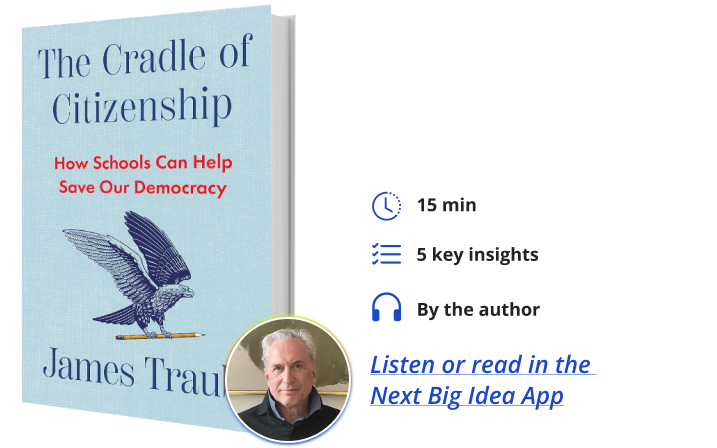
Below, James Traub shares five key insights from his new book, The Cradle of Citizenship: How Schools Can Help Save Our Democracy.
James is a journalist and teacher. He has written extensively for America’s leading publications, including The New Yorker and the New York Times Magazine, and teaches classes on American foreign policy and the history of liberalism at NYU Abu Dhabi and NYU.
What’s the big idea?
American history isn’t failing students because it’s unimportant, but because curricula across the nation have been stripped of depth, courage, and meaning. When taught seriously, creatively, and without fear, it can still form thoughtful democratic citizens.

1. Students don’t learn American history because we don’t know how to teach it.
I spent a year visiting public schools all over the country. I wanted to understand what schools were doing to prepare students to be democratic citizens. How were they teaching history and government? What kind of values was the culture of our schools transmitting? How much were schools subject to the increasingly polarized struggle over the American past and present?
One of my first trips took me to a big high school in the suburbs outside of Chicago—a well-run school in a blue state where almost everyone graduated and went to college. In the very first class I sat in on, an eleventh-grade class that combined American history and literature, I was struck by how much trouble the kids were having with the language of the Declaration of Independence. Few of them said they had encountered the document before, though their teachers assured me that they had. On a visit to the same classroom a few months later, I wandered around asking the students to tell me about Reconstruction, which they had just been studying. None of them could.
I had this experience again and again: the students didn’t seem to have either the stock of knowledge or the reading fluency they needed to have a thoughtful discussion about our history and government. Their teacher, Miss Crawford, said to me, “History has been pushed to the side because there’s too much reading and writing. That creates stress, and it makes the kids feel bad about themselves, and then the parents get upset and the school hears about it.” It was, she said, almost unthinkable to assign a whole book to kids whose attention span had been radically shortened by social media. The school administration was skeptical about the value of learning facts and even chronology. So were state educators. Illinois’ high school history standards take up only a quarter of a page; students are expected to gain general skills but no particular articles of knowledge.
The school I visited did a wonderful job of catering to the students by offering dozens of clubs and myriad electives and filling class time with interesting videos, but it was failing at the essential business of preparing them to be democratic citizens.
2. American history has become scorched earth.
Although our national story has always been contested, the high school textbooks of my remote day, half a century ago, offered a more or less consensual account acknowledging our grave flaws—above all, slavery and racism—but also stressing our national capacity for addressing our failures, as we did through civil rights legislation. That era is gone, and our history curricula are as polarized as we are.
The 1619 Project (a set of articles in the New York Times, later turned into a book, a documentary, a children’s book, and a source of school lesson plans) sought to demolish the hopeful narrative of my youth. “This nation,” the lead essay argued, “was founded not as a democracy but a slavocracy.” The ideals for which, first the Revolution and then the Civil War, were supposedly fought in the name of were mere hypocrisy. The great through-line of the American narrative is racism. Civic education, in the 1619 sense, means seeing through the lies that America tells itself.
“That era is gone, and our history curricula are as polarized as we are.”
This account enraged conservatives, and in 2020, Donald Trump ordered a counter-narrative from Hillsdale College, a conservative Christian school, that was, inevitably, titled The 1776 Report. That document, which became the source of a curriculum of its own, minimized the role of slavery, described the progressives of the 1920s as totalitarians, and called for a new form of patriotism based on religion and family. The Trump Administration plans to use the 250th anniversary of our founding to reinforce this one-sided narrative. The Hillsdale version of civic education is learning to revere America’s past and deplore much of the present.
Both the 1619 and the 1776 accounts rewrite the past in the name of arguments about the present. Both are polemical, but only the conservative one now has the force of the White House behind it. We have not heard the last of The 1776 Report.
3. History teachers are scared to teach.
Many red states have enacted laws prohibiting the teaching of “divisive concepts,” which all have to do with race and gender. Many have passed “Parents Bill of Rights” that ensure that parents can both see and object to anything their children learn. And school libraries have become minefields where activist groups seek to remove or limit access to books of which they don’t approve.
Florida, under Governor Ron DeSantis, has been in the vanguard of this movement. I spent several days at the state’s annual convention for Social Studies teachers and learned some very odd things there. One teacher told me that restrictions on assigning any text not listed in the curriculum meant that if a topic came up that wasn’t covered in the text, she had to tell kids, “You have to find it on your own.” If they asked why, she said, “Those are the people your parents voted for.”
There was a prohibition on the use of nicknames to prevent potentially transgender students from asking teachers to call them by a preferred name. So, you couldn’t call Robert “Bobby” without express permission from a parent. I learned from a panel discussion on state mandates that teachers had to set aside time for “Victims of Communism Day” and “Portraits of Patriotism.” Another panel focused on “the ways we can tweak our lessons to protect ourselves.” Seasoned teachers told me that they knew how to navigate among the shoals, but the single best way to protect yourself was by avoiding anything controversial. Grasp no nettles; keep it vague; default to bland. In short, teach badly.
4. Good things are happening.
Civic education is a blooming field. Many nonprofit instructional providers offer terrific lessons on topics in American history and government. Many states are tightening their civics requirements and their course standards. Many schools are assigning thought-provoking projects.
“Civic education is a blooming field.”
The single most thrilling thing I saw during my year in schools was the Hamilton Education Project, a program that allows high school students to attend a matinee of the rap musical Hamilton. To qualify, the students must prepare a performance of their own based on study of the period. The material on the founders is furnished by the Gilder Lehrmann Foundation, which promotes civic learning.
I spent time in a participating school in Queens, where most of the kids were immigrants, and they came from everywhere. Yet they didn’t seem to regard the American Founding as something hopelessly remote from themselves. A Muslim girl in a headscarf and two non-Muslim friends performed a very polite rap poem on the Whiskey Rebellion. Two Dominican kids played Hamilton and his wife, Eliza, on the eve of the Constitutional Convention. Several of the kids told me later that they had spent time reading the Founders’ correspondence.
And then, a month later, the kids sat in the front row of the Richard Rodgers Theater to watch a performance of Hamilton, their faces shining with joy. Some of them sang along under their breath. They shouted when the foppish Jefferson pranced across the stage and recoiled with horror when Hamilton’s son James was killed. Many had never been to Broadway before. Hamilton showed them that you can make something enthralling out of the materials of history. It showed them that high culture can speak in an idiom they know and enjoy, and that a complicated story about complicated people can be delightful. And because the students had made something themselves, they came away with a far more personal connection to the story than most other playgoers did.
5. There is a better way.
I spent a lot of time at what are known as “classical” schools, in part because I found them so encouraging. These are public charter schools, mostly in conservative states, that eschew the conventional belief in learning general skills in favor of a deep immersion in history, language, and above all, books, very much including the classical texts of the ancient world and of the West. Classical schools believe that a rigorous course of study helps lead young people to an appreciation of timeless goods—of truth, goodness, and beauty. That is what civic education means to classical teachers. They believe that a student trained this way will love learning for the sake of learning and not just as a means to get good grades or admission to a fancy college. I’m sure some of the 300-odd classical schools in the U.S. do this badly, and I would guess that some of them feel overtly conservative and even sectarian, but the schools I went to were strictly secular and not at all doctrinaire, and viewed the child more as a garden to be cultivated than a vessel to be filled.
“Classical schools believe that a rigorous course of study helps lead young people to an appreciation of timeless goods—of truth, goodness, and beauty.”
I sat in on a sixth-grade English class at the Founders Classical Academy in Lewisville, a middle-class suburb of Dallas. Mr. Bishop asked the students to stand and recite the poem they’d memorized: the great Shakespearean sonnet that begins “Since brass, nor stone, nor earth. . .” Mr. Bishop had helped them work their way through this difficult text. Then a girl volunteered to talk about the chapter of The Count of Monte Cristo that the class was reading. She talked about the theme of “false identity.” The other kids asked questions. One said, “What’s a benefactor?” No one knew, so Mr. Bishop explained; by the way, he said, in Dante’s Inferno the lowest circle of Hell is reserved for those who betray their benefactors. They talked about stories from Greek mythology, and everyone knew the one about Diana turning Actaeon into a stag.
Of course, this was an English class. What did it have to do with civics? Everything, I thought. Over time, I had concluded that the best answer to our civic ignorance was not more classes in civics, or even in history, but a better and deeper way of training the minds of young people so that they became thoughtful, rational, fair-minded adults. Mr. Bishop’s class made me feel that this was not a hopeless proposition.
Enjoy our full library of Book Bites—read by the authors!—in the Next Big Idea App: