
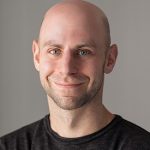











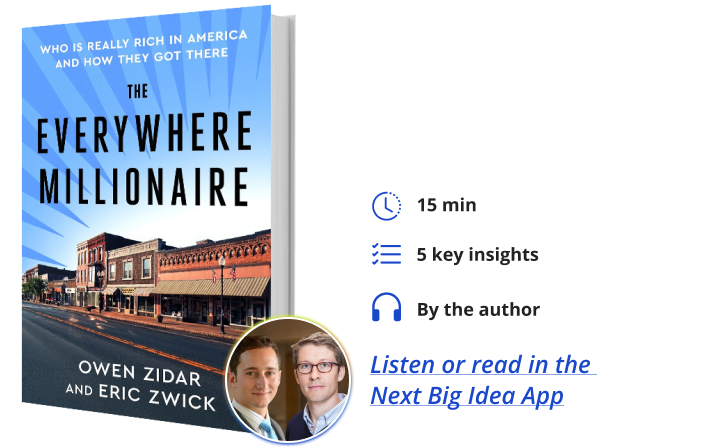
Below, Owen Zidar and Eric Zwick share five key insights from their new book, The Everywhere Millionaire: Who Is Really Rich in America and How They Got There.
Owen is a professor of economics and public affairs at Princeton University. Eric is a professor of finance and economics at the University of Chicago Booth School of Business. Together, they spent more than a decade analyzing anonymized tax data to map the true shape of American wealth.
What’s the Big Idea?
The richest Americans aren’t all tech founders, celebrities, or Wall Street titans. Millions have quietly built enormous fortunes by owning ordinary private businesses, from car dealerships to garage-door companies. These “Everywhere Millionaires” reveal a hidden engine of American wealth and upward mobility.
Listen to the audio version of this Book Bite—read by Owen—in the Next Big Idea App, or buy the book.

1. Actually, they’re car dealers.
In November 2023, Bob and Paula Brockway of Coral Gables, Florida, hosted what was dubbed “the wedding of the century” for their daughter Madelaine. Guests were flown in by private jet. There was a rehearsal dinner at the Paris Opera House, fireworks at the Eiffel Tower, and a dinner at the Palace of Versailles served by dozens of waiters in period costume. Adam Levine of Maroon 5 gave a private concert. The bill: $60 million.
You might think the Brockways had to be titans of technology or Wall Street to be able to afford such a lavish event. But actually, they were car dealers from Florida.
The way we typically think about rich people in America—Jamie Dimon, Taylor Swift, the Rockefellers, Elon Musk—represents a small slice of who’s actually wealthy. Roughly three million Americans, whom we call Everywhere Millionaires, have built substantial fortunes averaging around $25 million apiece by owning private businesses. Collectively, they hold more than 13 times the wealth of the Forbes 400. For every public company CEO you hear about, there are 1,000 business owners worth at least $25 million operating in near-total obscurity.
And they don’t just live on the coasts. They live in places like Dothan, Alabama, and Fort Wayne, Indiana. You probably know one, even if you don’t realize it. They’re coaching your kid’s soccer team, sitting next to you at a fundraiser, or they’re your dentist.
2. Private business is the dark matter of American wealth.
One reason it took us so long to understand how many Everywhere Millionaires exist is that rich people don’t answer surveys. Our view of American wealth has long been shaped by what gets reported in the news, what public company executives earn, and what celebrities make. That’s a profoundly distorted lens.
We worked with researchers at the U.S. Treasury to conduct a systematic assessment of everyone in America based on anonymized tax returns. We discovered a quiet revolution that has unfolded since the 1980s, when Ronald Reagan cut tax rates for individuals and raised them for traditional companies. Those tax changes set off an explosion of what are called pass-through businesses.
“We discovered a quiet revolution that has unfolded since the 1980s.”
Pass-throughs—S corporations and partnerships whose profits and losses flow directly to their owners—now account for 95 percent of all businesses in America. They also account for the majority of the rise of the top one percent since the 1980s. Because you can follow a paper trail from these businesses to their individual owners, they’re uniquely traceable in the tax data. That traceability is what let us map a world that was previously invisible.
The conversation about wealth in America has been missing the forest of entrepreneurs for a few redwoods in Silicon Valley.
3. Non-sexy is sexy.
A lot of these businesses are somewhat boring, and that’s the point. You can be wildly successful doing ordinary things. You don’t have to be a genius, you don’t have to have gone to a fancy school, and you don’t have to live on the coast.
These are businesses like getting gutters properly manufactured, building garage doors, running an auto dealership, or distributing beverages. You can think of these as Main Street businesses.
4. The American Dream runs through Main Street.
Prosperity is more widely available than many people believe, and entrepreneurship is one of the most reliable engines of it.
Dick Portillo grew up in a housing project in Chicago, never went to college, and had never cooked a hot dog before he started selling them. But that’s how he became a billionaire. His story is striking, but it isn’t exceptional. When we track the backgrounds of Everywhere Millionaires systematically, we find a genuine picture of upward mobility that deserves to be far more salient in how Americans think about economic opportunity.
“His story is striking, but it isn’t exceptional.”
For all the emphasis on attending elite colleges, not that many people actually go to them. If you take all the kids who grew up in the bottom 20 percent of the income distribution and made it to the top 20 percent, about 10 percent of them did it by owning a business—while only 1.3 percent did it by going to an elite college.
5. The Stealthy Wealthy write the rules.
Everywhere Millionaires are not just economically influential—they are politically influential in ways that most people don’t fully appreciate.
Business owners hold congressional seats at roughly 10 times their share of the population. They are also heavily represented in state and local government. And because they are less visible than tech billionaires or Wall Street executives, their policy influence tends to fly under the radar.
This matters enormously for understanding how the tax code and regulatory environment have evolved. There are substantial tax and regulatory benefits that flow to private business owners—benefits that are rarely the subject of public debate, in part because most people don’t realize how large and consequential this group is. Understanding who the Everywhere Millionaires are, and what they want from government, is essential to understanding how American economic policy actually gets made.
Enjoy our full library of Book Bites—read by the authors!—in the Next Big Idea App: