














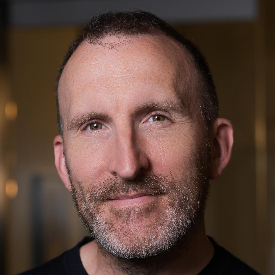
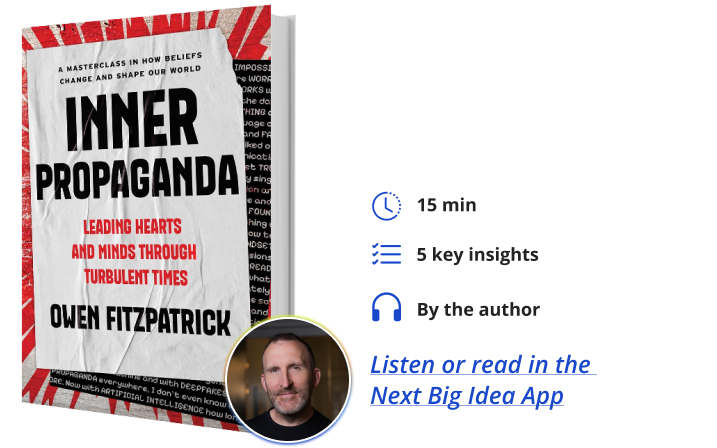
Below, Owen Fitzpatrick shares five key insights from his new book, Inner Propaganda: Leading Hearts and Minds Through Turbulent Times.
Owen is a social psychologist, behavioral change expert, and international speaker who has spent three decades studying how beliefs are formed, challenged, and transformed. He has traveled to more than 100 countries—including North Korea, Afghanistan, Rwanda, and Iran—researching the mechanics of persuasion and propaganda, and works with leaders and organizations around the world to help them understand and harness the power of belief.
What’s the Big Idea?
Your beliefs don’t come from objective reality—they’re stories your mind constructs, feels into, and then defends as truth. Once you understand how that internal “propaganda system” works, you can question it, reshape it, and more effectively influence both yourself and others.
Listen to the audio version of this Book Bite—read by Owen himself—in the Next Big Idea App, or buy the book.

1. You are your own greatest propagandist.
When I was 14, I sat on my bed in Dublin and wrote a suicide note to my parents. I’d been bullied for years, and the story in my head had become unbearable: I was a reject, I was alone, and the pain would never stop.
But as I wrote, something strange happened. I had just written an apology—“I’m so sorry. I love you both so much.”—when I found myself writing a question: Is this how much you love them? That single question cracked open the story my mind had been telling me and started a war between two voices: one insisting I should die, and one fighting for me to live. Eventually, the voice for life won. I spent the next 30 years trying to understand why.
My brain wasn’t on my side that night. It was running a relentless internal campaign, selecting what I noticed, deciding what things meant, and feeding me a story I completely believed. When you’re depressed, you don’t think negatively; you believe negatively. We all have that inner voice to some extent. I call it your Inner Dictator, and it has its own Inner News Corporation, broadcasting reality to you 24 hours a day.
The danger is that we never question it, because we assume our own thoughts are telling us the truth. They aren’t. Whatever you’re thinking and feeling isn’t a report on reality. It’s a story your mind has already decided to believe. The first move is seeing that there’s a story at all.
2. Your brain is the ultimate double agent.
Let me tell you about the greatest spy of the Second World War. His name was Juan Pujol García, codenamed Garbo. He worked for the Nazis and became so successful that he even won the Iron Cross. He had a network of 27 sub-agents across Britain reporting to him. At a certain point, Germany stopped sending additional spies to the UK because Pujol had already provided so much intel.
In truth, Pujol was a Spanish civilian who hated the Nazis. The entire network was invented. The agents didn’t exist. He fabricated reports from his apartment using newspapers, tourist guides, and his imagination—pretending to send dispatches from Britain while sitting in a hotel room in Portugal. On D-Day, his misinformation helped convince Hitler that the real invasion was still coming at Pas-de-Calais. As a result, the Germans held divisions back from Normandy.
“The most effective deception isn’t the one you resist—it’s the one you trust completely.”
Pujol didn’t win with force. He won with belief. He gave the Germans a story that felt right and fit what they already expected, and they defended it as the truth.
Your brain does exactly this to you. It’s the ultimate double agent: appearing to work for you while quietly feeding you a version of reality that serves an agenda you never consciously approved. The most effective deception isn’t the one you resist—it’s the one you trust completely. It’s like a report that fits what you already expected, delivered by the one source you’d never think to question. The version of reality most worth interrogating isn’t the one that feels suspicious, but the one that feels most obviously, comfortably true.
3. We feel our way into beliefs, then justify them.
We like to think we’re rational. We believe we look at the evidence, weigh it, and arrive at a conclusion. But that’s not how belief works.
After many years of research, I found that every belief that takes hold—whether it happens naturally or someone deliberately plants it—must fulfill three conditions, in this order:
- It has to feel right.
- It has to fit in with who we think we are and what our group believes.
- It must make sense, building the logical case for what we already feel.
Logic comes last, and yet it almost always takes credit for the belief.
This explains why facts alone almost never change a mind. Say you are a leader trying to convince your team to incorporate more AI into their roles. A slide full of data won’t do it. The facts might be spot-on, but around the table, someone is thinking, This is a threat to my job. Another: This makes me look wrong. Another: I’ll lose control. Each of them is feeling their way to a conclusion long before your chart appears on screen.
Being right is not enough. If you want to change a belief, then you have to start where belief actually starts: with how it feels. Make it feel right and people will be more likely to accept it.
4. There are five types of truth.
In leadership and persuasion, there are five types of truth:
- Objective truth: what’s actually, verifiably the case.
- Emotional truth: what they feel is true.
- Desired truth: what they want to be true.
- Shared truth: what their group says is true.
- Past truth: what they remember as true.
You might disagree and say, “No, there’s only objective truth. The rest is bias, groupthink, and wishful thinking.” But people don’t experience it that way. They experience all five as true.
If you don’t acknowledge what feels true to someone, you will never change their mind. They won’t feel understood, and so you will lose your chance to influence them.
This is why polarization is so entrenched. We’re not in one shared reality, calmly disagreeing. We’re standing in different reality tunnels, each convinced we’re the only ones who’ve stepped outside the cave. Naming the kind of truth at play is the first step toward bridging the gap.
5. Become a Belief Leader.
Becoming a Belief Leader happens in three steps:
- Lead your own heart. Take charge of the daily stories that make you feel anxious or cause you to doubt yourself.
- Lead your own mind. Make sharper decisions by catching your own biases and assumptions.
- Lead the hearts and minds of others.
You cannot influence others well until you understand how you influence yourself. A tool you can use is called the Belief Audit—four questions for any belief that’s running you:
- What is the belief?
- What are you actually trying to achieve by believing it?
- Is it genuinely helping you?
- What belief might serve you better?
These four questions can help you become the director of your own inner propaganda, and prove to yourself that you can change your beliefs. The story war in your mind never ends. But now, you get to choose which side wins.
Enjoy our full library of Book Bites—read by the authors!—in the Next Big Idea App: