









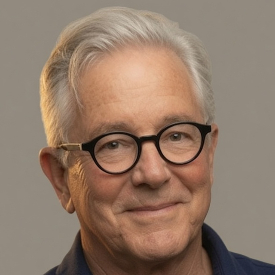
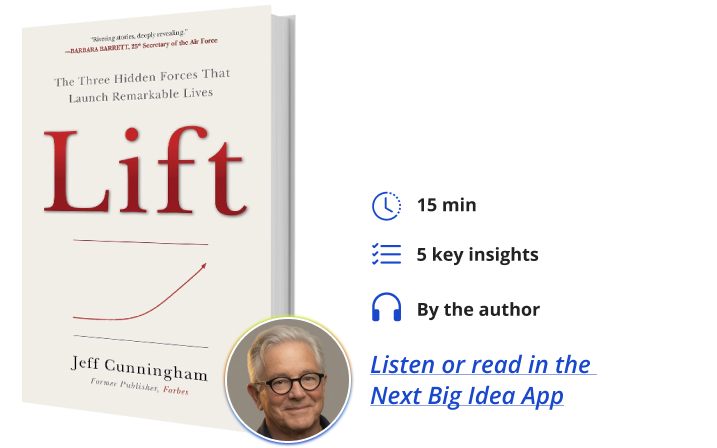
Below, Jeff Cunningham shares five key insights from his new book, Lift: The Three Hidden Forces That Launch Remarkable Lives.
Jeff is the former publisher of Forbes magazine and former CEO of Zip2, Elon Musk’s first company. He has served as chairman or board director of more than ten public companies and as a professor of leadership at Arizona State University’s Thunderbird and Cronkite Schools. He is also the host of Iconic Voices, an interview series featuring leaders such as Warren Buffett, Michael Phelps, and General David Petraeus.
What’s the Big Idea?
Greatness doesn’t happen inside people. It happens between them. No one climbs alone, and no one gets through life alone.
Listen to the audio version of this Book Bite—read by Jeff himself—in the Next Big Idea App, or buy the book.

1. Nobody is self-made, but you can choose the people who make you.
It started with an anomaly. Omaha, Nebraska, a city with no oceanfront, no mountains, and weather that makes you question your fashion choices every January, had about forty thousand millionaire households, double the rate of similar cities like Des Moines and Wichita. It wasn’t proximity to Buffett, and it wasn’t one hot industry. The money was spread across teachers, shop owners, and UPS drivers who were retiring richer than hedge fund managers.
I cold-called Buffett to find out why. On my trips to see him in Omaha over the next few years, I heard neighbors trading investment hunches over backyard fences, the way they traded bread recipes. A Pyrex dish of lasagna on the porch said more than any market prediction on CNBC. When I asked Buffett what made him so successful, he didn’t talk about stock picking. He talked about people-picking, his father’s ethics, and the seven early believers who backed him with their life savings when he had nothing to offer but a master’s degree from Columbia.
After that, I began a series of interviews with extraordinary achievers: presidents, generals, CEOs, Olympians, and a Nobel laureate. 14 out of 14, their voices broke the moment they started talking about the parent or teacher who helped build them.
The University of Chicago psychologist Benjamin Bloom found where that begins. In the 1980s he studied 120 world-class performers, from concert pianists and Olympic swimmers to research mathematicians. Very few had been spotted as prodigies. What they shared was what he called the initial spark, lit by someone else: a first teacher who made the work feel like play, or a family that kept the fire going. In every case, the talent came after the spark.
Think of your life as a room. People come and go all day, but you invite a few to pull up a chair beside you. Who sits in those chairs decides how high you rise. Most of us leave that to chance. The people who rise don’t.
2. Look for the person who sees your strength when the world sees your weakness.
The first of the three forces that launch remarkable lives is cultural. I call this the Law of the First: the person who sees what you could become before there is any evidence.
When Michael Phelps was in kindergarten, a teacher told his mother he would never be able to focus on anything. By nine, he had been diagnosed with ADHD. Most adults saw a problem to manage, not to solve. Then an unknown Baltimore swim coach named Bob Bowman watched the same restless kid and saw a swimmer who never seemed to tire and hated to lose. He told Phelps’s mother her son could swim in the Olympics by the time he was 15.
Bowman wasn’t gentle about it, either. He would sometimes pull Phelps’s goggles before a race so the boy would learn to swim when he couldn’t see. In Beijing in 2008, Phelps’s goggles filled with water in the 200-meter butterfly. He counted his strokes, touched the wall first, and set a world record.
“Nothing had changed except what their teachers believed about them.”
The psychologist Robert Rosenthal proved how powerful that kind of inspired belief can be. In 1965, he and a school principal named Lenore Jacobson told teachers at a California elementary school that a test had identified certain students as about to bloom. There was no such test. The names were chosen at random. By the end of the year, those children had gained more than their classmates. Nothing had changed except what their teachers believed about them.
Here’s the catch: you can’t be sure that someone will just turn up to lift you. Don’t wait to be discovered. Go where people can see you, keep showing up, and ask them: what do you see in me that is worth betting on?
3. Build a small circle that tells you the truth.
The second force is social: the Power of Tight Circles, a handful of people who stay after the arena is empty, and who will tell you what went wrong, even when you don’t want to hear it.
In March 2003, as the 101st Airborne Division drove toward Baghdad, its commander, Major General David Petraeus, turned to the journalist Rick Atkinson and asked a question that would come to define the war: “Tell me how this ends.”
There were indeed answers. A retired general from the reconstruction office had already offered one: “You just get us to Baghdad, Dave. We’ll take it from there.” But it wasn’t one Petraeus could follow. A year later, roadside bombs were killing American soldiers by the hundreds, proving that the Army was fighting the wrong kind of war.
So in 2005, Petraeus went to Fort Leavenworth, Kansas, where the Army runs its training schools. He saw it as the one place he could change the outcome of the war. “The most important decision we made,” he told me, “was saying, ‘We are going to do a new counterinsurgency field manual,’ which no one directed me to do.”
He didn’t recruit people who agreed with him. He brought in a Tight Circle: a military historian, a Harvard human rights scholar, journalists, and NGO aid workers. Rank was checked at the door: a captain with better evidence could hold the floor against a three-star general, and a human rights lawyer could argue with a Special Forces colonel. The manual they produced became the playbook for the 2007 surge. Within a year, violence in Iraq had fallen dramatically, and civilian deaths had dropped to a fraction of their peak.
The Berkeley psychologist Charlan Nemeth spent decades studying why the right circle produces the right answers. Groups that encourage a dissenter who holds a different view consistently think better than groups that agree early, even in those cases when the dissenter turns out to be wrong. In your circle, who tells you you’re wrong and still cheers for you afterward? If the answer isn’t clear, that’s the first chair in your Tight Circle you want to fill.
4. Learn the Rules of the Room before you decide whether to follow them.
The third force is situational, the Rules of the Room: the ability to read a room, understand what is happening in it, and anticipate what comes next, so you make the right call in the moment.
In 1957, a 19-year-old named Reatha Clark rode in the back of the bus, as her mother told her to, from Jim Crow Georgia to Pawling, New York. She grew up in a house with dirt floors. Her parents never finished the third grade, but they told her to get an education and be somebody. Those two words became her compass.
She was hired for the summer to look after a small boy, and her employer handed her a Saks Fifth Avenue charge card, encouraging her to “buy anything you see that you like.”
“Those two words became her compass.”
60 years later, Reatha’s voice still broke when she told me about it. “She trusted me,” she said. “You cannot imagine what that meant to me.” She never used the card. Being trusted was the gift. Spending the card would have spent the trust, and that isn’t what ‘be somebody’ meant. Reatha Clark King went on to earn a doctorate in chemistry, do research that helped NASA reach the moon, and sit on the boards of ExxonMobil and Wells Fargo. Her parents’ two words went with her into rooms that had never seen anyone like her.
Her mother knew that in 1957 Georgia, defiance on a bus could cost a Black teenager far more than a seat, and that her daughter would rise anyway. When the people who make the rules disagree with you, there are three choices: go along, try to change the room, or find another one.
The psychologist Mica Endsley, who studied how fighter pilots make split-second decisions, calls this situational awareness: perceiving what is happening around you, understanding what it means, and projecting what happens next. Her research on aviation accidents found that most errors weren’t bad decisions. They were bad readings of the situation. So learn each room’s rules, and know what you can change and what you have to accept until you can rewrite the rules.
5. Build a Lift life before you need one.
Modern life is quietly pulling apart the communities where Lift happens, and social media is accelerating it. In a single recent month, according to the Wall Street Journal, more than 138,000 new TikTok videos talked about cutting off parents, ten times as many as in 2020. We have traded the back fence for the algorithm, and the circle for the follower counts. But followers are not the people who catch you when you fall.
When a chair beside you sits empty, something always fills it: the loudest voice, the endless scroll, the meme that tells you only what you already believe.
The psychologist Solomon Asch showed what is at stake when we lose it. In the 1950s, he put people in a room where everyone else gave an obviously wrong answer. Three out of four went along at least once. But when just one other person gave the right answer, conformity fell by roughly 80 percent. And when that partner switched sides and joined the crowd, conformity climbed almost all the way back. One honest voice changes what you are willing to see. The worst kind of thinking is thinking by yourself. The second worst is thinking with an echo.
We didn’t always think like this. In 1647, a Puritan minister named William Bridge stood before a grieving congregation in Stepney, east of London, after a civil war that had killed nearly one Englishman in 25. He told them that when a river has no water but its own, the ships sit stranded on the sands. When the tide comes in from the sea, they are raised.
“We have traded the back fence for the algorithm, and the circle for the follower counts.”
Centuries later, it became a slogan: a rising tide lifts all boats. But at Stepney, the Thames swings twenty feet with the tide, enough to swallow a boatman who doesn’t see it coming. Bridge’s listeners knew the danger wasn’t the tide. It was a small boat alone on the river. The skippers who could read the water taught the ones who couldn’t, and the whole harbor came off the sands together. That is a Lift culture. It’s also where this book got its name.
Success does not relieve you of the troubles of being human. Like the people I interviewed, you can win a Nobel Prize, an Olympic gold medal, or a seat on a powerful board, and still face a marriage coming apart, a fatal diagnosis, an aging parent who has known you all your life but can no longer recognize your face, a child you cannot reach, or betrayal by someone you trusted.
That is when the forces of Lift matter most. Someone who believes in you when you lose faith in yourself. A trusted circle that tells you the truth and helps you find a way forward. And the wisdom to know what you can change, what you must endure, and when you need to leave.
Tonight, write down three things. The first is the person who influenced you most. It might be a parent, a teacher, or someone you know only from a book. The second is the few people you can call before making a hard decision. The third is the person who taught you how the world actually works. If any of those chairs are empty, start filling them.
Enjoy our full library of Book Bites—read by the authors!—in the Next Big Idea App: