















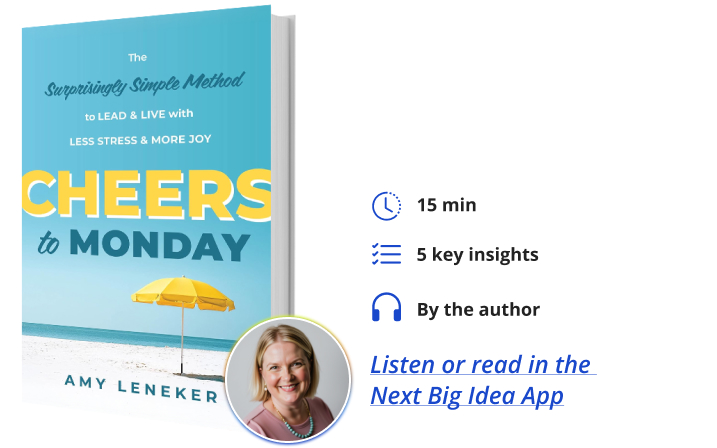
Below, Amy Leneker shares five key insights from her new book, Cheers to Monday: The Surprisingly Simple Method to Lead and Live with Less Stress and More Joy.
Amy is founder and CEO of the Center for Joyful Work. She has helped more than 100,000 leaders and teams, including those at Fortune 100 companies, lead with less stress and more joy. With more than 25 years of leadership experience, including a decade in the C-suite, she has studied leadership at Yale, neuroscience at the NeuroLeadership Institute, and stress resilience at Harvard Medical School. She leads the annual national workforce study, The State of Stress and Joy at Work, and hosts the Less Stress, More Joy with Amy Leneker podcast.
What’s the big idea?
Our jobs feel so overwhelming because stress is built into how work is designed. Once you learn to recognize and respond to different kinds of stress—and stop blaming yourself—you can feel better and perform better at the same time.
Listen to the audio version of this Book Bite—read by Amy herself—in the Next Big Idea App, or buy the book.

1. Work isn’t working.
If you’ve ever woken up on a Monday exhausted—or spent Sunday night bracing yourself for the week ahead—you are not the problem. The problem is work. And more specifically, the problem is how stress has been built into the structure of modern work.
Workforce stress is rising, engagement is falling, and well-being is declining. The global cost is estimated at $8.9 trillion annually. But beyond the economic impact is something more personal: we are paying with our physical, mental, and emotional health.
I burned out in a terrible, horrible, no good, very bad way. Twice. That experience led me to conduct a national workforce study and more than 150 interviews and focus groups with leaders and teams across industries. I discovered that stress is systematically undermining success, and joy is part of the solution.
Stress isn’t the price of success; it’s the thief that steals it. People are not broken. The way work is designed is broken. Yet many organizations still treat stress as a personal resilience problem instead of a work-design issue. No amount of time management training can compensate for a system that produces stress faster than people can recover.
2. Humans and organizations both have stress stories.
If we want to change our relationship with stress, we have to take a real, honest look at the role it plays in our work and lives. We all carry beliefs about stress—what it means, why it shows up, and how we are supposed to respond to it. Some of these stories were handed down by families or workplaces. Others we wrote ourselves.
“These stories operate quietly in the background, shaping our choices without our awareness.”
Many of them are outdated. They tell us that stress is weakness, pushing through is strength, and everyone else is handling it better. These stories operate quietly in the background, shaping our choices without our awareness.
Organizations carry stress stories, too. Cultural narratives determine what gets praised, what gets normalized, and what people feel safe saying out loud. If stress is treated as a badge of honor, people will hide their struggles. If it is treated as a signal, people can respond to it effectively. Changing our relationship with stress begins by examining the stories driving it.
3. Start using the Stress Ruler.
When you’re not sure where to begin with stress, start with the Stress Ruler. It’s a simple Likert scale based on one question: On a scale of 0 to 10, how challenging has your stress been? I modeled it after one used by the U.S. Department of Veterans Affairs because it gets three important things right that many other stress scales miss:
- It leaves the word challenging undefined because what’s challenging for one person may not be for another. Two people can experience the same organizational shake-up and have completely different internal responses. The scale makes room for that reality.
- It doesn’t impose a timeline. It doesn’t ask about the past week or month. Stress doesn’t arrive on a schedule, and it doesn’t always resolve on one either. By avoiding artificial time frames, the Stress Ruler captures what needs attention.
- It doesn’t separate work stress from life stress. It treats you as a whole human being. What’s happening at home affects your work, and what’s happening at work follows you home. The Stress Ruler honors that integration.
Its power is in its simplicity. What is often left invisible becomes visible. Once stress is visible, it can be addressed.
4. There are five kinds of work stress.
The majority of leaders and teams I work with make the mistake of believing that there is only one type of work stress. However, there are five primary sources of workplace stress:
- Schedule stress comes from too much to do and not enough time.
- Suspense stress builds while waiting for an uncertain decision, deadline, or difficult conversation.
- Social stress stems from tension and unresolved conflict in relationships.
- Sudden stress hits without warning in the form of urgent requests or last-minute changes.
- System stress is embedded in the structures, processes, and culture of the organization.
When we fail to distinguish between these sources, we treat symptoms instead of causes. Naming the type of stress changes the solution.
5. The Un-Stressing Method™ is a simple way to reduce stress and restore joy.
This is where my three-step Un-Stressing Method™ comes in. In my national workforce study, 96 percent of working Americans said using these three steps would help them manage work stress more effectively.
See stress differently. Grab a pen, some sticky notes, and write down your stressors (one per sticky note). Then, for each stressor, ask yourself two questions:
Is this important right now?
Do I have control?
Imagine a simple 2×2 matrix: important vs. not important, and within your control vs. outside your control. Place each stressor into the box where it belongs.
Sort stress into actionable categories. When you can name the kind of stress you’re experiencing, you can start taking meaningful action. Using the five types of work stress, write the number(s) of the type(s) of stress on each sticky note.
Solve stress without spinning. Now that you’ve identified and sorted your stressors, you can use the matrix to inform your next move: acknowledge the stressor and move on, accept it without fixing it, ask for help, or act on the next right thing.
After you’ve gone through the three steps, celebrate the shift! Because reducing stress isn’t just a wellness strategy, it’s a joy strategy. In my research, 79 percent of working Americans say joy is essential to doing their best work, yet more than half report feeling far less joy than they want. That gap affects productivity, engagement, and retention.
“Reducing stress isn’t just a wellness strategy, it’s a joy strategy.”
Joy is not toxic positivity. It is not pretending everything is fine. In fact, pressure to “just stay positive” increases stress. Real joy tells the truth about what is hard and still creates the conditions for progress. At work, joy is grounded in three things: meaning in what we do, mattering in our relationships, and the momentum that comes from making progress.
Think of it as a simple equation: less stress + more joy – toxic positivity = the joyful rebellion against stress and burnout.
Enjoy our full library of Book Bites—read by the authors!—in the Next Big Idea App: