














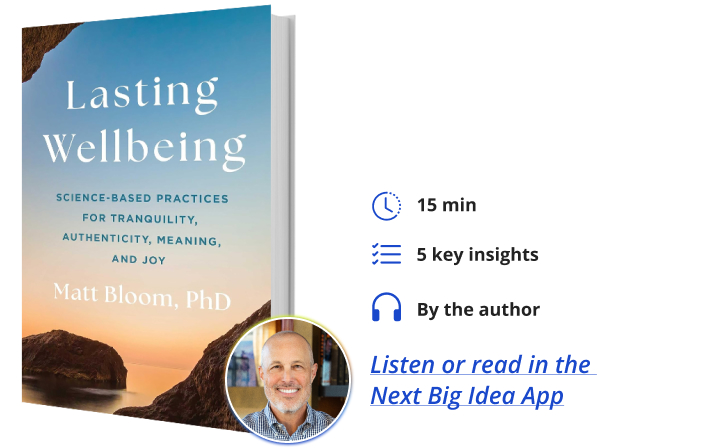
Below, Matt Bloom shares five key insights from his new book, Lasting Wellbeing: Science-Based Practices for Tranquility, Authenticity, Meaning, and Joy.
Matt is a social psychologist and emeritus professor of business at the University of Notre Dame where, for almost thirty years, he studied the wellbeing of people who work in the helping and healing professions. He is cofounder of Ritual, a mobile app that offers a living library of evidence-based wellbeing practices.
What’s the Big Idea?
Lasting well-being isn’t about finding the perfect advice or transforming your life overnight. It’s about practicing small evidence-based habits that fit your unique life.
Listen to the audio version of this Book Bite—read by Matt himself—in the Next Big Idea App, or buy the book.

1. The best way to start is to stop.
Many people feel stuck, not knowing how to even begin figuring out what to do. A great way to begin is to stop. Take a moment to reflect on how your life is unfolding. Consider what’s going well and where you are finding meaning, purpose, and fulfillment. Also consider where you are facing challenges. Ask people who know you well to share what they think is going well for you and where they think you might be struggling. Stepping back like this allows for a shift from autopilot to awareness.
Time passes quickly, and we rarely remember the details of our days. We might say, “I’m stressed at work,” but if asked to be specific about what is causing that stress, our answer is often incomplete. Even when we think we know what is stressing us, we are often only partly right.
Let me illustrate: Can you remember what you had for your last meal yesterday? How about a week ago? A month ago? Unless you have a set menu, you probably answered yes to the first question and no to the others.
Our days slip by quickly, and we don’t remember many of the details that matter for our wellbeing. We forget some of the things that bring us joy and make life meaningful. We can’t remember what makes our days challenging, so we feel incapable of turning things around. Stepping back gives you the perspective needed to establish where you want to improve your wellbeing.
Map Your Days is a simple practice for stepping back. All you need is a place to record your thoughts. At the end of each day, make a quick evaluation of whether it was a good or bad day. Use a smiley or frowny face, a single word, or some other quick way of recording what the day was like. Do not overthink it. Go with your gut. Then, briefly describe one high point from that day and one low point. You decide what those are; the criteria you use are the right ones. Write just enough to remember what happened. You should be able to complete this entire process in five minutes or less.
Do this each day for at least two weeks—or longer, if you can. Then, take a look back. Note the high points on your good days and look for patterns. What kinds of things made those days good? Common themes shed light on what makes a day positive for you. Next, shift to the tough days and look for patterns in the low points. Look more closely at those days to identify what made them stressful, challenging, or difficult. At this point, you will have identified the areas you need to address to improve your wellbeing.
2. To make big changes, think small.
Many of us try too hard. We search for the absolutely “best” practices or imagine that caring for ourselves and those we love will take more hours of time than we have. We wonder how we can jam one more thing into our overfull days. But we don’t need to take on another major activity or try to make big changes. In fact, we shouldn’t do either.
Big changes and time-consuming experiments come with risks. Unless we get everything right, they often cause other problems that may be worse than the ones we are trying to fix. A much better way is to take the simple approach.
“The key is using a simple practice consistently.”
There are a variety of evidence-based practices that will fit comfortably into your daily life. I share dozens of simple wellbeing practices in the book, many of which require less than fifteen minutes. The key is using a simple practice consistently. Over time, the benefits will accumulate into the big improvements you seek.
For example, what I refer to as tranquil practices are highly effective ways to reduce stress. Mindfulness meditation is one, but there are plenty of others. You only need to spend five to ten minutes with a tranquil practice, and you can break that into chunks. Meditate while you are stopped at a red light, waiting in line at the grocery store, or even while brushing your teeth.
Or, consider receptive practices, which boost resilience. One simple and highly effective receptive practice is the Worry Window. Grab a piece of paper and something to write with. Set a timer for five minutes. Hit start, and worry. Write down a few words to capture those worries. Don’t censor yourself. Write down all of the big and small worries that pop up into your mind. Let your thoughts indulge in catastrophizing and exaggeration. Don’t distract yourself or reason your worries away. Just confess them. When time is up, stop writing. Do this regularly, and you will worry less.
Think small. Pick a practice and give it a try for a few weeks. Be patient because small changes add up to big improvements.
3. Be unique.
We live in a world that compels us to compare ourselves to others in every possible way, in every possible place, such as work, home, the gym, or on social media. This kind of constant social comparison undermines our self-confidence and self-worth. We ping-pong between trying to fit in by conforming to social pressures and trying to stand out to feel special and worthy.
But when it comes to choosing how to take care of yourself, be unique: find what works for you. I know people who swear by sitting meditation for building more tranquility into their days. For them, settling down on a cushion in a quiet room and clearing their mind is a great way to release stress and calm their troubled mind. My mind buzzes from one thought to another. I’ve tried breath-focused meditation, and that doesn’t work either. But walking does. I put in ear pods with some beautiful music and start walking. I let the music wash over me, and my mind settles into a quiet place.
“If a practice isn’t helping after a couple of weeks, try another practice.”
Another of my favorite tranquil practices is baking bread. There is just enough to think about that I get pleasantly lost in measuring ingredients, gently kneading the dough, baking the bread, and then having a delicious, warm piece fresh out of the oven.
So, if your friend’s favorite practice or an influencer’s “must use” technique or the latest-and-greatest advice doesn’t work for you, there are practices that will. If a practice isn’t helping after a couple of weeks, try another practice. There are dozens of great practices, so you will be able to find one that fits your unique wellbeing needs. Rather than copying what other people are doing or trying to match their level of wellbeing, be unique.
4. Achieving lasting wellbeing is a journey, not a destination.
Our lives unfold one day at a time. We travel through highs and lows, over inspiring mountaintop experiences and down into deep valleys of difficulty. We sometimes wander down the wrong path. Lasting wellbeing is a part of that journey. Our wellbeing will, naturally, have ebbs and flows. Some seasons bring ease and flourishing, while others bring stress, loss, and lower wellbeing.
Lasting wellbeing means building the capacity to live fully during the best parts of life, the most difficult ones, and all the times in between. It’s being grounded and guided through highs and lows by core values that create meaning and purpose. And it is sustained by strong relationships and a sturdy sense of self-integrity. Integrating simple practices into your life when the journey is easier will ensure you are well equipped when times become more difficult.
5. There is no such thing as your wellbeing.
The rugged individualism we prize so much in America creates one of the biggest challenges to our wellbeing. Whether we realize it or not, our health and our wellbeing are deeply intertwined with the wellbeing of the other people in our lives. It is no surprise that your family and friends have a significant impact on your wellbeing, as you do on theirs, but it goes much deeper than that.
In their book, Connected: The Surprising Power of Our Social Networks and How They Shape Our Lives, sociologists Nicholas Christakis and James Fowler found that even your friend’s friend’s friend—someone you may not even know—has a significant impact on your wellbeing. They summarized their findings this way: “We discovered that if your friend’s friend’s friend gained weight, you gained weight. We discovered that if your friend’s friend’s friend stopped smoking, you stopped smoking. And we discovered that if your friend’s friend’s friend became happy, you became happy.”
“Being more intentional about nurturing social connections can have a huge impact on everyone’s wellbeing.”
When we ignore or overlook these deep connections, we miss opportunities to support others, and we miss the ways other people can support us. Being more intentional about nurturing social connections can have a huge impact on everyone’s wellbeing. Even small gestures of respect toward a server or cashier make a difference—to them and to us. And, of course, our relationships with family and friends have an even bigger impact on our wellbeing, and theirs.
When I greet someone and ask how they are, I am more intentional about pausing to receive a real answer. I am more open with the important people in my life about my wellbeing challenges, and I am more willing to ask for their help. I am also, I hope, more eager and receptive to accompanying them through the highs and lows of their journey. I invite you to be more intentional about how you journey with the people in your life—those you are close to and, when you can, your friend’s friend’s friend.
Enjoy our full library of Book Bites—read by the authors!—in the Next Big Idea App: