














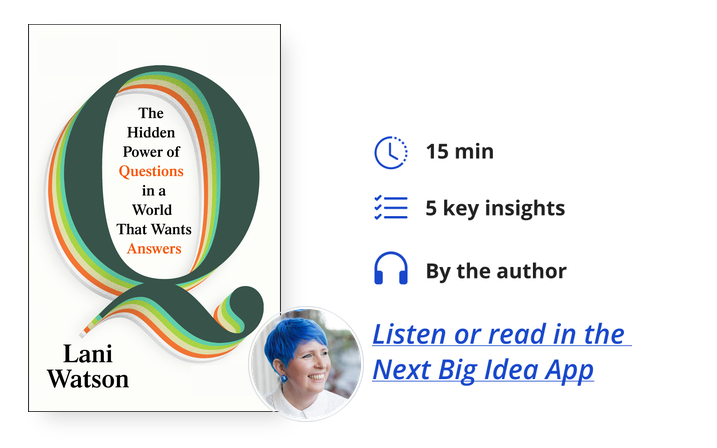
Below, Lani Watson shares five key insights from her new book, Q: The Hidden Power of Questions in a World That Wants Answers.
Lani is a philosopher and Honorary Fellow at the University of Edinburgh. She is a world-leading expert in the philosophy of questions, having researched the topic for nearly two decades. Businesses and organizations around the world have sought her help in learning how to ask great questions.
What’s the Big Idea?
We’re living through uncertain, unsettling times, and every instinct pulls us towards quick, comforting answers. But certainty, chased too hard, makes us rigid and closed. Uncertainty isn’t a problem to be eliminated, it’s the texture of a rich, complicated, unpredictable life. Questioning is what lets us meet it, not with anxiety, but with openness, curiosity and a little humility.
Listen to the audio version of this Book Bite—read by Lani herself—in the Next Big Idea App, or buy the book.

1. Questions direct our attention.
I’ll start by asking you a question: Where are you? Take a moment with this.
It’s a very simple question, but notice that before you even answer, it has already had an effect. Perhaps you glanced unconsciously at your surroundings or thought briefly about the view in front of you or reflected on the journey you’re on. That’s the first hidden power of questions. They direct our attention instantly.
Nobody understands this better than magicians. Watch a close-up magic show and you’ll notice the magician asking questions: what’s your name, is this your first magic show, can you check that this is a normal pack of cards? These questions are an integral part of the trick. Each one draws your attention to where the magician wants it, at precisely the moment the sleight of hand happens somewhere else. Psychologists have even tested this in the lab: volunteers are told to watch a simple card trick and not be distracted. Yet the moment the magician asks a question, almost everyone instinctively looks up at their face, the move is made right under their nose, and most people don’t even remember looking away.
That’s how strong the attentional pull of a question is. Even when we’re actively trying to resist it, we can’t. This is why I describe questioning as an attentional mechanism. Questions influence what we notice and what we miss. And because attention shapes what we think, how we feel and what we do, the questions running through your day are quietly steering your life.
Magicians use this attentional effect to surprise and delight us, but the same force is at work everywhere, all the time. The questions a doctor asks determine the diagnosis you get. The questions you ask at work affect how others see you. The question a headline asks influences what you click. Change the question, and you change the direction of travel. The trouble is that questions are so familiar we barely notice them. We rush past the question to grab the answer, but by then the question has already chosen where we’re going. If you want to understand your experiences, relationships, work, or the world around you, start by noticing the questions quietly moving your attention.
2. Questions change our brains.
The power of questions begins in your head. Think of a question that has genuinely gripped you: a half-remembered piece of trivia that you couldn’t quite place, a story you couldn’t resist clicking on, a personal question that stayed with you for days. That pull, that itch of wanting to figure it out, isn’t just a mild distraction—it’s your brain rewarding you for reaching toward what you don’t yet know.
When a question sparks curiosity, it lights up the brain’s reward circuits—the same dopamine-driven system involved in anticipating things we enjoy. It’s like your brain giving you a dopaminergic thumbs up, telling you to keep going, to keep asking, to stay curious. And that small hit of dopamine has a vital role to play in helping you learn and remember.
“When a question sparks curiosity, it lights up the brain’s reward circuits.”
In one study, researchers scanned people’s brains while they were reading trivia questions and asked them to rate how curious each question made them. When curiosity was high, activity rose in the brain’s reward pathways and, crucially, in the hippocampus, a region essential for memory and learning. The questions worked as a kind of primer, alerting the brain to hold on to whatever was coming next. People were markedly better at recalling the answers to the questions that had made them most curious as well as remembering unrelated things they happened to see while in that curious state.
Your brain doesn’t reward you for finding the answer. It rewards you for wanting it, and it uses that impulse to help make the answer stick. Your natural curiosity isn’t a childish itch or an intellectual luxury. It’s one of the most powerful learning systems you own. A good question doesn’t just lead to learning. It’s what makes learning possible.
3. Questions show we care.
Questions help us learn about, understand, and connect with one another. Think of the small questions that hold a day together. How are you? How did you sleep? Do you need anything? Do you want a cup of tea? They can feel automatic, barely worth noticing. But they’re one of the main ways we say to another person: I know there’s an inner world in there that I can’t see, and you’re the only one who can tell me about it.
That makes questions deeply relational. When I ask you something and truly wait for the answer, I’m handing you my attention. Attention, given freely, is one of the most valuable things any of us has to offer. Of course, not every question connects. Some are careless, intrusive or hollow. “How are you” can be an honest invitation, or a reflex we don’t really mean. But asked with real attention, and listened to with genuine intent, a question is one of the simplest and most powerful ways to show that you care.
You see it in therapy rooms, where the right questions can help someone find words for a feeling they couldn’t name. You see it in hospitals, where whether a patient feels heard and informed can hinge on the questions they are asked. You see it in friendship, in parenting, in love and in grief, where often the most caring thing we can offer isn’t an answer, but a question, asked gently enough that another person can finally speak.
Staying curious about the people closest to us is what keeps those relationships alive. It reminds us that even the people we know best are never finished, never fully solved. There’s always another question worth asking. A good question is a powerful form of connection that can transform our relationships and make the people around us feel valued and understood.
4. We are taught to answer, not to ask.
Detailed studies of young children find them asking somewhere between one and three questions every minute in conversation with familiar adults, helping them connect with caregivers and making full use of the most efficient learning engine they have. Our questions get more sophisticated as we grow and we figure out when and how to ask, as well as who, to learn about the mysterious world around us and understand our place within it.
“Being taught to answer, not to ask, can lead us to value false certainty.”
And then, for most of us, something changes when we go to school. Classrooms are typically full of questions, but it’s rarely children who are asking them. Study after study, going back to the 1930s, finds the same pattern: teachers ask questions and students answer them. Think of a classroom full of raised hands. That’s almost always a class full of students trying to answer a teacher’s question rather than asking one of their own. This question-answer dynamic has a powerful effect. It teaches us that answers are what determine our success, and throughout our education we slowly absorb the lesson: what’s rewarded isn’t the questions you ask, it’s the answers you give.
For many of us this lesson carries straight into our adult lives. We encounter it in exams, interviews, pitches and meetings, where we are often prized for being certain, fast and right, and where ‘I don’t know’ feels increasingly dangerous. Being taught to answer, not to ask, can lead us to value false certainty over the more real and honest ambiguity that characterizes much of our lives.
5. Technology gives us answers but needs our questions.
Nowhere are the effects of this answer-orientation more obvious than in the palm of your hand. Search engines, apps, and AI have collapsed the time between questions and answers to almost nothing. Ask, and the answer is simply there. That’s a modern miracle, but it comes at a cost we rarely notice.
We stop asking each other. Search engines and large language models are so good at instantly telling us what we need to know that many of the questions we would once have asked a human are now directed at our screens without a second thought. But this impulse to turn to technology for answers is eroding our ability to trust each other.
When I ask you a question and you give me an answer, we build a simple but powerful form of trust. You might not be right every time, but for the most part, I can be pretty sure that you’ll try to be, or you’ll tell me if you aren’t sure. This kind of information-sharing is fundamental to our ability to coordinate, cooperate, and make progress. By having all the answers at our fingertips, we are losing something uniquely human that is foundational to our collective survival and success.
“In a world drowning in answers, questions are a compass and a guide.”
What’s more, our tech has become so good at working out what it thinks we want to know that we barely need to form a proper question in the first place. You simply type “pancakes” into Google and literally hundreds of thousands of recipes appear. That’s handy, in a way, but it means that our questioning muscles aren’t getting any exercise. AI is dramatically accelerating this by even generating the follow-up questions for us, so that we don’t have to.
But all this technology runs on human questions. On its own, even the largest dataset just sits there, inert. It’s our questions that bring it to life. Which means that our technology isn’t taking our questions away. Quite the opposite—it needs them to do anything at all. And that’s incredibly powerful. What we ask determines what we see, believe, and do. In a world drowning in answers, questions are a compass and a guide. When we put better questions to our devices, and harder questions to the people building them, we’ll get the answers, the technology, and ultimately the future that we need.
Enjoy our full library of Book Bites—read by the authors!—in the Next Big Idea App: