















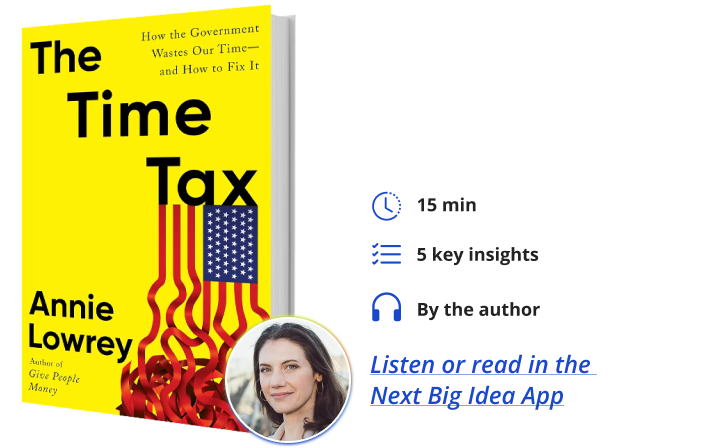
Below, Annie Lowrey shares five key insights from her new book, The Time Tax: How the Government Wastes Our Time―and How to Fix It.
Annie is a staff writer at The Atlantic. She covers economic policy and its consequences for everyday Americans.
What’s the Big Idea?
Americans pay a hidden “time tax” in the countless hours we spend navigating paperwork, applications, and administrative hoops. Much of that bureaucracy is unnecessary, falls hardest on people with the fewest resources, and reflects choices we can change rather than an unavoidable fact of modern life.
Listen to the audio version of this Book Bite—read by Annie herself—in the Next Big Idea App, or buy the book.

1. Americans do way too much paperwork.
We spend an extraordinary amount of time administering our own lives. Health insurance claims. Prior authorizations. Tax returns, which are something residents of many other high-income countries never have to file themselves. School forms, financial aid applications, retirement account management, disability paperwork, expense reimbursements, zoning permits, occupational licenses. The list goes on.
Some of this makes sense. It’s reasonable to require that nurses hold a degree and maintain a license. But do we really need to certify people’s ability to braid hair or design gardens? As a society, we have essentially decided to outsource clerical work to individuals and families. In doing so, we have created a staggering volume of unnecessary work.
This is what I call the time tax. And it really is a tax. Sometimes it costs money, but more often it costs us our bandwidth, effort, and mental capacity. It’s a subject we don’t discuss nearly enough, even though almost all of us are living with some version of it right now.
2. Most of this burden is unnecessary.
We tend to assume that all the bureaucratic work we do as individuals—all the ways we’re called on to be our own administrators—is necessary and unavoidable. I don’t think most of it is.
If a government program exists and you want to access it, it may make sense to apply. But we’re routinely asked to apply for too many things, maintain eligibility for too many things, and navigate rules so obscure they seem designed to defeat us. That design isn’t accidental, and it is enormously deleterious for both individuals and bureaucracy as a whole.
“We tend to assume that all the bureaucratic work we do as individuals is necessary and unavoidable.”
In my book, I draw on James C. Scott’s Seeing Like a State—the idea that paperwork, registers, and censuses exist to make populations legible to governments, translating the messy reality of human life into categories and lists. You can see this impulse to push bureaucratic elements onto people in some of the earliest states we know of. In Roman-occupied Egypt, Romans ran a census, categorized the population, and applied different rules to different groups: If you’re going to do this, then you need to get that or if you want to do this, you have to pay this sum. We still have a lot of these elements today.
We also still have a great deal of administration that functions as a tool of social control, where difficulty and bureaucratic inanity are the point. Complexity designed to tax certain people more than others. A lot of it simply isn’t necessary to begin with.
3. The time tax is profoundly unequal.
Everyone deals with paperwork. But these burdens aren’t applied equally, and people don’t navigate them with the same resources.
Low-income people face the most intense administrative demands. They interact with the government more often because they are more likely to need programs like SNAP, Medicaid, housing assistance, disability benefits, child-care subsidies, and other assistance programs. Yet they have the least capacity to absorb the paperwork those programs require. Women shoulder a disproportionate share of household administrative labor: managing schools, coordinating care, dealing with private businesses, and doing more of the caregiving and domestic work on top of it. Black Americans have historically faced (and continue to face) administrative systems shaped by discrimination, surveillance, and exclusion.
“Low-income people face the most intense administrative demands.”
Money, meanwhile, lets you buy your way out of administrative burdens. You can hire someone to handle what you don’t want to deal with. If you can’t afford that, you’re on your own.
Programs used by high-income Americans tend to be bureaucratically elegant; programs used by low-income Americans tend to be bureaucratically brutal. My favorite example is 529 college savings plans. I have one of these for each of my kids. It’s a tax-advantaged account that can save a family thousands of dollars. It takes about two minutes to set up, with essentially no paperwork and no application. TANF, the federal welfare program for families in poverty, requires hours of effort to apply for, and is so administratively grueling that many low-income mothers simply don’t bother. The disparity is not a coincidence.
4. The United States has a particularly severe case of bureaucracy.
Our peer countries struggle with bureaucracy too, but the United States has a particularly severe case. Four structural factors help explain why:
- Race and racism. Many peer countries were relatively homogeneous when they established their major social programs—unemployment insurance, public pensions, and national health systems. That made it politically easier to build universal, automatic programs. In the United States, we were building those same systems during Jim Crow, and the politics of race made universalism far harder to sustain. Programs were means-tested, restricted, and burdened by design.
- Federalism. We have one federal government, 50 states, thousands of counties and municipalities, and more than 10,000 voting jurisdictions—each with its own rules, funding streams, and practices. There is almost no unitary place to go for anything in American life.
- Fragmented accountability. When responsibility is split across so many levels and agencies, it’s nearly impossible to know who is responsible for what—or who to pressure when things go wrong.
- Financialization and privatization. Government increasingly contracts out services rather than providing them directly, inserting private intermediaries at every turn. Think of insurance agents, claims processors, voucher administrators. We are a country of subsidies, middlemen, and managed markets—and all of that friction gets pushed onto the people trying to navigate it.
5. There’s no political constituency for fixing bureaucracy—yet.
Even though virtually everyone is harmed by the time tax, no organized political constituency is fighting to end it. We don’t even have a shared vocabulary for naming the problem.
I hope that changes. The terms “time tax” and “administrative burden” (the latter used in academic research) give us language to identify what’s happening and talk about it together. Because right now, almost nobody in a policy discussion stops to ask: Wait, why are we making people apply for this at all? Why don’t we just provide it? The complexity is treated as a given rather than a choice.
“We don’t even have a shared vocabulary for naming the problem.”
These burdens are linked in ways we rarely recognize. The fact that you have to file your own taxes is connected—structurally, politically—to how hard it is to get a building permit, to how difficult it is to register to vote, to how much healthcare administration sick people are expected to manage on their own, to how nearly impossible it is for someone with a criminal record to simply function in society. This is one of the ways power is exercised. This is one of the ways the government is failing us. It affects democracy in the most literal sense—fewer people vote when registration is hard—and in the deeper sense that when government treats us this way, we stop believing it can work at all.
That doesn’t have to be inevitable. These are choices. And we can make different ones.
Enjoy our full library of Book Bites—read by the authors!—in the Next Big Idea App: