













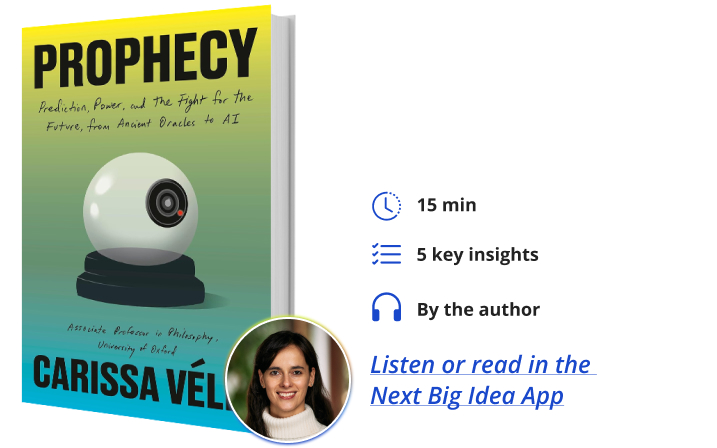
Below, Carissa Véliz shares five key insights from her new book, Prophecy: Prediction, Power, and the Fight for the Future, from Ancient Oracles to AI.
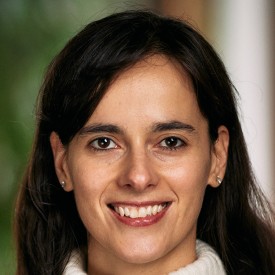
Carissa is a Professor of Philosophy at the University of Oxford’s Institute for Ethics. Her first book, Privacy is Power, was an Economist book of the year. Her academic work has been published in The Harvard Business Review, Nature, and AI & Society, among others.
What’s the big idea?
Algorithmic predictions are now embedded in everyday life, shaping decisions about work, health, and even what we consume. Though they seem modern, they function much like ancient prophecies—tools of influence that can quietly guide behavior and power. Overreliance on these predictions is risky, as it can turn possibilities into self-fulfilling outcomes and limit our ability to shape our own future.
Listen to the audio version of this Book Bite—read by Carissa herself—in the Next Big Idea App, or buy the book.

1. Beware of prophets.
We tend to think about predictions as belonging to the realm of knowledge. It’s easy to forget that predictions are never facts, because the future doesn’t exist yet, and there can only be facts about what has already happened. At best, predictions can be educated guesses. But often, they are not even that; they are power plays in disguise.
King Louis XI kept an astrologer in court. One day, the astrologer predicted that a lady of the court would die within a week. She did. Louis was rattled. Either the seer had murdered the woman to prove his accuracy, or he was so prescient that his foresight could threaten Louis himself. The astrologer had to be murdered. The king ordered his servants that upon his signal, they were to throw the astrologer out the window.
When the astrologer arrived to meet Louis, the king asked him one last question before giving the signal: “Given your prophetic abilities, tell me about your fate; how long will you live?” “I will die three days before Your Majesty,” came the reply. Louis never gave the signal.
Did the astrologer find his answer in the stars? Of course not. He understood the power of predictions and used it to get himself life insurance. In a similar way, tech executives pontificating on the future of tech are doing marketing, not science. That’s also why politicians are betting on themselves in prediction markets.
Predictions come in many kinds, and forecasts about the social world are fundamentally different than those about things or natural phenomena. If you make a prediction about the weather, it won’t affect whether it will rain. But social predictions tend to bend reality toward them by changing expectations. That makes them dangerous—if we believe them and give them credence. If we show skepticism toward prophets and their predictions, they lose much of their power.
2. AI isn’t a truthteller.
Machine learning (the kind of AI most widely used today) and the technology behind large language models, is a prediction machine. It fills in the blanks where data is missing, making projections through statistical analyses based on the data it does have. As a statistical machine, it ventures plausible responses without having any certainty as to whether it’s right; that’s unwise.
In his Apology, Plato tells the story of how Socrates’s friend goes to visit the oracle at Delphi to ask whether there is anyone wiser than Socrates. The priestess responds that there isn’t. Socrates seems puzzled. How could he be the wisest, with so many other people well known for their knowledge and wisdom, while he knows that he lacks both?
“As a statistical machine, it ventures plausible responses without having any certainty as to whether it’s right.”
To solve the mystery, he goes around interrogating politicians, poets, and artisans. He found that those who claim to have knowledge either do not really know what they think they know or else know far less than they proclaim.
If Socrates was the wisest person in ancient Greece because he understood the limits of his knowledge, then large language models are foolish for the opposite reason: They don’t know what they don’t know. That also makes them the ultimate bullshitters.
Bullshit (I promise, it’s a philosophical term) is speech that is persuasive but detached from a concern with the truth. Large language models, as they are currently designed, are the ultimate bullshitters because they are designed to be convincing with no regard for the truth. They are designed to sound plausible, validate our opinions, and make us want to engage further—not to track the truth.
Even more serious versions of AI, for example, used to predict supply chain issues, can only work with the data they have. So be careful using AI to predict the future; at best, it can project past data into the future. But the future doesn’t always resemble the past.
3. Freedom thrives only when the future is unpredictable.
Democracy is the least bad political system that we’ve come up with, partly because it protects the freedoms and rights of citizens. Only when we don’t know what’s going to happen (e.g., who will win an election) do we have democracy. If we can predict what people will do, it’s not a sign of knowledge or the advancement of science, but of manipulation and tyranny.
The future is unwritten. When predictive accuracy about people increases, it is not because we are discovering their future but because we are determining what they will do. Attempts to predict human behavior are often also attempts to control it. As an extreme case, it is easy to predict where someone will be tomorrow if you put them in jail. If we’re able to accurately forecast people’s fates, we’re that much closer to turning human beings into things. That’s too high a price to pay for accurate predictions.
“If we’re able to accurately forecast people’s fates, we’re that much closer to turning human beings into things.”
That democracy is faltering at the same time as the rise of an increase in the use of predictions is not a coincidence. There is a correlation between ancient Rome’s obsession with divination and the fall of the Republic. The more people believed in imperial charts (the prediction that someone would become emperor), the less they trusted the power of the citizenry to run their ship. Democracy never returned to ancient Rome. And when ancient Rome fell, corporations died with it for a thousand years. We should learn from our ancestors’ mistakes.
In ancient Rome, some “predictions” were written after the fact. The prophecy that Augustus would be great was likely fabricated to legitimize his power after he had already achieved greatness. Earlier this year, a journalist was threatened by strangers to get him to change his reporting on the story of an Israeli missile strike in Iran because they wanted to win a $900,000 bet they’d made on a prediction market. Predictions put pressure on freedom and democracy.
4. Uncertainty is where creativity and humor live.
Uncertainty means that your fate is not sealed and that you have a chance to shape it. To be successful—in life, business, and democracy—we need to get comfortable with not knowing what the future holds. Resolving uncertainty as quickly as possible surrenders our power to others who end up deciding our future. Spaces of indeterminacy are where creativity, innovation, and humor flourish.
Seinfeld didn’t start off as a successful sitcom. It decidedly wasn’t what people wanted to watch. Test audiences thought the show was weak. Luckily for Jerry Seinfeld and Larry David, and for fans, one NBC executive championed the show, despite other people’s predictions.
The network used to give Jerry Seinfeld notes on how to make the show better, but the recommendations fit generic past sitcoms. Seinfeld would listen, nod, and then not follow their advice, “You almost knew that you were on the right track when people at the network didn’t like it,” Seinfeld said.
Seinfeld attributes the unique qualities of the show to it being written by people who had never made a sitcom before. They weren’t following rules, using the cookie-cutter mold, or repeating what others had done.
“Spaces of indeterminacy are where creativity, innovation, and humor flourish.”
An algorithm would never have selected Seinfeld, but it went on to become one of the most successful shows ever produced. The show was different. Nobody had seen anything like it. And predictive analytics don’t choose new, because they work with historical data, and there are no databases about the future. Part of what is brilliant about Seinfeld is that the comedy itself changed the audience’s sensibilities and sense of humor.
Don’t use an algorithm that will fit patterns of the past to make choices. Be bold. Innovate.
5. Build the future you want to see.
One way to avoid the tyranny of predictions is increasing your exposure to serendipity. The most important events in your life are likely to be the least predictable. Maybe how you got your job or how you met one of the most important people in your life was serendipitous.
Be open to the unforeseeable. Read widely. Talk with people vastly different from you. Allow luck to strike. Try activities that might seem out of character. Surprise yourself. Write a quirky book, film an unusual movie, redesign an everyday object from scratch. Explore the offbeat. Say hello to strangers; don’t let algorithms determine whom you meet. Send messages in bottles, and if you ever receive one, consider responding. Take strolls along the beach; you never know what the tide might bring.
Another way to avoid falling prey to the allure of predictions is to interpret them, not as facts, not as sealed fate, but as invitations for defiance.
“The most important events in your life are likely to be the least predictable.”
The boxing match between Joe Frazier and Muhammad Ali in 1971 was branded the Fight of the Century because it was the first time that two undefeated boxers who’d won the world heavyweight title fought each other for that very title. In a press conference before the match, Ali forecasted a win: “I predict that when I meet Joe Frazier (…) this will be no contest,” he said. He wasn’t running probability numbers; he was trying to intimidate his opponent. It motivated Frazier to fight harder than ever and win; it was the great Ali’s first loss.
To defy a culture of prophecy is to stop worrying about predicting the future, as if it were a script to discover, and to get busy building the future you want to inhabit, writing the script for yourself. The future is what you make of it.
Enjoy our full library of Book Bites—read by the authors!—in the Next Big Idea App: