














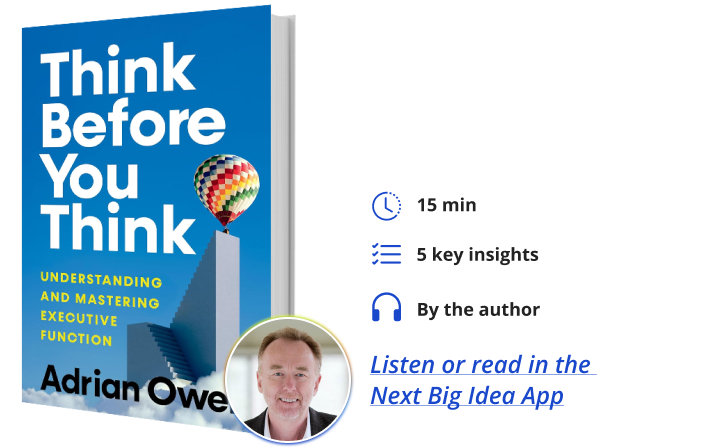
Below, Adrian Owen shares five key insights from his new book, Think Before You Think: Understanding and Mastering Executive Function.
Adrian is a professor of cognitive neuroscience and imaging at the University of Western Ontario. He has been featured in the New Yorker, the New York Times, Nature, Wall Street Journal, and Science, among other publications.
What’s the Big Idea?
Your success in life depends less on how smart you are and more on how well you manage your mind. Executive functions determine whether you turn ability into good decisions and meaningful action.
Listen to the audio version of this Book Bite—read by Adrian himself—in the Next Big Idea App, or buy the book.

1. The brain system you rely on most is the one you understand the least.
Have you ever walked into a room and completely forgotten why you went there? Found yourself reading the same paragraph three times because your mind kept wandering? Perhaps you sent an email you immediately wished you hadn’t or promised yourself you’d start that important project today—only to find yourself scrolling through your phone an hour later instead.
Most of us treat these as unrelated little quirks. We blame our memory, our willpower, our attention span, or simply tell ourselves that we’re getting older. But these everyday experiences are all connected. They’re all examples of one remarkable set of mental abilities called executive functions.
Executive functions are the brain’s management system: the abilities that allow us to focus our attention on what’s important, hold information in mind while we use it, plan ahead, resist distractions and temptations, regulate our emotions, and understand what other people are thinking. They don’t determine how intelligent you are. They determine how effectively you use the intelligence you already have.
Executive functions quietly shape almost every aspect of our lives. They influence how well we do at school and at work, how successful our relationships are, how we raise our children, how we make decisions with money, how we cope with stress, and even how successfully we age. Yet if you stopped someone on the street and ask them what executive function was, very few could tell you.
I spent more than 30 years studying the brain, and during that time I’ve watched neuroscience transform our understanding of memory, intelligence, and even consciousness. Yet one of the most important discoveries has remained largely hidden from public view. We all know what IQ is. We all worry about our memory. But the mental abilities that often matter most in everyday life are the ones we’ve barely talked about.
The part of your brain that most influences the life you lead isn’t necessarily the one that’s best at solving crossword puzzles or remembering facts. It’s the part that helps you decide what deserves your attention, what to ignore, what to do next, and what not to do.
2. The smartest people can make the worst decisions.
If I asked you to name the smartest person you know, you’d probably think of somebody with an exceptionally high IQ. That’s how we have thought about intelligence for more than a century. We admire people who can solve difficult problems, recognize patterns, or perform impressive mental calculations. And there’s no question that IQ measures something important. But we’ve been asking the wrong question.
The question shouldn’t be: How intelligent are you? It should be: How well do you use the intelligence you already have?
We’ve all met people who are extraordinarily bright but somehow never quite fulfil their potential. They procrastinate, make impulsive decisions, struggle to organize their lives, and fall for the same mistakes over and over again. Equally, we’ve all met people who might never describe themselves as intellectual giants, yet consistently make wise decisions, build successful relationships, and navigate life with remarkably good judgement. What’s the difference? I would argue that it’s often executive function.
“We’ve all met people who are extraordinarily bright but somehow never quite fulfil their potential.”
Executive functions are what allow us to translate ability into action. They’re the mental skills that help us plan ahead instead of reacting impulsively, stay focused when we’re distracted, resist temptations that undermine our long-term goals, and adapt when life throws us something unexpected. They’re the bridge between knowing what to do and actually doing it.
One of the biggest studies ever conducted in my lab involved more than 44,000 people completing a series of cognitive tests online. We wanted to answer a deceptively simple question: Is intelligence really just one thing? And the answer surprised us. What we call intelligence turned out to be a collection of distinct mental abilities, many of which depended heavily on executive function. That changed the way I think about human potential.
So perhaps it’s time we stopped asking who’s the smartest person in the room. A better question might be: who’s making the best decisions?
3. Hidden brain skills shape life more than you realize.
We tend to think of planning, attention, emotional control, or understanding other people’s feelings as completely separate abilities. In fact, they’re all part of the same mental toolkit.
Once you start looking through the lens of executive function, you see it everywhere. Think about the last disagreement you had with someone close to you. Perhaps you said something you regretted in the heat of the moment. That’s inhibition and emotional regulation, both key executive functions. Think about juggling several things at work while remembering to collect the children from school and pick up the shopping on the way home. That’s planning, attention, and working memory—three more key executive functions. And think about meeting someone new. As the conversation unfolds, you’re constantly trying to work out what they’re thinking, what they already know, whether they’re joking, whether they’re interested. That’s theory of mind, another important executive function.
We barely notice these abilities when they’re working well, because they’re operating quietly in the background. It’s a bit like the conductor of an orchestra. The audience notices the violins, the brass, or the percussion, but tend to overlook the person coordinating everything. Executive functions don’t perform the music, but they make sure everything comes together at exactly the right time.
“We barely notice these abilities when they’re working well, because they’re operating quietly in the background.”
They also explain why so many seemingly unrelated conditions have something important in common. Whether it’s ADHD, concussion, Parkinson’s disease, Alzheimer’s disease, or normal ageing, one of the first things that often changes is not intelligence but the ability to organize, prioritize, adapt, and regulate behavior. Executive function provides a single framework for understanding an enormous range of human experiences, from everyday absent-mindedness to some of the most serious neurological conditions.
Once you understand these hidden mental abilities, you begin to notice them in yourself. You become more forgiving when your attention wanders, more patient when other people make mistakes, and perhaps a little more intentional about the way you make decisions.
4. The real threat of AI isn’t what you think.
A little while ago, I asked ChatGPT to draft an email I could easily have written myself. It wasn’t a difficult email. I just wanted to thank a colleague, apologize for a delay, and explain why I couldn’t attend a meeting. ChatGPT produced a perfectly respectful draft in a couple of seconds. I tidied up a few sentences, pressed send, and got on with my day. Had artificial intelligence just made me more productive, or had it quietly persuaded me not to think?
That’s a question we’re all starting to ask. Every week brings another headline claiming that AI, smartphones, or social media are making us less intelligent, shortening our attention spans, or rotting our brains. And I think that framing is wrong. Human beings have always invented tools that extend our minds. We write shopping lists instead of memorizing everything. We use calculators instead of doing long division in our heads. GPS helps us navigate unfamiliar cities. AI is simply the latest tool we’ve ever created.
I don’t worry that technology is replacing our brains, but I do worry that we’re becoming less intentional about deciding when to rely on it. Sometimes handing a task over to AI is the right decision. If it saves me 20 minutes drafting a routine email, that’s probably a good use of technology. It frees me to spend more time on work that genuinely requires my attention, creativity, and judgement. The problem comes when we stop making that choice consciously. If we automatically ask AI to solve every problem, rewrite every paragraph, or make every decision for us, then we’re not using the technology to extend our thinking. We’re using it to avoid thinking.
The challenge of the AI age is protecting our brains from technology. It’s learning to become more intentional about which parts of our thinking we choose to outsource and which parts we should insist on keeping human. The future won’t belong to people who refuse to use AI. It will belong to those who know when not to.
5. There’s no silver bullet, but there is a path.
I give a lot of public lectures, and someone always asks me: What’s the one thing I can do to improve my executive function? And people are often disappointed by my answer: There isn’t one.
If you’re hoping I’ll recommend a particular supplement, brain training app, or a simple daily exercise guaranteed to transform your thinking, I’m afraid the science just doesn’t support it. But that doesn’t mean there’s no hope. We just have to work a little bit harder to find the answer.
Executive function is a lot like physical fitness. You don’t become physically fit by doing one thing brilliantly. You become fitter by getting lots of different things broadly right: sleeping well, staying active, eating sensibly, and challenging your body regularly. Our brains work in much the same way. The neuroscientific evidence suggests that executive functions are supported by:
- Regular exercise.
- Good-quality sleep.
- Managing stress.
- Maintaining strong social relationships.
- Continuing to learn new skills.
- Keeping mentally engaged throughout life.
None of these is a silver bullet, but together they create the conditions in which our brains are most likely to thrive.
Perhaps the most important thing I’ve learned about executive function, though, has nothing to do with lifestyle. It’s awareness. Once you understand what executive functions are, you begin to notice them everywhere. You catch yourself reacting impulsively instead of pausing. You recognize when your attention has drifted, or when you’re putting off an important task. You become more aware of the moments when you’re letting technology think for you, and the moments when your own thinking would be more valuable.
That awareness doesn’t make you perfect, but it does make you more intentional. Executive function is not about having the world’s highest IQ or having the world’s best memory. It’s about developing the ability to pause, think, and make better choices.
Enjoy our full library of Book Bites—read by the authors!—in the Next Big Idea App: