














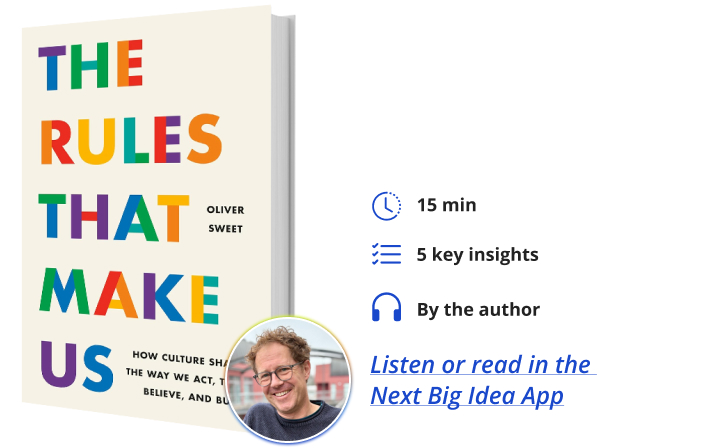
Below, Oliver Sweet shares five key insights from his new book, The Rules That Make Us: How Culture Shapes the Way We Act, Think, Believe, and Buy.
Oliver is a business anthropologist and head of ethnography at Ipsos, one of the largest research agencies in the world. There, he looks at cultures all around the world and advises companies and governments on how they can become more culturally relevant.
What’s the big idea?
Culture is our shared way of living. We interact with one another based on cultural rules. If we want to understand ourselves better, we need to understand the culture that we live in.
Listen to the audio version of this Book Bite—read by Oliver himself—in the Next Big Idea App, or buy the book.

1. Culture is no longer linear; it is divergent.
When I started studying culture 20 years ago, it was all a bit different. Culture used to be linear, and I would hang out with people in trendy subcultures to see what people listened to, watched, and wore for clothing. You could then map where culture was going, because you could be sure that mainstream culture would subsume trendy subcultures.
Once upon a time, Oasis used to give two fingers to the man, and now they are multimillionaires. The Simpsons used to be ironic and shocking, but now they are part of the wallpaper. It’s all quite different now. Culture seems to thrive on being in opposition. There are:
- Political divides, like the Republicans and Democrats.
- Gender divides, like hyper-masculine role models as well as gender non-binary
- Influencers, like Joe Rogan and Bad Bunny.
Essentially, anything at the edges of culture is thriving. By contrast, the center ground of mainstream culture is in retreat. In many democratic countries, we are seeing narratives like:
- There’s a difference between the haves and have-nots.
- The country is broken.
- Normal people are being left behind.
This narrative basically describes how the system is broken for many people. The promise that dominant culture used to offer—a social contract based on hard work creating rewards—is no longer true, and people are looking for answers elsewhere.
This fragmentation, based on oppositions, makes culture feel tense and full of arguments, and that’s because it is. Living in a divergent culture isn’t about who wins the battle for right and wrong, it’s about who wins the battle for attention.
2. We live in a symbolic society.
Before 1800, we lived in what historians call an oral society. Oral societies passed stories from peer to peer, as part of a campfire culture in which stories and evidence spread across the country through whispers. Only certain stories did well in an oral society, and those were stories that were believable and memorable. It wasn’t about being right or wrong.
After 1800, with the increased use of printing presses, higher levels of literacy, and better distribution of newspapers and books, we moved into literate society. Writing everything down changed the structure of stories. Being right became more important than being memorable, and being logical and rational was the new measure for being believable. This rewired human cognition and is largely considered a contributing factor to the Enlightenment and the spread of democracy.
Nowadays, though, we seem to be adopting the characteristics of an oral society again:
- News and stories are often passed peer-to-peer, often at high speed.
- Stories need to be memorable in this new world. “Make America great again,” “take back control,” and “stop the boats” are all slogans that focus on being memorable.
We also live in a world where a picture of a politician in a pub or having a burger is more powerful than a leader giving a speech from behind a lectern. The world passes information in a far more symbolic manner these days, as we transition to becoming a literate society.
3. Era of agency.
Now that the center of culture is in retreat through a series of broken promises, people are starting to follow interesting characters at the fringes of society who promise a new way of life:
- This might be a new way of doing politics, with many populist leaders like Marine Le Pen, Nigel Farage, and, most successfully, Donald Trump.
- Andrew Tate has offered young men a new way to get rich and dominate women through his messages on the manosphere.
- Greta Thunberg offered people a new way forward on climate change.
Beyond these big-name characters, there is a whole world of influencers in beauty, wellness, technology, sports, and more that people follow because they want to believe they can hack a broken system. In an era when the system has let people down, agency is the new character trait that’s becoming ever more desirable.
4. We will enter a world of digital narcissism.
There is currently an AI arms race to develop the Personal AI: a subscription-based AI that will learn about us so that it can act like us. In a future not that far off, we will all have our own AI that can order your food, manage your calendar, suggest a nice holiday, and—because we live in a capitalist system—suggest what you should buy.
Because AI is designed to learn about us in order to be us, it will start to show us versions of the world it knows we like while hiding the stuff we don’t. In time, you can imagine all the targeted advertisements being filled with people who look like us, sound like us, and encourage us to buy products that they know we like the day after payday. The world will become a sycophantic mirror of us, and we will grow to love everything about ourselves.
“Because AI is designed to learn about us in order to be us, it will start to show us versions of the world it knows we like while hiding the stuff we don’t.”
This has already started with social media. I conducted a study in 2024 examining young people’s social media habits. The young people I interviewed spent three to four hours a day on social media, which equated to looking at about 700 posts per day. When we asked them how many they remembered from the day before, they could recall about five or six posts. We know from cognitive psychology that it only takes about two seconds to register something that you’ve seen, so what happened to the other 695 posts of the day?
We also know that everyone lives in an algorithmic echo chamber, so scrolling on social media is basically equivalent to subliminal messaging on a mass scale. This level of digital narcissism is another moment when cognition will be rewired, and we will start to expect everything to have an AI lens applied to it that aims to please us.
5. Cultural insight for everyone.
Many of these changes in culture are starting to rewire human cognition. So, my final insight, is a gift for understanding the world. There is a framework that runs throughout the book, called the Cultural Trinity, that helps people see the world in a more intricate, connected, and accessible way.
The Cultural Trinity is made up of identity, community, and belief systems:
- Identity – Who do you want to be? Who do you want people to think you are?
- Community – What does everyone get up to when you all meet up? What do you drink, eat, and discuss?
- Beliefs – What do you think is right and wrong? Good and evil?
If we identify each one of these in our friends, colleagues, and acquaintances, we can start to understand people’s cultural viewpoints in new and enlightening ways. It helps us see the similarities and differences across different cultural groups, and in turn, we begin to see the world a bit more like an anthropologist.
Enjoy our full library of Book Bites—read by the authors!—in the Next Big Idea App: