













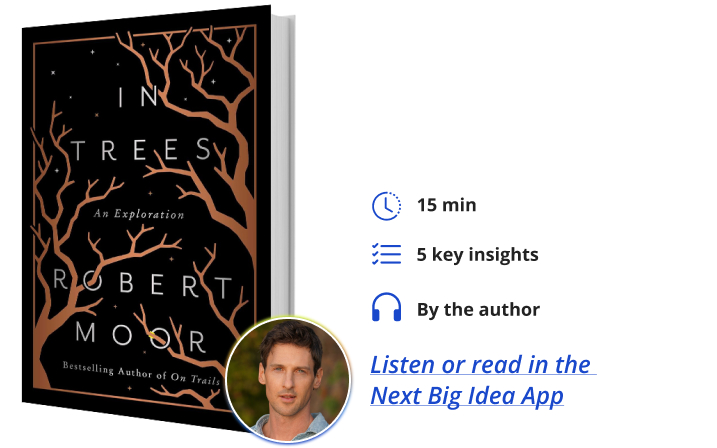
Below, Robert Moor shares six key insights from his new book, In Trees: An Exploration.
Robert is a bestselling author who spent nine years traveling around the world—from jungles in Papua and bonsai gardens in Japan to grand estates in England and sequoia groves in California—to learn how to “think like a tree.” His first book, On Trails, won numerous awards, including the National Outdoor Book Award, and his writing has appeared in The New Yorker, The Atlantic, and Outside, among other publications.
What’s the big idea?
Trees stand silent, but their lessons speak volumes. Learning to think like a tree encourages personal growth and long-term collective flourishing in surprising and profound ways.
Listen to the audio version of this Book Bite—read by Robert himself—in the Next Big Idea App, or buy the book.

1. Stay branchy.
While talking with a neuroscientist named Jeff Lichtman at Harvard, I learned that as a baby your brain has the most neurons it will ever have. The rest of your life is spent pruning away those neural connections, as your brain struggles to reduce cognitive clutter and make sense of the world. As we get older, psychologists say it becomes imperative to keep our brains branchy, by practicing new skills, learning new languages, and putting ourselves in novel situations. But I don’t think it’s quite enough to just putz around on Duolingo for a few minutes every morning.
I suspect that what really keeps the brain branchy is going out into the wild world and engaging with beings unlike yourself—be they human, animal, or plant. As Leo Tolstoy once wrote, life cannot be “lived for myself alone.” We are fundamentally ecological beings, and it is by engaging with that wild ecology that we, too, can keep our brains stubbornly, wildly alive. Some people do that by volunteering at their local homeless shelter, gardening, working on wildfire crews, or joining a climate protest. I did it by going to England and learning how to climb trees again with a barefoot eccentric named Ben Atkinson. I’ve been climbing trees ever since. My brain—and my soul—is all the better for it.
2. Genius is profligate and nonlinear.
A tree is born with three riddles to solve:
- It grows upward, looking for a ball of light (the sun) that rolls around the sky all day.
- It grows downward, looking for a more or less random distribution of water.
- It grows outward, hoping to survive the unpredictable ravages of wind, fire, ice and pests.
As it struggles to solve these three riddles, it might seem like a tree is undertaking a process of trial and error—trying first this solution, then that one—but that’s not what’s happening at all. Instead, a tree solves the puzzle of its own existence through what might be called trials and errors, trying many things at once, ditching those that fail, and strengthening the ones that survive.
In the words of Italo Calvino, from the perspective of reductive beings like us, it can often look like it is only “through a chaotic waste of matter and forms that the tree manages to give itself a shape.” But this wild, unconstrained act of multidirectional and multivarious exploration is how the greatest breakthroughs are made. Computer programs and economic marketplaces routinely run these kinds of tree-shaped operations, testing out many options simultaneously, then allowing the better options to winnow out the less optimal ones in a Darwinian fashion. While writing his masterpiece, War and Peace, Tolstoy wrote thousands of pages, only to throw most of them away. If brevity is the soul of wit, then branchiness is the soul of genius.
3. Creation necessitates destruction.
A tree grows by branching out in all directions, but it survives because it prunes away all those branches that don’t help the tree thrive. One of the joys of writing this book was getting to spend a lot of time around bonsai professionals, who are masters at the art of pruning. From them, I learned the importance of being ruthless in paring away all those ugly, clunky things that most people allow to linger around out of sheer complacency.
“A tree survives because it prunes away all those branches that don’t help the tree thrive.”
Traditionally, bonsai artisans begin their careers as apprentices, whose masters guide them through harsh (sometimes even violent) criticism. Over time, the apprentice learns to be ruthless in addressing their own shortcomings, and, hopefully, to cherish their own strengths. That balance of self-love and self-scrutiny is the secret to creating something truly great.
4. Outgrow simple binaries.
One of the many things I love about tree-thinkers is that they are emphatically resistant to the plague of reductive, black-or-white, binary reasoning. When faced with a sharp dichotomy, arborescent thinkers ask: instead of either/or, could the answer be both / and?
This was one of the great insights of the anthropologist Frans Boaz. Rather than dividing the world’s cultures into crude categories like civilized and uncivilized, he placed every society on its own branch of a grand Tree of Culture. Tree-thinking teaches us that many truths can be true simultaneously, and each can have value within its own context. Once you let your mind expand beyond the narrow confines of binary thinking, the world opens in radical and beautiful ways.
5. Being deeply rooted means embracing deep relationships.
Native philosophers often say that one thing uniting nearly all Indigenous cultures, which is notably lacking from the modern Western worldview, is a quality they call relationality. Rather than carving the world into separate categories and packaging it into easily saleable products, Indigenous thinkers tend to emphasize the relatedness between things, and they place enormous importance on maintaining those relationships, like so many fungal threads connecting the roots of trees in an old-growth forest.
“Indigenous thinkers tend to emphasize the relatedness between things.”
A lot of people around the world are feeling hollow and adrift nowadays, and they go looking to fill that void inside of them, that lack of rootedness, by defaulting to counterfeit ideologies like ethnonationalism. But that’s a profound mistake. True rootedness is having a deep sense of relationality—to other people, other living beings, and the earth itself.
6. The meaning of life is to help living things flourish over time.
I know it sounds a bit grandiose to say that studying trees for a decade taught me the meaning of life itself, but in a way, it’s true. In the past few decades, a wide array of philosophers have converged on the word “flourishing,” which comes from the Latin for “to flower,” to encompass the goal of a life well-lived. I like that word, but what I like even better is a term the philosopher Donna J. Haraway has coined: “co-flourishing.”
That’s what trees in a forest do: they flourish alongside, and with one another, by balancing cooperation and competition. But unlike flowers, trees don’t just flourish briefly and then wilt. Trees flourish for centuries, or even millennia. Adding that element of deep time to the project of communal flourishing provides the missing piece that much of our current discourse is missing.
The future looks pretty dark right now, so it’s easy to throw your hands in the air and just live for today, especially if, like me, you don’t have any kids. But when you stand in front of a tree that’s a thousand years old, you can’t help but wish to see it live for a thousand more. That’s what I call “entering the ecology of time itself.” As the Apache philosopher Viola F. Cordova proclaimed, “There is no glorious ‘future’ out ‘there’ waiting for us to arrive. We build the future through our present actions.” So, let’s get out there and start building.
Enjoy our full library of Book Bites—read by the authors!—in the Next Big Idea App: