














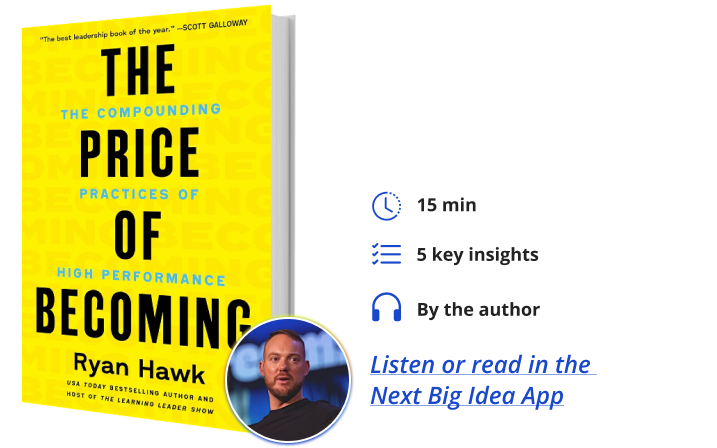
Below, Ryan Hawk shares five key insights from his new book, The Price of Becoming: The Compounding Practices of High Performance.
Ryan is the host of The Learning Leader Show, a podcast where he has interviewed more than 700 of the world’s most impactful leaders over the past 11 years. Recently, it was ranked the #1 business podcast in the world by Apple Podcasts.
What’s the Big Idea?
The life you want isn’t built through talent, luck, or fleeting moments of inspiration. It’s built by fully committing to what matters and showing up for it every single day.
Listen to the audio version of this Book Bite—read by Ryan himself—in the Next Big Idea App, or buy the book.

1. Selling is leading.
Leaders who claim they’re “not salespeople” are usually bad at getting anyone to follow them, because leadership is the art of getting people to want to do what must be done. It’s about persuading people to buy into a vision they can’t yet see.
I spent the first 12 years of my career as a new business sales professional at LexisNexis and then Elsevier Clinical Solutions. I went from sales rep to manager to director, and my last job in corporate America was as the VP of Sales. Leadership is all about selling. We are all in sales every day.
2. The hard is what makes it great.
There’s a great scene in the movie A League of Their Own. Geena Davis is with Tom Hanks, and she says, “It just got too hard.” Tom Hanks pauses, then looks up at her and says, “It’s supposed to be hard. If it wasn’t hard, everyone would do it. The hard is what makes it great.”
This reminds me of looking at the AllTrails app when going hiking. You can choose from a variety of hikes which are labeled either Easy, Moderate, or Strenuous. The biggest difference between the difficulty levels is what you earn when you choose the Strenuous hikes. The suffering, the increase in elevation, the tired legs—when you get to the top, you earned that view. That feeling of accomplishment doesn’t happen on Easy hikes. The hard is what makes it great.
3. Be grateful.
Adam Sandler tells a great story about an acting teacher he learned from at NYU. One day the professor said, “Adam, I’d like to take you out for a beer.” While there, the professor said, “Adam, listen, you’re a great guy, but this acting thing. You don’t have it. It’s not going to work for you. Find a different profession.”
Many years later, Adam Sandler was out at a bar with his friends. This was after he had made a number of hit movies and was one of the biggest movie stars in the world. That night, his college acting teacher happened to be at that bar too. This was his opportunity to rub it in his old teacher’s face. When the teacher walked up to Adam and his group of friends, Adam stood up, introduced the acting teacher, and said, “This was the only teacher in my life who was nice enough to buy me a beer.” And they had a great laugh together.
“Gratitude and joy are more powerful than spite and resentment.”
We get to choose what we bring forward. We get to choose if we need or want a chip on our shoulder. We get to choose if we feel the need to rub it in someone else’s face. Part of what made Adam Sandler such a success story is that he is notoriously a grateful person who is a joy to work with and be around. Gratitude and joy are more powerful than spite and resentment.
4. Consistency beats intensity and motivation.
Consistency beats motivation because it removes the daily negotiation. I don’t decide whether to publish a new podcast every Sunday night at 7 p.m. I’ve done it for more than 11 years. That’s just what I do. There is no negotiation.
I don’t think about whether I should write Mindful Monday every week. That is just my Monday. I’ve done it for 540 weeks in a row. No misses. That’s just what I do. “Should I?” is off the table. Make the commitment, then do it.
5. Don’t just dabble.
At the 2025 Learning Leader Growth Summit in Scottsdale, I hosted Ed Latimore for a surprise live podcast—heavyweight boxer, physics graduate, competitive chess player, bestselling author. At one point, Ed talked about wanting to “beef up his obituary.” I thought, what a cool way to talk about living an impactful life. So I asked him what he actually wanted written in it. He paused. The room went quiet. Then, with total conviction, he said, “I didn’t just dabble.”
We live in the golden age of dabbling. Endless options, endless flexibility, and a thousand other lives on display any time you open your phone. Keeping your options open sounds smart. But there’s a hidden cost that compounds over years, and that’s the opportunity cost of depth. Real freedom comes from commitment. When you go all in on something, you unlock a level of mastery and satisfaction that is not available to people who keep one foot out the door.
“Real freedom comes from commitment.”
Business author Jim Collins told me something similar. The best companies weren’t the ones juggling the most options. They found their hedgehogs—that one thing—and went all in, and stuck with it relentlessly.
When I think about my own life, I hope the evidence shows that I understood what mattered. That I committed fully to being a good husband, a good dad, and a good friend. That I did work worth doing and did it well. That I created more value than I captured. In other words, I hope they’ll say I didn’t just dabble.
Enjoy our full library of Book Bites—read by the authors!—in the Next Big Idea App: