













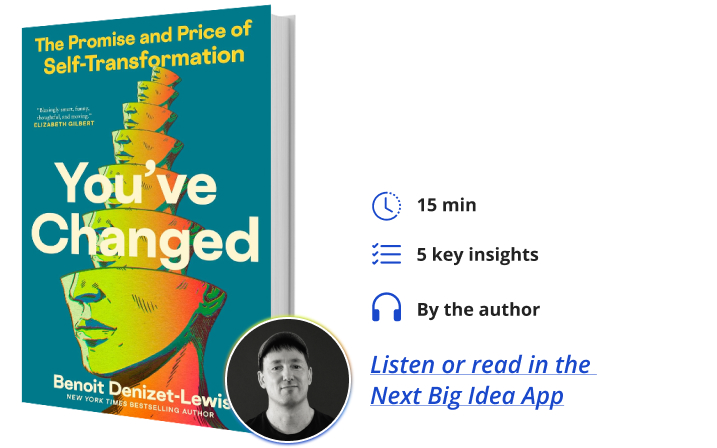
Below, Benoit Denizet-Lewis shares five key insights from his new book, You’ve Changed: The Promise and Price of Self-Transformation.
Benoit is a contributing writer for The New York Times Magazine, an associate professor at Emerson College, and a New York Times bestselling author.
What’s the big idea?
Can people really change? There’s the Instagram version of change. The TED Talk version. The version packaged by self-professed change agents eager to relieve you of your hard-earned money. But what does the real version—messy, partial, uncertain, sometimes humiliating, sometimes ineffable and seemingly miraculous—look like? The only honest way to tackle change is with humility riding shotgun and holding the map upside down.
Listen to the audio version of this Book Bite—read by Benoit himself—in the Next Big Idea App, or buy the book.

1. Change has changed.
Over the last decade, we’ve been living through the most dramatic wave of personal change since the 1970s, which was another era marked by social upheaval and political disillusionment. But there’s a crucial difference.
Back then, transformation usually required escape. People moved to ashrams, communes, or California. Today, it rarely requires leaving your bedroom. Change unfolds in a strange duality: performed for the world online, yet often conceived and experienced in isolation. When institutions falter and we feel increasingly powerless, changing the self—our beliefs, identities, bodies, names—can feel like one of the few forms of agency left.
We’ve always had to convince someone that we’ve changed. A spouse. A parent. If we were really unlucky, a parole board. Now the audience is everyone. In the age of social media and permanent archives, transformation isn’t just experienced. It’s narrated, justified, branded, defended. We track announcements, apologies, pivots, and pronoun changes. We’re all on the parole board now.
When someone changes in a direction we approve of, we call it brave. Growth. Evolution. When someone veers in a direction we dislike, we call it confusion, radicalization, or a too-long trip down the rabbit hole, which is how we might explain the actions of one man I spoke to, who traded his downward dog cushion for a hatchet and tactical gear to storm the Capitol over imaginary election fraud. If change isn’t seen as delusion, it’s opportunism—the shift as grift.
To be fair, skepticism isn’t irrational. Has someone really changed just because they declare it? The louder the proclamation, the warier we should probably be. But here’s the tension: We live in a culture that demands visible transformation and simultaneously distrusts it. That makes genuine change harder to recognize and harder to sustain.
2. Actually, we do change for other people.
We like to say you have to change for yourself. It sounds bracing. Mature. Empowered. It’s also often wrong. After six years spent talking to people who had remade their lives—and others still trying—I’ve come to see how rarely transformation is a solo achievement. It’s relational, contingent, and often reluctant.
The paroled murderers I spent time with didn’t describe change as heroic willpower. Many talked about a mother who refused to believe they couldn’t change. A cellmate who modeled something better. A religious experience they couldn’t explain. People get sober because they don’t want to lose their kids. They start therapy because their marriage is collapsing. They soften because the alternative is dying alone.
“Beyond the fear of failure lurk deeper reasons to default to inertia, including the unsettling possibility of losing ourselves.”
Even when we insist we’re changing “for ourselves,” we’re unreliable narrators. Therapists will tell you: patients aren’t exactly to be trusted when they declare their desire for transformation.
We both want to change and to stay the same. Many of us aren’t so sure change will happen. Even the simplest New Year’s resolution is typically abandoned by February. For those of us with a history of false starts, flirting with change can feel like a dangerous game we’d rather sit out than lose again.
Beyond the fear of failure lurk deeper reasons to default to inertia, including the unsettling possibility of losing ourselves. Profound change, as James Baldwin understood it, “implies the breakup of the world as one has always known it, the loss of all that gave one an identity, the end of safety.” Even a negative identity—addict, criminal, internet troll—can seem preferable to that.
We don’t build ourselves from scratch. We revise in response to love and shame, fear and longing, pressure and loss. Change isn’t a solo project. It’s better understood as an often-hazardous team sport.
3. Doubt isn’t a red flag.
We talk about change as if it should feel decisive. A clean break. But from the inside, it rarely does. We backslide. We equivocate. We wonder if we’re fooling ourselves. We worry we’ll change our minds and change back to what we were—and then what will everyone think? There’s an additional possibility. What if we change too much? Push away the few people foolish enough to love us as we are?
Doubt can also be weaponized, with any hesitation seized upon as proof that your change isn’t real. So, at a time when change is booby-trapped with culture-war politics, feigned certainty usually prevails. But dig into real change stories and doubt is everywhere. I met pastors quietly losing their faith, for whom doubt was a professional landmine. I met political shapeshifters who privately wrestled with their beliefs while publicly insisting they hadn’t changed at all. I met trans people, detransitioners, and retransitioners whose private questions were fraught because any hesitation could be used against them. In these stories, doubt wasn’t the absence of change. It was the friction of it.
“We worry we’ll change our minds and change back to what we were—and then what will everyone think?”
The psychiatrist Robert Jay Lifton once described a flexible, adaptive identity the protean self, and he argued that doubt wasn’t a flaw of that condition. It was its defining feature. Doubt doesn’t undermine change. It keeps it honest. If we want transformation to be real—our own and others—we have to make room for uncertainty. Not as weakness, but as evidence that something real is happening.
4. Change can happen in an instant.
We tend to assume meaningful change is slow. Incremental. Earned. Often, it is. But sometimes people change in an instant. Epiphany. Satori. Quantum change. The holy-shit moment.
The neuroscientists Andrew Newberg and Mark Robert Waldman insist that, “The big Enlightenment experiences are the ones that ultimately relieve suffering and bring peace and happiness to people.” And yet we remain deeply suspicious of these experiences. Psychology has traditionally been more comfortable studying breakdown than breakthrough. A sudden collapse makes sense. Trauma can shatter life in an instant.
But a sudden positive transformation? The psychologist William Miller began asking a destabilizing question decades ago: Might there be such a thing as a breakdown in reverse? Many colleagues were skeptical. Even one supporter wondered whether so-called overnight transformations were just the culmination of slow, invisible change—like someone walking through heavy fog and suddenly realizing, “I’m wet.”
Today, as psychedelics become mainstream, more people report rapid spiritual or identity-level shifts—some ecstatic, some destabilizing. I attended a conference in Atlanta hosted by the American Center for the Integration of Spiritually Transformative Experiences, which helps people navigate what they call spiritual emergencies, meaning moments when powerful experiences overwhelm emotional wiring.
It’s not always easy to distinguish delusion from transformation. Joseph Campbell captured the ambiguity perfectly: “The psychotic drowns in the same waters in which the mystic swims with delight.” What fascinated me most wasn’t the certainty people felt in those moments. It was the aftermath. The months, sometimes years, spent asking: Did I lose my mind? Or did I finally come to my senses?
5. Being the change is not easy.
Does real change begin inward or outward? The phrase “Be the change you want to see happen” has had astonishing staying power. It’s become a secular mantra repeated at retreat centers, on protest placards, and on your progressive aunt’s Facebook page. It’s roomy enough to hold both fierce activism and quiet self-work. Brands love it. Politicians love it.
The viral aphorism came from a woman living in an Arizona retirement community—Arleen Lorrance—whom I spent time with while wrestling with a debate we’ve been having since the 1970s: Should we focus on inner work? Or on changing the world?
“What if relentless self-improvement is part of the problem?”
That question feels especially urgent now, in our surreal and destabilizing time of psychic despair, cultural unmooring, global unrest, political delirium, and technological disruption— including artificial intelligence that promises to optimize our thinking, refine our identities, and predict who we will become.
What if relentless self-improvement is part of the problem? What if optimizing our habits, productivity, and mindfulness becomes a way of avoiding collective responsibility? And yet, look outward for too long and you risk drowning. We now consume more suffering in a single day than our ancestors encountered in a lifetime: local violence, distant wars, climate collapse, democratic decay, AI upheaval, cruelty on loop. Our brains evolved to scan for nearby threats, not to metabolize the anguish of eight billion people.
The tension is real. How much anguish should we bear witness to? Is checking out ever ethical? Is meaningful inner change even possible when we’re chronically distracted and wired for outrage? With the help of Arleen Lorrance, I try to sketch a blueprint for how to live, but also for how to think about change more honestly in a destabilized age.
You’ve Changed doesn’t tell you who to become. I’m not a self-appointed change agent out to fix you. The book asks what change looks like in real lives—messy, partial, contradictory—and whether we might allow ourselves and one another to evolve without demanding perfection, certainty, or speed.
Because, let’s face it, something needs to change. If not for our world, then at least for ourselves. And if not for ourselves, then at least for our world.
Enjoy our full library of Book Bites—read by the authors!—in the Next Big Idea App: