















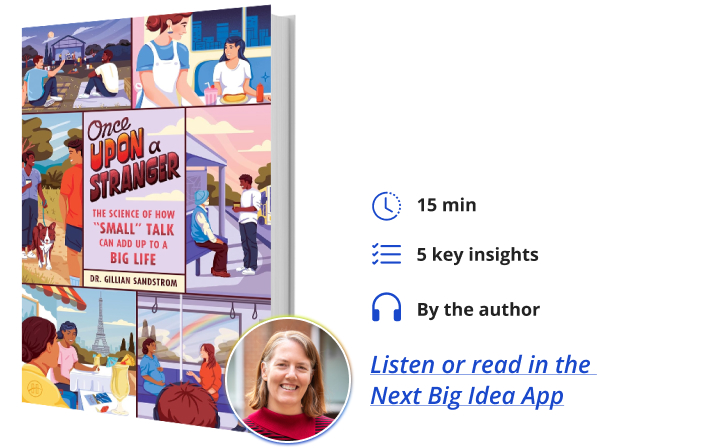
Below, Gillian Sandstrom shares five key insights from her new book, Once Upon a Stranger: The Science of How “Small” Talk Can Add Up to a Big Life.
Gillian is an Associate Professor in the Psychology of Kindness at the University of Sussex. She has talked to hundreds of strangers, personally and for research purposes. Her work has been featured in the New York Times, The Wall Street Journal, and The Atlantic, among other outlets around the world.
What’s the big idea?
Talking to strangers isn’t as scary or risky as we imagine. Most of the barriers are in your head, and even brief, simple interactions can enrich your life, expand your opportunities, and make the world a little kinder.
Listen to the audio version of this Book Bite—read by Gillian herself—in the Next Big Idea App, or buy the book.

1. It’s natural to feel nervous, but you’re more worried than you need to be.
Although we tend to think we’re better than average in most ways—we think we’re a better driver, more honest, etc.—we don’t think we’re better than average when it comes to social skills, like having a casual conversation at a dinner party. It’s not just you, and that’s comforting.
As a kid, I found it super embarrassing that my dad loves talking to strangers. I worried specifically that he would make people nervous, that he’d bother people, and that people wouldn’t want to talk to him. Over the years, I’ve asked a lot of people about their worries. It turns out that people worry about so many things:
- What if it’s boring?
- What if they don’t want to talk to me?
- What if they think I’m hitting on them?
- What will they think of me–isn’t it against the rules?
- What if I can’t figure out what to say?
Some of these things might happen sometimes. I’ve been stuck on a train listening to someone complain about their work. I’ve tried to strike up a conversation, only to have the other person plug in their earbuds. I’ve tried to crack a joke that was met with confusion. But these things don’t happen very often, and when they do, they don’t feel as bad as we fear, and the bad feelings don’t last for very long.
I’ve lived to tell the tale of my failures, and it hasn’t stopped me from trying again. We don’t love every meal or every TV show, but we don’t stop trying new restaurants. We still watch the next show that everyone is talking about. Some conversations are unfulfilling, but I pay the price because I know that many more will be interesting, useful, or meaningful.
Whatever your worries, the research is extremely comforting:
- Rejection happens far less often than you might imagine. In one of my research studies, only 40 percent of people thought they’d be able to strike up a conversation with the first person they approached, but 90 percent were successful.
- People like us more than we think—a phenomenon referred to in the research as the “liking gap.”
- We worry more than we need to. In study after study, after people have a conversation with a stranger, they are forced to admit that none of the things they had worried about had come true.
- Most of the time, after people get over their initial confusion about why a stranger is talking to them, they are happy to chat, and we tend to have a pleasant conversation.
When I started doing my research, I wanted to understand people’s fears and then figure out a way to reduce them. I thought: If there are barriers between you and your goal, then you focus on how to break down the barriers. But in this case, the barriers are ones we’ve created in our heads.
We don’t need to break down the barriers after all. Mark Twain said, “Courage is resistance to fear, mastery of fear; not absence of fear.” If we can find a way to muster a tiny bit of social courage, then we can talk to strangers in spite of our fears.
2. You can learn how to talk to strangers—even if you’re an introvert.
Talking to strangers takes a bit of confidence and social skills, but it’s not complicated. You already talk to people all the time. We can experiment and learn what works for us and, like other skills, talking to strangers gets easier with repeated practice. We can’t all expect to immediately be as skillful at it as my dad. We can learn:
- How to choose people and situations that make it a little easier.
- How to start a conversation—maybe a question, comment, or kind gesture.
- How to help make it easier for others to start conversations with us.
There are baby steps we can take to work our way up to talking if we’re not ready yet, starting with maintaining eye contact, paying attention to others, and visualizing a pleasant conversation.
I know people can learn because I ran a research study where people played a talking-to-strangers scavenger hunt. Every day for a week, participants had to practice talking to strangers, completing missions like “find someone who’s drinking a coffee” or “find someone who’s wearing a hat.” After a week of repeated practice, people were less worried about being rejected, and they were more confident in their conversational skills. Practice makes progress.
3. There’s so much to gain from talking to strangers.
When I was a kid, I couldn’t figure out why my dad was always talking to strangers. What did he get from it? Now I understand:
- It’s fun. It adds a spark of novelty and richness to life.
- It makes us feel seen, which is crucial for well-being. One day, I was walking in my local green space, stuck in my own head, holding back tears. Then, a lady pushing a baby carriage smiled at me. I didn’t instantly feel better, but her smile interrupted my negative thought spiral, and a small shift happened inside me.
- When we talk to people, we learn. Maybe we learn random fun facts, or helpful information like directions or new opportunities.
When you talk to a stranger, you plant seeds that might grow into a new acquaintance or friend, a new client or business opportunity, or a new path that could change your life. Strangers model possibilities that we may not have considered.
I’ve had a few boring or slightly uncomfortable conversations and lots of unmemorable ones, but I’ve also had so many that have been enjoyable, valuable, and meaningful. A few conversations have even changed my life. One contributed to me changing careers (I used to be a computer programmer). A conversation on the Tube in London contributed to my taking up cello lessons. And, of course, my husband used to be a stranger.
4. Learning how to talk to strangers pays off in unexpected ways.
When you talk to strangers, you:
- Become more comfortable with rejection. You’re a little more likely to think “what’s the worst that can happen?” Talking to strangers has helped me do things like ask a LinkedIn contact to introduce me to someone and ask a potential employer for a meeting to learn more about a job I wanted to apply for.
- Become more comfortable with uncertainty. It’s impossible to know how a conversation with a stranger will go. This is both scary and exciting! Talking to strangers helps you stay open to curiosity instead of closing off in fear.
- Start to think more positively about other people. I walk around the world differently now, feeling safer, happier, and more trusting of others. This gradual change in outlook has been, for me, the biggest benefit.
5. Talking to strangers puts some good into the world.
Research finds that people are kinder than we think. It’s easy to underestimate others’ kindness because people aren’t as kind as they’d like to be. They—we—worry about kindness being misconstrued or about it being awkward—for the recipient and us.
Kindness between strangers can be simpler than kindness between people who are acquainted. When you’re kind to a stranger, your motivations are clear. You’re not currying favor; you won’t see them again, so their opinion of you doesn’t matter. You’re not looking for them to return the favor in the future. When you’re kind to a stranger, it’s clear that you’re simply doing it because you want to put some good into the world.
It’s possible to be kind to a stranger without talking to them: you can let a car pull out ahead of you on the road or hold the door open for someone. But generally, to be kind—to offer a compliment, or directions, or assistance—you need to talk, at least a little bit. And so, learning to talk to strangers allows you to be more kind.
It’s so simple. It doesn’t cost anything. It doesn’t take much time. Simply noticing and acknowledging a stranger—saying hello or making eye contact—is an act of kindness and humanity in our increasingly disconnected world.
Enjoy our full library of Book Bites—read by the authors!—in the Next Big Idea App: