















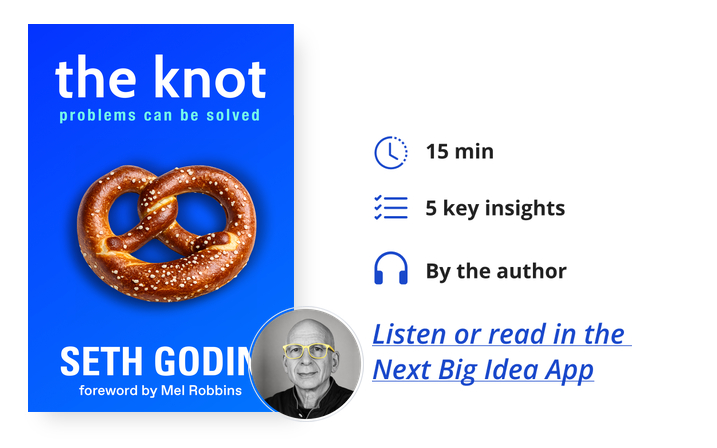
Below, Seth Godin shares five key insights from his new book, The Knot: Problems Can Be Solved.
Seth is a bestselling author, entrepreneur, and one of the world’s most influential thinkers on marketing, leadership, and creativity. He has written more than 20 books, including The Dip, Purple Cow, and This Is Marketing, and has published thousands of posts on his widely read daily blog.
What’s the Big Idea?
We often stay stuck because we confuse situations we must accept with problems we can solve, while dragging along old identities, imagined expectations, and sunk costs. Getting unstuck means seeing the problem clearly, deciding what the work is for, and letting go of whatever no longer serves that purpose.
Listen to the audio version of this Book Bite—read by Seth himself—in the Next Big Idea App, or buy the book.

1. Gravity is a situation. The moon is a problem. Problems can be solved.
Mel Robbins helps us understand what a situation is. A situation is something we can’t do anything about; a situation is something we should accept and move on from. She says we should just let them. When we’re stuck with a situation, we can acknowledge it, accept it, and then use it as the foundation for the work we are going to do.
But problems—all problems—can be solved. That’s why we call them problems. Getting to the moon is a problem because of gravity. We get stuck because we are looking at problems the wrong way. Sometimes we give up too soon, and other times, we waste enormous amounts of time fighting a situation. The word “transfixed” means pierced by a spear and held in place. We can let go of the spear. If there’s a problem, there’s a way through. We may not like the price, we may not like the consequences, we may not like what it costs us to get to the other side, but the problem can be solved.
I’m recording this on an island as I take a week off, and I was at a supermarket. A young man came up to me and asked if it was me, and I said it was, and he told me that his father had been one of my editors 35 years ago. He said, “I really like your work for two reasons: it’s simple and it’s hard.” It’s simple because it helps us see what’s right in front of us, and it’s hard because once we see it, we have to do something with what we learn.
2. Two three-letter words: “but” and “and.”
We’re stuck because we are entangled, like a knot with ropes linking and circling each other that we can’t discern. We are entangled with all sorts of nonsense, real and imagined, and what we need to do is figure out whether the multiple things we want are “buts” (which means they are mutually exclusive) or “ands” (which means they point us in the same direction). “I want to run the marathon, but I don’t want to get tired.” That “but” paralyzes us. “I want to run the marathon, and I’m eager to get tired” pushes us in exactly the right direction.
In the book, I tell the story of Jackson Pollock, perhaps the greatest American artist of the 20th century, certainly the most famous at his moment in the ’50s—on the cover of Life magazine, avatar for an entire generation of artists. Jackson Pollock had a three-year run where he could do no wrong. Every painting instantly sold, and he was described as the future.
“We’re stuck because we are entangled, like a knot with ropes linking and circling each other that we can’t discern.”
His widow, Lee Krasner, later said that Jackson felt like he had exhausted everything he could do with that avenue. Some people would have just kept painting versions of the original Jackson Pollock, creating covers of themselves. They would have been more famous and richer. Jackson didn’t want to do that. He wanted to experience what it meant to be an outsider artist, the person who’s working on the frontier. So he changed his style, changed the scale of the work, changed how he did the work, and went away for months.
When he came back, he launched a big new show, and not one painting sold. It was a failure. The critics didn’t know what to make of it. That threw him for a loop. It led him to depression and heavy drinking and other substance abuse, and he ended up dying in a tragic car crash that he caused, killing someone else as well.
Jackson Pollock wanted two things at the same time. He wanted to be a creative working on the edge, but he also wanted to be embraced, celebrated, and successful. He forgot how long that took the first time. “I want to come up with something innovative, but I don’t want anyone to misunderstand me.” You can’t have both at the same time. We must do one thing at a time. We can do many things over time. One thing at a time. We have to let go of the buts.
3. The entanglements are not in the room.
The things we need to look for are not here and they are not now. When you look at someone like Steve Ballmer criticizing the early iPhones—flatly, clearly announcing that they would never work—he was hooked on the past he had worked so hard to build, and hooked on a future that he was counting on to arrive. Because he was confused about time, he was entangled.
We also get hooked or stuck on phantom judges—people who aren’t in the room with us, who might not even be aware we exist. The cool kids from the lunchroom who don’t remember you from high school. The people down the hall who will never be your backers or your customers. But what if they notice something we’re doing, and it doesn’t work out? These stakeholders—the ones who aren’t in the room, the ones we think are demanding that we come up with something that they don’t even know about—they lead us to entanglements.
“We get to choose what success looks like.”
The third hook or snag: borrowed scorecards. Borrowed scorecards are measurements that are important to Mark Zuckerberg, measurements that are important to the local venture capitalist, measurements that are important to the person down the street. Those measurements don’t have to be our measurements. We get to choose what success looks like.
We also get entangled with identity: who we think we are, who we think we should become. How do we forgive ourselves for not becoming that person? That person in our head might be disappointed in the short run, but they are not you. You are not the imagined identity. You are the person here to make something better.
4. Intentional design.
We get to design on purpose, with purpose. What is this for? Who is this for? Not the purpose you are born with—I’m not sure what that is—but the purpose of the work, of spending the time, of interrupting the other people, of investing in the process, of taking the risk. Why are we doing it at all? Will solving this problem help us achieve whatever purpose we set out? Who are we here to help?
If we think it’s a problem that people aren’t signing on for what we’re doing, that’s not up to us. They don’t owe us anything. Practical empathy is the skill of saying, “I don’t see what you see, I don’t need what you need, I don’t want what you want, and that’s okay.” When we can forgive the world and the other person for not doing what we insist they do, we can see the actual problem and begin to solve it.
5. The one you’ve been waiting for: we have to ignore sunk costs.
These are gifts from our former self that we don’t have to accept. If you went to dental school for five years, and ten years into it you realize you have no future and you hate being a dentist, you can forgive the former you who earned that dental degree and handed it to you. You don’t have to accept it. When we put the cycles in, the hard work, to build an asset, to build a reputation, to make choices, to earn whatever spiritual or physical muscles we have, and then the world changes? The world doesn’t care about those gifts we gave ourselves.
“Many people don’t actually have the privilege and agency to make choices.”
What we get is the chance to start over in a way that solves the problem. Kelly Johnson built America’s first jet. The baggage was very clear: the committees, the approval chains, the inspections, the bureaucracy. We see the baggage, we name the baggage, and then we drop the baggage. What Kelly did was rent a circus tent, find 23 engineers instead of 200, make decisions in a heartbeat and contracts on a handshake. He delivered the jet 37 days early and under budget. He did it again and again.
So many people are caught. Many people don’t actually have the privilege and agency to make choices. Many people can’t do what you might be able to do right here and right now. They are caught with real walls, not unexamined ones. But each of us, if we have the chance, the shot, to show up and make a ruckus, to make things better, to lead—those are problems worth solving. Thank you for the work you do. Thank you for the work you’re about to do. We need you. Keep making a ruckus.
Enjoy our full library of Book Bites—read by the authors!—in the Next Big Idea App: