















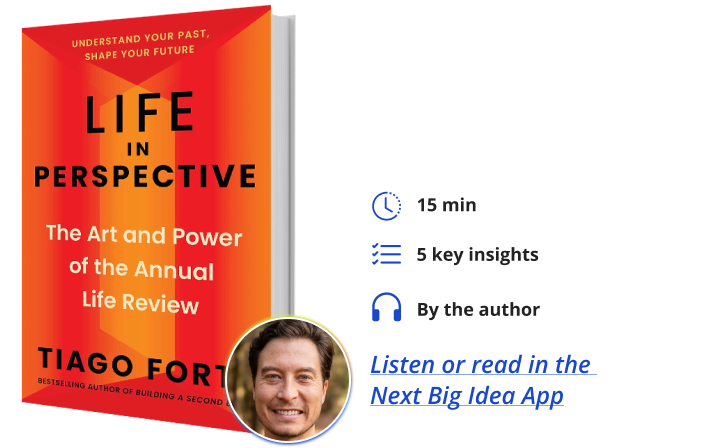
Below, Tiago Forte shares five key insights from his new book, Life in Perspective: The Art and Power of the Annual Life Review.
Tiago is a productivity expert and founder of Forte Labs, where he teaches people how to use technology to enhance their creativity and effectiveness. He is best known for developing the Building a Second Brain methodology.
What’s the Big Idea?
Most of us don’t get to choose our moments of clarity. They arrive by accident: a long flight, a chance conversation, a crisis that rearranges our priorities overnight. An annual review lets you create that clarity on purpose, once a year, for the rest of your life.
Listen to the audio version of this Book Bite—read by Tiago himself—in the Next Big Idea App, or buy the book.

1. Start with the past, not with goals.
Every January, millions of people sit down with a blank page and ask, “What do I want this year?” They try to reinvent themselves on the spot, ignoring everything their own history says about what that would take.
Before you set a single goal, spend a few hours looking back at the year you’ve lived: your calendar, the photos on your phone, your journal, the passages you highlighted. There are two reasons why this matters:
- Your memory is far less reliable than it feels. Every time you recall a memory, it gets subtly rewritten. And carrying a camera everywhere hasn’t fixed the problem. As Jason Farago wrote in The New York Times, we live in a time when “everything is recorded, nothing is remembered.”
- Your brain doesn’t have a separate system for imagining the future. Remembering and imagining run on the same core network. When you picture your future self, your brain is recombining fragments of your past into new scenarios. So the richer your picture of the past, the better your raw material for imagining what comes next.
There’s a practical payoff too. Dig beneath most people’s goals, and you’ll find that what they really want is to feel a certain way: at peace, in control, proud of themselves. Instead of projecting that feeling onto some distant future, you can look back at the last time you felt it and study what made it possible.
Your past is the most reliable evidence you have about what makes you come alive. Start there.
2. Stop giving yourself a performance review.
When most of us look back on our year, we slip into the only mode of evaluation we know: judgment. We tally up where we fell short, catalog our failures, and hand down a verdict. It feels rigorous. The research says it backfires.
In a Gallup study called “More Harm Than Good,” only 14 percent of employees strongly agreed that their performance reviews inspired them to improve. About a third of the time, reviews made performance worse. Critical feedback puts people on the defensive. If that’s what criticism does coming from a manager, imagine what it does coming from inside your own head.
So use a different lens: appreciation. The word “appreciate” has two meanings. It means to recognize the value of something. It’s also what happens to an asset over time: it grows in value. What you appreciate appreciates. Ask “What went surprisingly well?” before you ask, “Why did I fail?”
“About a third of the time, reviews made performance worse.”
This also means your review should be enjoyable. Honest reflection will sometimes bring up hard emotions, and that’s fine. But if you find yourself dreading any part of it, that’s the number one warning sign you’ve gone off track. If journaling feels like pulling teeth, record voice memos on a walk instead. Spread your photos across the floor. Put on your favorite music.
One of my students put it this way after trying this approach: “I’ve spent years treating my life as a list of problems to solve. But what if, instead of fixing myself, I changed how I see myself?”
In a war with yourself, you always lose.
3. Complain and compare, on purpose.
We’ve been told since childhood not to complain or compare ourselves to others. During your review, I suggest doing both deliberately.
Start with complaining. Pick the area of life you’re least happy with and spend half an hour writing out every specific symptom. What exactly is wrong? What’s missing? What isn’t fair? Think of it like describing symptoms to a doctor. Hiding them only leads to the wrong diagnosis.
Then comes the hard part: resist the urge to fix anything yet. The moment you jump to solutions, your understanding crystallizes and your learning stops. You latch onto the first plausible fix. Instead, look at the whole list and ask what single source might be driving all of it. A dozen separate problems often trace back to one root cause, and you’ll never see it if you rush to treat each symptom one at a time.
Now, comparison. The standard advice is to stop comparing yourself to others, and it has never really worked. Use those comparisons as data. Jealousy is one of the most honest emotions we have, precisely because we can’t control it. You don’t get to choose what provokes your envy. That means it’s pointing at a desire or a value you may not have admitted to yourself yet.
“Jealousy is one of the most honest emotions we have, precisely because we can’t control it.”
So the next time someone’s post gives you a flash of envy, skip the shame and get curious. What exactly do they have that you want? Then bring yourself back to your own baseline. Swap “Am I successful?” for “Where have I succeeded?” Swap “Am I happy?” for “What am I happy about?” Your complaints show you what needs to change. Your envy shows you what you want instead.
4. Let your emotions cast a vote.
Most goal-setting advice speaks the language of the intellect: systems, objectives, strategy, discipline. Smart, capable people are especially prone to making plans that make perfect sense logically and zero sense at the level of the heart.
We’ve been taught that emotions cloud our judgment. But the neuroscientist Antonio Damasio spent decades studying patients with damage to the emotional centers of their brains. Their logic was perfectly intact, yet they struggled to make even simple decisions, like what to eat for lunch or when to schedule an appointment. Without emotion, every option looked equally valid.
Emotions are the foundation of good decisions. They’re your nervous system’s way of compressing a lifetime of experience into a signal you can feel before you can put it into words. So when you’re weighing a new direction or commitment for the year ahead, pay attention to your body. Look for “three signs of yes”:
- A quickening of your breath
- A flush of warmth in your face or chest
- A tingling at the back of your neck
- Goosebumps
- A catch in your throat
Any one of these on its own could be nothing. When three or more show up together, your intuition is casting a vote.
The opposite signal matters just as much. Notice the knot in your stomach when you think about a certain commitment, or the way some tasks keep getting pushed to next week, and the week after. That’s your internal “no.” You have to hear it before you can say it out loud.
Don’t act on impulse but give your intuition a seat at the table for the one ritual of the year designed to hear it. Your mind can rationalize anything. Your body tells the truth.
5. Plan for the three-week wall.
New Year’s resolutions have a bad reputation. But research by the psychologist John Norcross found that people who made formal resolutions were about 10 times more likely to succeed six months later than people with the same goals who didn’t. So setting the intention helps. The trouble starts a few weeks later.
The most common mistake after a review is starting too many new things in the rush of fresh energy. The psychologist Brian Little found that the average person juggles about 15 active projects at a time. Once you count everything you’re already committed to, most people have room for two or three new ones at most. So before adding anything, go through your current commitments and decide what to cancel, pause, or hand off.
And turn vague wishes into concrete projects. “Get healthier” has no beginning, no end, and no obvious next step. “Complete a thirty-day walking challenge” does.
“To have more inflection points in your life, you need more reflection points.”
Then expect the wall. About three weeks after a review, the daily grind reasserts itself, and the vision starts to fade at the edges. The fitness app Strava analyzed eight hundred million data points from its users and named January 19th “Quitters’ Day,” the day most people abandon their new exercise habit.
The answer is structure. In one study, people who wrote down their goals and sent weekly progress updates to a friend achieved them at nearly twice the rate of those who only thought about them: 76 percent versus 43 percent. So share what you’re working toward with a few people you trust. And schedule check-ins: a short one each month, and a deeper one at the midpoint of the year.
To have more inflection points in your life, you need more reflection points.
Enjoy our full library of Book Bites—read by the authors!—in the Next Big Idea App: