















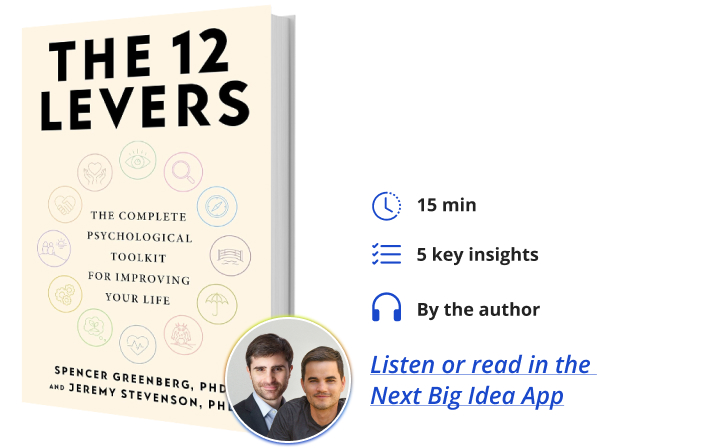
Below, Jeremy Stevenson and Spencer Greenberg share five key insights from their new book, The 12 Levers: The Complete Psychological Toolkit For Improving Your Life.
Jeremy is a clinical psychologist. Spencer is a psychology entrepreneur and mathematician who is founder and CEO of ClearerThinking.org.
What’s the Big Idea?
You don’t need hundreds of self-help ideas—you need the right techniques. Nearly every effective approach to personal growth can be traced back to just 12 core strategies that give you a practical framework for improving your life.
Listen to the audio version of this Book Bite—read by Jeremy—in the Next Big Idea App, or buy the book.

1. Self-help is overwhelming, but you can simplify it by focusing on the techniques.
The other day, I was browsing the self-help aisle of an airport bookstore. There was advice on everything:
- How to build good habits.
- How to transform pain into purpose.
- How to stop sweating the small stuff.
- How to have the courage to be disliked.
- How to reset your vagus nerve.
And it’s not just books. There are millions of podcast episodes and YouTube videos with neuroscientists, psychologists, psychiatrists, life coaches, and other gurus telling you how to improve your life. On top of all that, there are dozens of therapies, like acceptance and commitment therapy, cognitive behavioral therapy, and dialectical behavior therapy, that can also be used as self-help.
What are we supposed to do with this ocean of information? How do we make sense of it all and figure out what’s useful? We propose that you focus on the most important ingredient of self-help: the techniques.
Self-improvement resources contain various ingredients, like theory, stories, research, and case studies. But the techniques matter most. They’re the answer to the million-dollar question: what do you actually do to fix your problem? What do you do to reduce your anxiety or depression? What do you do to improve your happiness or productivity? What do you do to deepen your relationships?
Techniques matter because you control them directly. You can’t necessarily choose your feelings, beliefs, or circumstances, but you can always choose to try a technique. And effective techniques cause change—they can produce the outcomes you want, like greater fulfillment or stronger relationships.
2. Effective techniques can be surprisingly hard to find.
When I was younger, one pivotal discovery in my life was the concept of shame. It was a single word for an emotion that captured so much about my deepest struggles: feeling inferior, inadequate, not good enough.
You can imagine my excitement when I stumbled upon a book specifically on shame and how to overcome it. But that excitement didn’t last long. As I delved deeper into the book, all I found was page after page of theory—what shame is and what causes it. Even when I reached the final chapter on healing shame, there were no clear instructions on what to do.
It was a frustrating experience because I was left empty-handed. This is common in the self-help world. It can be hard to find effective techniques because they can be buried beneath piles of complex theory or scattered across different books and therapies.
“Even when I reached the final chapter on healing shame, there were no clear instructions on what to do.”
Sometimes, useful techniques are only known to therapists, or even worse, only known to a small number of therapists with a specific type of training. There’s no single place where you can find all the best techniques. Which means you’re likely unaware that highly effective techniques (that might perfectly match your circumstance) exist.
And even when you do have access to a promising technique, the instructions can be unclear or difficult to follow. You might be told to do things you can’t control, like “believe in yourself” or “stop thinking negatively.” Despite the abundance of self-help resources, almost no one knows the full range of effective techniques and how to apply them.
3. A lot of techniques are repackaged under different names.
Spencer and I have both had life-changing experiences from applying self-help techniques. We know firsthand the potential of good techniques. But we discovered that there’s a lot of overlap between self-help resources. You might have found this too. Once you get past the theory, stories, and motivational material, you often arrive at techniques that seem familiar.
You can even find this in therapies (which is where a lot of self-improvement techniques come from). When I was doing my PhD in clinical psychology, I was starting a placement in a PTSD clinic, and I was eager to learn about cognitive processing therapy. To my surprise, the core technique in cognitive processing therapy is the same as one of the core techniques in cognitive behavioral therapy. (The technique I’m talking about is cognitive restructuring, which involves reframing your thoughts to make them more accurate and helpful.)
Now, that doesn’t mean that this technique or those therapies don’t work. Far from it. Both cognitive processing therapy and cognitive behavioral therapy are gold-standard therapies. But this is a good example of the patterns in the self-improvement world. Even if the terminology differs, many techniques are repackaged or recycled. And the same techniques are often used for many different problems.
For example, cognitive restructuring, can be used to help nearly any difficult feeling, like depression, anxiety, shame, and even behavioral problems like procrastination. Or take mindfulness. Mindfulness can be used for many issues, from chronic pain to excessive worry. In the world of psychology, we call these techniques “transdiagnostic” because they can each be used to treat many different issues. There are a handful of techniques for a bucketload of problems.
4. All self-help techniques boil down to just 12 broad strategies.
After years of observing these patterns in self-help techniques, my coauthor Spencer and I decided to embark on a massive research project studying self-improvement resources. We went through famous books like The 7 Habits of Highly Effective People, How to Win Friends and Influence People, Atomic Habits, and The Subtle Art of Not Giving a F*ck. We did this for less famous books, too. Every time we came across a technique, we extracted it to a database.
“After two years of research, exploring 106 self-help books, 23 therapies, and numerous journal articles, videos, manuals, and other materials, we hit a saturation point.”
We also studied the protocols for therapies like acceptance and commitment therapy, compassion-focused therapy, and schema therapy, extracting whatever techniques could be applied as self-help. That database grew until we had a list of nearly 500 techniques. After two years of research, exploring 106 self-help books, 23 therapies, and numerous journal articles, videos, manuals, and other materials, we hit a saturation point. We stopped finding meaningfully new techniques, only variations of ones we’d already captured.
From there, we began to synthesize. We carefully reviewed each technique and grouped them into categories based on their similarities. This is where we made the central discovery: All the hundreds of techniques fell into just 12 distinct categories. We called these categories “The 12 Levers” because they reflect the broad strategies for improving your life—the Levers you can pull to create change. By contrast, we use the word techniques to refer to the specific ways one can implement each Lever.
Take Lever 3: Actualize your Guiding Foundations—that’s the broad strategy, which is about acting in line with your values. One specific technique within this Lever is habit formation. Levers are the macro. Techniques are the micro.
5. Knowing the 12 Levers can meaningfully improve your life.
When my coauthor Spencer was younger, he suffered from intense social anxiety. The mere idea of talking to a stranger would fill him with dread.
In his 20s, he decided to seek help. He saw a psychologist and learned a technique called exposure therapy. This involved gradually confronting his fears by doing challenges assigned by his psychologist. The challenges started simple, like asking strangers for the time. But they became increasingly outrageous, like walking up to random men in bars and politely asking for a hug. At first, these challenges filled him with terror, but remarkably quickly, they helped him overcome his social anxiety.
For me, my life changed when I read a book called A New Guide to Rational Living. The book taught cognitive restructuring, and it blew me away. It gave me a tool that reliably relieved my misery. The impact this book had on me is a big reason why I became a clinical psychologist in the first place. It showed me the power of a good technique.
“Different techniques will resonate in different situations and during different phases of life.”
But cognitive restructuring won’t work for everyone. Likewise, the technique Spencer used, exposure, won’t work for every problem. That’s why we need more than one technique.
I see this in my clinic. Certain clients gravitate toward cognitive techniques, like cognitive restructuring, whereas other clients gravitate toward physical techniques, like controlled breathing. Not only that, but different techniques will resonate in different situations and during different phases of life. I’ve been through phases where it really clicked to clarify my values, and other phases where it was more helpful to use attentional techniques like mindfulness. It’s valuable to have access to the full range of effective techniques.
Enjoy our full library of Book Bites—read by the authors!—in the Next Big Idea App: