















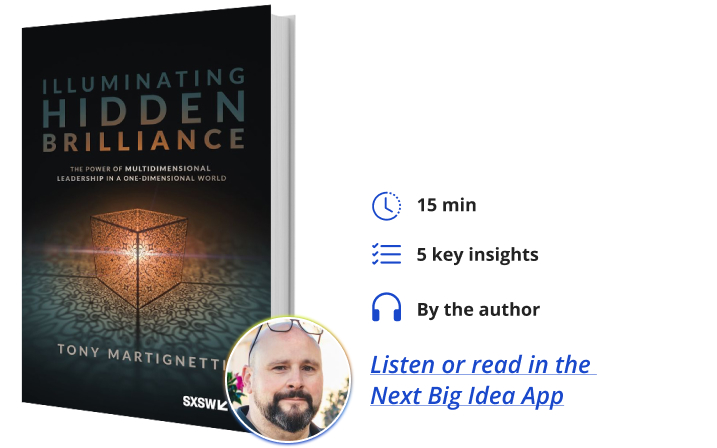
Below, Tony Martignetti shares four key insights from his new book, Illuminating Hidden Brilliance: The Power of Multidimensional Leadership in a One-Dimensional World.
Tony is a leadership and workplace culture advisor, global keynote speaker, experience designer, and the host of The Virtual Campfire podcast. He began his career as a finance and strategy executive in the high-tech and life sciences industries before leaving the corporate world to help leaders integrate all of who they are into how they lead.
What’s the Big Idea?
The world does not need more exhausted leaders. It needs integrated and multidimensional leaders who can serve as lighthouses for others. If you are ready to stop fragmenting your brilliance and start illuminating it, then the four phases of Illuminating Hidden Brilliance are for you.
Listen to the audio version of this Book Bite—read by Tony himself—in the Next Big Idea App, or buy the book.

1. Discover.
The first phase is about uncovering what’s been hidden. For decades, we’ve been sold a seductive story: focus narrowly, pick a lane, master one thing, and leave the rest of yourself at the door. That story made sense in the age of the assembly line, when problems were linear and predictable. That isn’t the world we’re leading in now.
I lived this myself. Early in my career, I took pride in being “the numbers guy.” But my real breakthroughs never came from the spreadsheets alone. They came when I paired that analytical rigor with something more creative, like sketching visual maps or drawing metaphors that helped executives feel the strategy instead of just understand it.
Now that AI has arrived, it could run those same models in seconds. But it is only able to replace the mechanical part of my contributions. What made me valuable was never the calculations. It was the ability to connect analysis with narrative and logic with imagination.
Integration isn’t dilution; it’s differentiation. AI is the ultimate specialist. Our human edge is curiosity, empathy, intuition, creativity, and the ability to make meaning across boundaries.
So how do you find what’s been hidden? One way is what I call Flashpoint Excavation. When I began interviewing guests on my podcast, I noticed a pattern. Every leader, whether a CEO, an artist, or a change maker, could trace their most significant growth to a single inflection point: a moment when the old story stopped working and a new one began. Those moments often came disguised as endings. But each one carried an ember of brilliance.
When have you hidden a part of yourself to fit the mold of professional success? And what did it cost you?
2. Distill.
Not every dimension needs equal airtime. Distilling is about deciding what matters most, what wants expression now, and what deserves protection.
The heart of this phase is learning to navigate polarities. Being multidimensional means living in constant tension: focus and freedom, logic and intuition, ambition and rest. We’re taught to pick a side and eliminate complexity. But these tensions aren’t flaws to fix. They’re the forces that shape growth.
I once coached a healthcare executive who constantly wrestled with the tension between compassion and performance. When we mapped that polarity, she realized her empathy wasn’t softening her results. It was strengthening her influence. Her teams trusted her more deeply, which made accountability easier to sustain. When she stopped choosing between results and relationships, both grew stronger.
“Being multidimensional means living in constant tension.”
I think of it like jazz. There’s a structure, a key, a beat, and within it, there’s improvisation. The music works because of the relationship between discipline and play. Leadership works the same way.
One of my clients, Alina, keeps a simple note on her desk that reads, “Hold both ambition and humility lightly.” Whenever she feels herself slipping into all-or-nothing thinking, those words bring her back.
Distilling also means finding your edge. When I left the corporate world, I thought freedom would be the reward. Instead, I found the chaos of too many possibilities. One morning, after weeks of trying to design the perfect business plan, I closed my laptop, walked outside, and said to myself, “I don’t need more space. I need better focus.”
So, I ran a small experiment. I called it Campfire Conversations: intimate gatherings where leaders shared the stories behind their breakthroughs. That single experiment created a depth I could never have planned, and it became the foundation of my work. I call this the Edge Effect. Brilliance doesn’t happen in endless open space. It happens at the edges, where freedom meets form.
3. Design.
With clarity in place, the third phase is about designing the practices, rhythms, and environments that sustain your brilliance. This is where leadership becomes intentional instead of reactive.
The first quality to design for is elasticity: the capacity to bend without breaking. I love the story of LEGO. In the early 2000s, the company was on the verge of collapse. It had expanded into video games, theme parks, fashion, and television. The problem wasn’t too little innovation. It was too much, too fast.
When Jørgen Vig Knudstorp became CEO, he did two things that seemed contradictory. First, he set limits. He cut the number of unique pieces in half and guided every decision with one question: Does this build on the brick? Then he opened the doors wider than ever, inviting fans around the world to design new sets. Structure and imagination stopped being enemies and became dance partners. As he put it, “We needed to become smaller and bigger at the same time.”
“You cannot live in a multidimensional life with a one-dimensional operating system.”
The second piece of Design is Presence Engineering. You cannot live in a multidimensional life with a one-dimensional operating system. Without intentional practices, expressing more of yourself can turn into scattered energy and role-switching fatigue. Presence Engineering gives you a throughline that holds your whole identity, so you don’t lose yourself as you expand.
When you design for integration, remarkable things can happen. Dina, a cardiac surgeon I once coached, told me privately, “I feel like a robot sometimes.” When I asked her the last time she’d lost herself in the moment, she quietly said, “When I used to paint.” She had hidden that part of herself for years. “You can’t be a serious surgeon and a painter,” she said.
A few weeks later, she faced one of the most complex cases of her career. She stepped up to the table and saw the patient’s heart differently. “It looked like something I wanted to paint,” she told me. Her team later described her movement that day as fluid, and almost choreographed, and the surgery was a success.
She designed small practices: sketching before difficult cases, taking two minutes outside before scrubbing in, and hanging her paintings in her office. Not only that, but she began telling her residents, “Technical precision saves lives, but your presence saves you.”
4. Deliver.
The final phase is about extending your integration outward into conversations, teams, organizations, and communities, so your leadership becomes a catalyst for collective brilliance. It often starts with a single conversation.
I once worked with a global tech company that was six weeks from a major product launch, and every meeting felt like a battlefield. Engineering said the product wasn’t ready. Marketing said the messaging was unclear. Finance said the budget was already over. No one could see the whole picture.
Then a quiet, mid-level product manager stepped in and said, “Before we talk about deliverables, let’s talk about realities. Paint me the picture of what you’re seeing.” Each group sketched its version of the problem on a whiteboard, and as they drew, a pattern appeared that everyone could finally see. Within two days, they’d redesigned the launch, and the product shipped on time.
She didn’t solve their problems. What she did was build a bridge between their worlds. That’s the kind of leader the future needs: interpreters and bridge builders who design conversations where people feel seen.
“People rarely copy what leaders say. They copy who leaders are.”
To sustain that impact over the long arc of a career, I come back to the image of a lighthouse. A lighthouse doesn’t shine in every direction with equal intensity. It doesn’t react to every wave passing. It stands rooted, and it rotates in a steady rhythm, and its light is focused, which is precisely why ships can steer by it.
Think of Ernest Shackleton. In 1915, his ship, the Endurance, was trapped in Antarctic ice and eventually sank. He understood that the greatest danger to his crew was the slow erosion of hope. So, he became their lighthouse, moving deliberately between roles: strategist, caretaker, challenger, and anchor, depending on what the moment required. His men later said they watched Shackleton more closely than the sun. Every single crew member survived.
His brilliance wasn’t dramatic. It was disciplined. People rarely copy what leaders say. They copy who leaders are. When you model wholeness, you give others permission to bring theirs.
The world doesn’t need more exhausted leaders shining endlessly in every direction. It requires integrated, multidimensional leaders who can shine steadily enough to guide others home. You don’t need to become louder, only clearer. And you don’t need to become someone new. You just need to let more of who you already are into the room.
Enjoy our full library of Book Bites—read by the authors!—in the Next Big Idea App: