















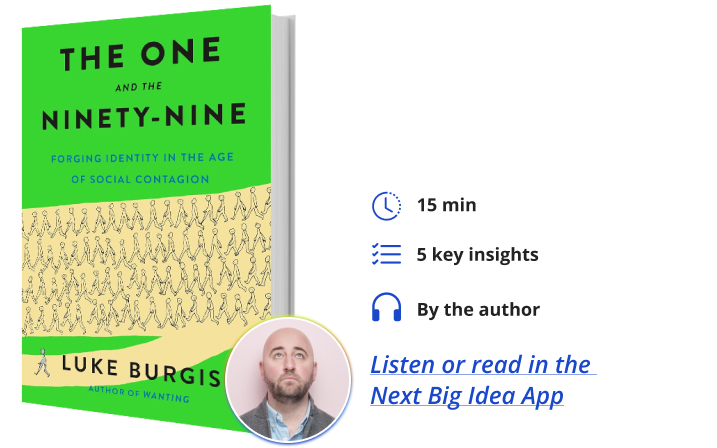
Below, Luke Burgis shares five key insights from his new book, The One and the Ninety-Nine: Forging Identity in the Age of Social Contagion.
Luke is a professor at The Catholic University of America, the director of The Cluny Institute, and the author of a previous book, Wanting, about mimetic desire.
What’s the Big Idea?
We’ve spent years learning how to find our tribe; now we need to learn how to belong without losing ourselves. The work of becoming a solid self—capable of truthful speech, authentic creation, and genuine community—is the defining challenge of our age.
Listen to the audio version of this Book Bite—read by Luke himself—in the Next Big Idea App, or buy the book.

1. How to leave a tribe.
For two decades, we’ve been told to find our tribe. But humans don’t lack tribal instincts—we’re drowning in them. The deeper skill needed today is the opposite: knowing how to leave a tribe and being able to belong to one without disappearing into it.
There’s a famous photograph from 1936 in a Hamburg shipyard. A sea of arms is raised in the Nazi salute. One man—almost certainly August Landmesser—stands with his arms folded. He doesn’t salute. He’d already been expelled from the Party for becoming engaged to a Jewish woman; he would later die in a penal battalion, and his fiancée would be killed in a camp. What strikes me isn’t his heroism. It’s that he wasn’t performing. He didn’t know a propagandist was photographing him from the bleachers. His refusal wasn’t shaped by the crowd, validation, or gain.
How do you cultivate that? Try making a real decision without first checking what others in the group are doing. Watch the gap that opens between your own conscience and the group’s. That gap is your “I”—separated, even briefly, from the conscience of the crowd. Do that often enough and you’ll start to feel the moments of tension or coercion when they arrive. That’s the signal. Draw a line or leave.
And when you leave, don’t be like a wing walker who never releases one wing without a hand already on the next. Leaving must cost something. Otherwise, you’ve only swapped one tribe for another, and the self you wanted to protect never had to show up at all.
2. The pseudo-self and the solid self.
In the 1950s, the psychiatrist Murray Bowen began to see the family not as a collection of individuals but as a single emotional system. He noticed that most of us live from what he called the pseudo-self—a negotiable version of the self that we adjust in real time to keep the group’s emotional system in equilibrium. The pseudo-self is acquired from others, and it’s negotiable in relationship with others. That makes it particularly susceptible to social contagion.
The opposite is what Bowen calls the solid self—the level of self that does not get renegotiated in every interaction. A person with a solid self can be part of a group without fusing with it. They can say what they believe without engaging in social calculus.
“We mistake the rise and fall of group anxiety for our own thinking.”
The essential term here is fusion. Most of us are fused with the emotional systems we’re embedded in—our family, our workplace, our political tribe—and we don’t see it. We mistake the rise and fall of group anxiety for our own thinking.
You’ve probably met someone with a solid self. They make it possible for you to be yourself, because you sense they don’t require your conformity. Such people are rare. Differentiation—Bowen’s word for the slow work of forming a solid self—is the central project of our age.
3. Make art, not content.
The jazz musician Ornette Coleman spent ten years in obscurity. He played in clubs that wanted Bing Crosby covers but played his own way instead, improvising melodies the audience didn’t recognize. He got fired from bands. He got beaten up by audiences. His mother sent him food in the mail because he was too broke to eat.
What he refused was what his fellow saxophonist Yusef Lateef called the “commodification of emotions” — the process by which deep, personal expression gets turned into a predictable, sellable product. Coleman put it bluntly: most people find a thing that hits, and they package it. He refused to package his art, because he knew that if he packaged the art, he’d eventually package himself.
There’s a contemporary phrase for what happens when we don’t refuse: audience capture. It’s what happens when a creator gradually, without realizing it, gets shaped by what their audience wants. The pull is invisible because it feels like success. The numbers go up. The applause is real. Slowly, the work bends toward whatever performs.
The point isn’t only about artists. We’re all packaging ourselves now—on LinkedIn, on social media, in how we describe what we do. The question worth carrying around is small but sharp: in any one thing I’m making today—a presentation, an email, a post, a project—am I responding to something real, or am I responding to what I think the audience wants? The first is art. The second is content. And the difference, over time, is who you become.
4. The unifying virtue.
Most of us evaluate communities by their stated values—the mission statement, the brand, the things people say they’re about. That’s almost always wrong.
The philosopher Dietrich von Hildebrand had a sharper idea. The strongest communities aren’t held together by personality, by proximity, or even by shared values. They’re held together by what he called a unifying virtue—an objective good that the members are actively pursuing, together.
“If you can name a community’s unifying virtue, you’ve come close to understanding its soul.”
Picture a global network of doctors racing to treat a new disease. They’ve never met. They work in different languages, different time zones. But they’re bound by something specific: rigorous attention, professional integrity, the moral urgency to relieve suffering. They form a real community, even though most of them will never meet.
In a monastery, the unifying virtue is obedience—not conformity, but a particular way of submitting to a shared rule. In a research lab, it might be intellectual honesty—the willingness to discard your favorite theory when the evidence overturns it. In a healthy family, fidelity—the daily choice to stay, to show up, to remain true over time. In a start-up, audacity. In a civil rights movement, courage in the face of danger.
If you can name a community’s unifying virtue, you’ve come close to understanding its soul. Why does that matter? Because communities form us. Whatever a group is animated by, you’re slowly becoming. Look at the groups you spend the most time in—your workplace, your friend group, the apps you scroll, the people in your text threads. What virtue, if any, is animating them? Because whatever it is, that’s the virtue (or vice) that’s quietly forming you.
5. Parrhesia means speech that costs something.
The ancient Greeks had a word for speech that costs something: parrhesia. Plain words, no hedging. Speech that matches the speaker’s deepest conviction. Speech that could cost them reputation, position, or even life. Motivated by care for others or the common good, and never by self-interest.
Michel Foucault devoted the last lectures of his life to parrhesia, and the figure he kept returning to was Diogenes of Sinope, the philosopher who slept in a barrel and walked through Athens with a lantern in broad daylight, saying, “I am searching for a man.” When Alexander the Great stood over him and offered him any wish in the world, Diogenes told him, “Stand out of my light.” That’s parrhesia in its most extreme form. But the principle isn’t extreme. It’s just speech that doesn’t calculate.
“Say plainly what you believe to be true.”
Here’s a test and a small practice. The test: in your home, your workplace, and your school, is it clear to everyone that no one is punished for simply saying what they believe to be true? Or are there quiet mechanisms that disincentivize parrhesia—soft penalties, social cooling, polite omissions?
The practice—pick one moment when you’d normally hedge to keep the peace: a meeting where you’d nod along, a conversation where you’d swallow what you actually think, an email where you’d add three apologies. Don’t. Say plainly what you believe to be true. Watch what happens in the room and inside you. That’s the muscle. It gets built the way every muscle gets built—through small, deliberate use, in moments most people would think too small to matter.
The work of becoming a solid self isn’t separate from the work of being in real community. They’re the same project.
Enjoy our full library of Book Bites—read by the authors!—in the Next Big Idea App: