













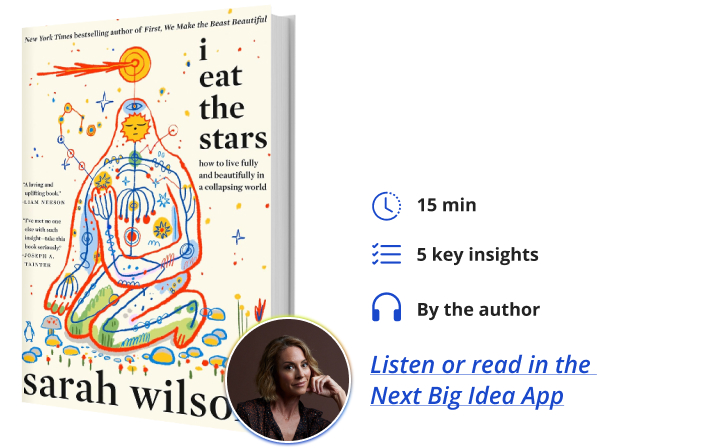
Below, Sarah Wilson shares five key insights from her new book, I Eat the Stars: How to Live Fully and Beautifully in a Collapsing World.
Sarah is a systems philosopher, podcaster and adventurer. She was previously a journalist and held the roles of editor of Cosmopolitan and opinion columnist and TV host at News Corp.
What’s the Big Idea?
Human civilization is entering a period of systemic collapse, but this collapse should be understood not only as a crisis but also as an opportunity to create a simpler, more humane, and sustainable way of living.
Listen to the audio version of this Book Bite—read by Sarah herself—in the Next Big Idea App, or buy the book.

1. Just like every other complex civilization, we’re going through a collapse.
It’s hard to fathom, let alone describe, what is going on in the world today. It’s a multi-pile-up of crises. We are hit hourly with headlines about climate catastrophes, tumbling democracies and fertility rates, AI singularity and nuclear threat, increasing economic inequality, genocides, and the rise of techno-fascist and authoritarian rule. But why now? And why everything all at once? Well, historians tell us we are undergoing what every sophisticated civilization before us has, and that is complex systems collapse. The unraveling of all the complex systems that make up the complex system that is our civilization.
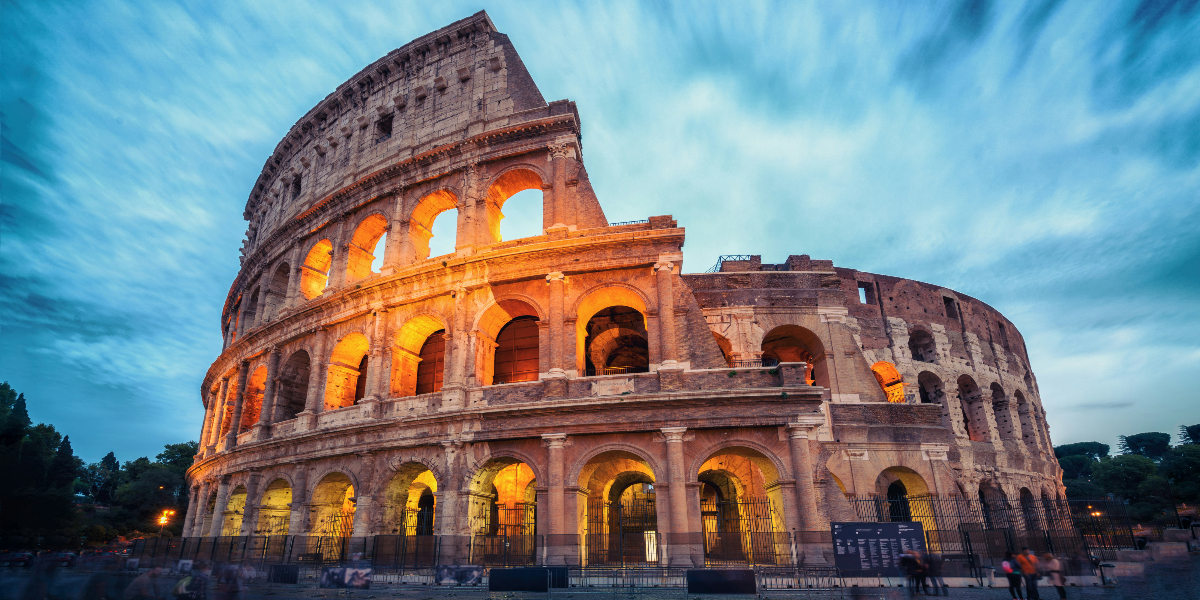
In the past 5,000 years, dozens of complex civilizations have existed: think of the Roman and Mayan empires or the Jing dynasty. Every one of them collapsed because they became too complex. They buckled under layers of bureaucracy, expanding cities and populations, resource and energy use, and chaos, like a house that can no longer hold all the extensions. All complex systems in nature exist within a finite vessel.
Various energy, futurist, economic, climate, and population modeling show that our extremely complex civilization is going the same way. It feels like everything is collapsing all at once because, well, it is. Most civilizations collapse, leaving little trace, around the 330-year mark. Our civilization—the post-industrial civilization that kicked off once we discovered and perfected the use of fossil fuels—is roughly 270 years old.
2. Unlike previous collapsing civilizations, ours is global.
A lot of people are feeling overwhelmed by the state of the world. It’s totally understandable if these thoughts are causing you exhaustion, anxiety, or depression. This emotional experience is itself another factor of collapsing civilizations: they’re characterized by leaders stoking chaos and trying to overwhelm and distract everyday citizens.
The Romans threw bread and circuses. Today, in the U.S., the Trump administration’s adviser Steve Bannon is instructing us to be flooded with distracting, maddening, polarizing misinformation. As Hannah Arendt wrote of the Nazi period, the constant lying was not aimed at making people believe a lie but ensuring that no one believes anything anymore. That’s what we’re seeing happening in much of the world today. Leaders are overwhelming and distracting us from their efforts to enforce problematic policies.
“Constant lying was not aimed at making people believe a lie but ensuring that no one believes anything anymore.”
Planting conspiracies and general social media pot-stirring are classic chaos-making tactics. Remember in the lead-up to the 2016 U.S. election when those conspiracies surfaced about Hillary Clinton running a child sex trafficking racket under a pizza shop in Washington, D.C.? Well, it was soon revealed that this conspiracy mill was being stoked by hackers and trolls operating out of Russian bot factories run by the Kremlin’s Internet Research Academy.
These same bots were simultaneously feeding anti-Trump mayhem into America’s social feeds. Why would they spread rumors about both sides? The answer is chaos. As the director of the Alliance for Securing Democracy said of the phenomenon, chaos is now the point.
Once we realize that chaos has become the point, we can galvanize against it. We can choose not to add to the chaos by simply not reacting in panic and not being distracted or overwhelmed. Instead, we commit ourselves to staying sane and focused on preserving democracy wherever we can, resisting problematic AI laws and regaining control of our own attention.
3. We might just be onto something about being human.
What I’m describing might strike you as terrifying and hopeless, but we’re actually talking about the death of a system that can no longer serve us: The neoliberal, extractivist, colonialist civilization we’ve existed in for 270 years. While it might have served a lot of us for a while, it is now causing a lot of pain.
To keep it going entails using 40,000 child slaves in the Congo to extract cobalt for our iPhones and other technologies that we can’t live without now. It requires burning untold amounts of fossil fuel and crossing planetary boundaries. Indeed, we just crossed the seventh of the nine boundaries as I was editing this book. It’s causing our kids to develop anxiety disorders and species to go extinct while people are losing their jobs to AI. And besides all of this, it’s a system of complex systems predicated on a very flawed notion of infinite growth on a finite planet. That was never going to hold. We were always going to hit a limit eventually.
Viewed through this lens, what’s going on might be a good thing. It might lead to a more equitable, humane future—a new system that works better for us. The American philosopher, the late Jonathan Lear, fleshes out what he calls a radical hope. Lear describes radical hope as an honest reckoning that entails moving forward in the face of “unbearable loss and with no rational justification for hope, just the hunch that we are onto something important about being human.” In many ways, what we are going through could also be viewed as a homecoming.
4. We have always danced through crisis.
As I was writing my book, I felt a need to dance. It’s not something that I’ve done before, at least not a lot. I dug down into why this might be so and it turns out humans have often turned to dance during uncertain, difficult times.
According to historians, we danced in the aftermath of the Black Death. There are reports of monks traveling across Europe, encountering villages where people danced as though under a crazed spell. We also danced in the wake of the French Revolution. I’d read a while back about the dance marathon craze that swept Europe and the U.S. before those liminal years between the World Wars—a period not too dissimilar from our own. Young people in deep pain and grief, having lost friends, lovers, and siblings to both a war and a pandemic, would attend these organized competitions, like you might attend an open mic night today. Sometimes they’d dance for months with only 15-minute breaks. Audiences would cheer from the bleachers.
“When humans are faced with a threat, it triggers the fight-or-flight response, and dancing may help release the stress hormones that have built up.”
The French historian Philippe de Félichy wrote that eras of greatest material and moral distress seem to be those during which people dance most. But why? When humans are faced with a threat, it triggers the fight-or-flight response, and dancing may help release the stress hormones that have built up, allowing us to regulate our nervous systems back to normal. It literally shakes off the terror.
Studies also show that fluid and intuitive movement, where we don’t anticipate the next move, like in dance, gets us comfortable with uncertainty and lack of closure. It also signals to our brains that we retain agency. It helps us shift focus from seeking reassurance in solid things like facts to finding it via our bodies in the feeling of wholeness within ourselves.
5. The solution is to simplify, not prep.
The collapse of complex systems could also be described as a simplification or undoing of everything that has been growing, expanding, complexifying, and becoming more interconnected and messier. It looks like electrical grid failures that will force us to live more analog with maps and paper address books. It will also look like less taxes to maintain cities and infrastructure. It will look like fuel prices going up so we’ll have to cut our car use. We’ll probably have food restrictions because the trade routes are cut or at least limited. This predicament has already become familiar to many of us.
One very dynamic salve is to get accustomed to simplicity before the system takes us there. Go analog wherever you can and learn some basic emergency survival skills, or perhaps invest in a push bike. Is becoming a prepper the fix? Or buying land outside the city, stockpiling, and growing our own food the answer? It’s a question I get asked often.
“The most effective route for all of us is to simplify our lives and do it in a way that strengthens the community we already live in.”
Stockpiling won’t work. Not unless you’re prepared to defend your canned corn and batteries and so on—so does that mean with violence and a gun? Well, that goes against what I believe it means to be human.
Studies of intentional communities around the world show that fewer than five percent last longer than five years because, to survive, these communities require between 100 and 150 people working full-time, growing food, maintaining water systems, and protecting the whole lot. These studies show that the most effective route for all of us is to simplify our lives and do it in a way that strengthens the community we already live in.
Enjoy our full library of Book Bites—read by the authors!—in the Next Big Idea App: