













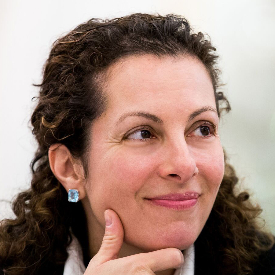
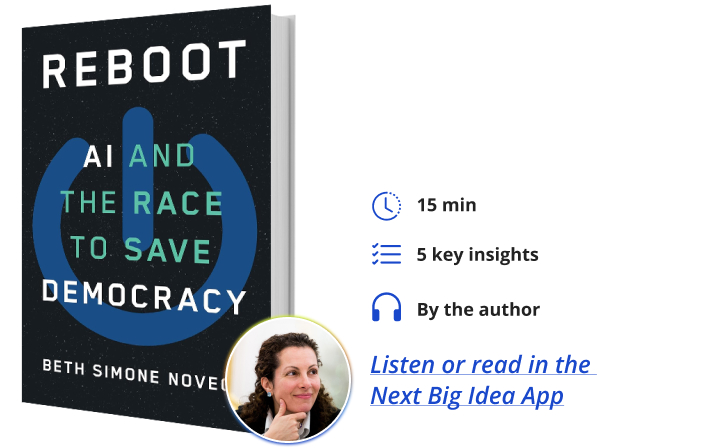
Below, Beth Simone Noveck shares five key insights from her new book, Reboot: AI and the Race to Save Democracy.
Beth has worked on and written about how we solve our hardest problems from the White House to 10 Downing Street to the German Chancellery and served as New Jersey’s first Chief AI Strategist. She is also a professor at Northeastern University.
What’s the Big Idea?
Just seven percent of young Americans see our democracy as healthy. Political violence is on the rise, and people are more willing to marry someone of another religion than another political party. Enter AI. Recent headlines warn of brain fry from AI use and an AI apocalypse on par with nuclear war. It could seem we are living in the worst of times. But Beth has spent the last three years building AI tools with students and communities, and those results and victories paint an encouraging, though cautious, picture of AI’s possibilities.
Listen to the audio version of this Book Bite—read by Beth herself—in the Next Big Idea App, or buy the book.

1. AI can help your government help you.
Sandricka Henderson is a 38-year-old single mother in Los Angeles with lupus. The disease forced her to leave her physically demanding job, and her disability benefits barely covered the bills. She was on the brink of eviction. Then, just before Christmas, a caseworker called her out of the blue.
Sandricka thought it was a scam. It wasn’t. Los Angeles had built an AI system that analyzes hundreds of factors—emergency room visits, use of food assistance, housing history—to predict who is most at risk of becoming homeless. Instead of waiting for people to show up at a shelter, the city reaches out before they lose their homes. 86 percent of the people in this program keep their housing.
This is one example of democratic AI. Not robots replacing people. A tool that helps a caseworker find Sandricka before it’s too late. And this is happening in more places than you’d think. Massachusetts is using AI to unlock millions of dollars in federal benefits the state didn’t know it was eligible for. Boston is using AI to issue permits to small businesses faster than ever. After the devastating wildfires in Southern California in 2025, the state launched an AI chatbot providing wildfire resources in 70 languages. To see how AI can improve lives, you have to look in places the headlines rarely do.
2. You don’t need to be a politician to shape a law.
When a four-year-old golden retriever named Joca died on a scorching airport tarmac in Brazil after an airline’s mistake, the country’s outrage could have stayed a trending hashtag and disappeared in a week. Instead, a young man in São Paulo named Fernando went to the Brazilian Senate’s online portal and drafted a legislative proposal for animal transport safety. Other citizens signed on. Senators held a hearing, and the public wrote some of the questions that senators asked the witnesses. Fernando’s proposal became the basis for an actual law.
Now the Brazilian Senate is using AI to identify when a bill being drafted connects to ideas residents have already submitted, closing the loop between what citizens propose and what lawmakers do. Most of us think of participation as voting every couple of years and maybe yelling at the news. But the reason it feels hollow isn’t that people don’t care. It’s that our institutions haven’t built real ways for us to contribute.
“Most of us think of participation as voting every couple of years and maybe yelling at the news.”
I learned this the hard way. During the 2008 presidential transition, we invited Americans to suggest policy ideas for the incoming administration’s first hundred days. Over 125,000 people sent in 44,000 ideas. The problem? We had no way to make sense of that flood. There were surely brilliant ideas buried in there, but we couldn’t find them—let alone act on them.
AI changes that equation. In Bowling Green, Kentucky, the city asked residents a simple question: “What do you want to see in your community’s future?” Nearly 8,000 people responded with almost 4,000 ideas and over a million responses. AI tools helped organizers group those ideas, find where people agreed, and surface patterns no one had seen before. Those results are now shaping the city’s 25-year comprehensive plan. The technology lets institutions listen at the scale that people are already trying to speak.
3. The best AI is built with communities, not for them.
Across the country, families of children with disabilities receive something called an Individualized Education Plan—an IEP. These documents spell out what services and support a child is legally entitled to. But they’re often 50 pages of dense legal and technical language. For a busy parent who’s working two jobs or whose native language isn’t English or who doesn’t know government speak, an IEP might as well be written in Greek.
Innovate Public Schools is working with families in California to build an AI tool that translates, simplifies, and summarizes these documents so parents can understand and advocate for their children’s rights. But here’s the part that matters most: the parents aren’t just the users. They’re co-designers. From the very beginning, families have been involved through leadership roles, focus groups, and testing. Families reported feeling more confident and better able to fight for what their kids need.
That’s the model we should follow. Not technologists building tools in a lab and handing them to communities, but communities shaping the tools from day one. We’re training students to work this way—partnering with government agencies and civic groups to build AI tools for real problems: helping families navigate disability rights, helping people get accurate election information, helping speed up the investigation of civil rights complaints.
When the people who will use a tool help build it, the tool works. And the people who built it know how to push for something better when it doesn’t.
4. We need to treat democracy as a solvable problem.
DeepMind used AI to predict how proteins fold—a problem that had stumped biologists for 50 years. Researchers are using AI to find drugs for rare diseases that pharmaceutical companies won’t invest in because the patient populations are too small. AI detects breast cancer in mammograms that human radiologists miss.
For medical and scientific problems, we have a playbook. We fund research. We build institutions—the NIH, the CDC—dedicated to solving it. We measure progress. But we don’t do any of that for democracy. Democracy is deteriorating worldwide. 72 percent of the world’s population now lives in autocracies, and only 29 liberal democracies remain. Only two percent of Americans say they trust their government. Yet the investment in actionable solutions is almost nonexistent compared to the scale of the crisis.
“72 percent of the world’s population now lives in autocracies, and only 29 liberal democracies remain.”
What if we treat democratic dysfunction the way we treat cancer or carbon emissions? We could use AI to protect elections—catching anomalies in real time, powering chatbots that give voters accurate polling information around the clock. We could strengthen representation—helping legislators read and synthesize the millions of calls and emails they receive from constituents or summarize bills so we can understand them. We could expand participation so that every city offers an opportunity to give feedback on every service and hear what we say. We could make government agencies faster and smarter, so that food safety complaints, student loan appeals or our court cases don’t languish for months and understaffed offices can keep up with the people they serve.
Where is the NIH of democratic trust? The DARPA for democracy? NASA for elections? We need to go beyond the hype and the fear-mongering and aim these powerful analytical tools at improving how we live together. Not someday. But now.
5. You can start using AI for civic action right now.
I know what you might be thinking: AI is controlled by a handful of big companies, and Congress isn’t doing much to change that, so what can someone like me do? More than you think. You can pick up your phone tonight and start.
Say your city council just published a 50-page agenda packet for next week’s meeting. Upload the PDF to a free AI tool and ask: “Which items on this agenda affect residential neighborhoods? Summarize what I need to know.” Then follow up: “Help me prepare three questions for public comment about the zoning change on page 23.”
Say you’re trying to figure out what benefits you qualify for. Ask: “What’s the difference between SNAP, WIC, and housing assistance? Which would help a single parent with two kids earning $30,000?” Or upload that confusing Medicaid form and say: “Explain what they mean by ‘countable resources’ — in plain English.”
Say the basketball court at your local park is about to be torn out, and 200 families use it. Ask AI to help you draft a petition with specific arguments about why it matters to the neighborhood’s kids, space for signatures, and talking points you can hand to your city council member.
“You can pick up your phone tonight and start.”
Or say you’ve got photos of broken sidewalks and busted playground equipment. Upload them and ask: “Help me write a report to the city describing these problems.” Then: “Now help me practice a three-minute presentation so I can explain this clearly at the next council meeting.”
None of this requires a technical background. Just curiosity, internet connection, and an interest in using this next generation of word processor to organize your neighbors, navigate a broken system, or fight for your rights.
Yes, there’s more to be done—we need public AI, better policy, and real investment. But we don’t have to wait for all of that to get started. The tools are free. The problems are ours. The question of how to get AI into the hands of the home health aide, immigrant parent, or small business owner never gets asked at all. This book is my attempt to start asking it.
Jerry Seinfeld said it best at his 2024 Duke commencement: “We’re smart enough to invent AI, dumb enough to need it, and still so stupid we can’t figure out if we did the right thing.” Right now, we’re mostly doing it wrong. I wrote Reboot to help point us toward doing it right.
Enjoy our full library of Book Bites—read by the authors!—in the Next Big Idea App: