














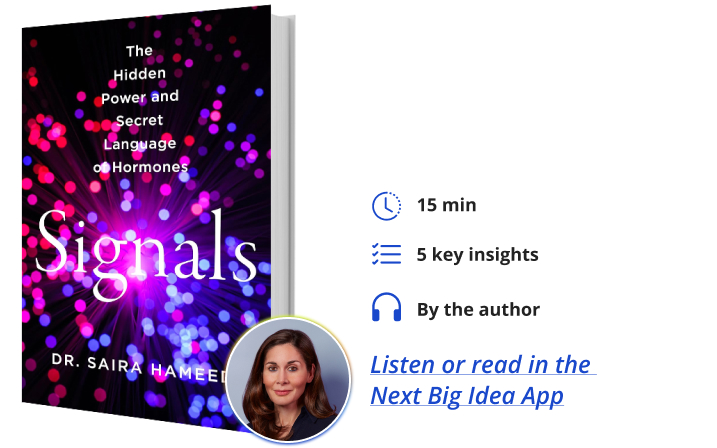
Below, Dr. Saira Hameed shares five key insights from her new book, Signals: The Hidden Power and Secret Language of Hormones.
Saira is a Consultant Endocrinologist at Imperial College Healthcare NHS Trust, a Senior Tutor at Imperial College London, and a prizewinning teacher in the Imperial College School of Medicine. She has been a Medical Research Council Training Fellow and a National Institute for Health and Care Research Clinical Lecturer. In 2024, she was elected a Fellow of the Royal College of Physicians.
What’s the big idea?
Much of what we think of as “us” is really hormones at work. Their story is, in many ways, the story of being human.
Listen to the audio version of this Book Bite—read by Saira herself—in the Next Big Idea App, or buy the book.

1. Do you really know what hormones are?
Hormones are the chemical signals that carry messages within the body. The basis of this communication network is that a hormone is produced by an endocrine gland and then carried away in the blood to deliver a message to faraway cells. This could be the postprandial transmission of the hormone insulin, which brings the blood sugar back down to normal after eating, or estrogen from the ovaries, which is sent to pubertal breast tissue, stimulating it to grow.
Hormones are the body’s way of connecting and coordinating disparate and distant cell groups, preventing them from working as siloed, autonomous tissues, and instead joining them up as an interconnected human body.
Hormones build a new human being in utero, before engorging the mother’s breasts with milk to nourish the baby. Hormones grow the helpless newborn into a rough-and-tumble toddler, and then hormones take the child’s body at puberty and conjure from it the adult form, directing the ovaries to mature their eggs or the testicles to produce sperm, each of these gametes containing the potential to create new life.
Meanwhile, aside from these big-ticket life events, minute-to-minute, our hormones’ control over us is so fundamental that they have orchestrated far more of your day-to-day than you have probably given them credit for. Take this morning, for instance: you felt like having breakfast because the stomach hormone ghrelin sent a hunger signal to your brain, which then compelled you to eat something. You may have congratulated yourself on your willpower after stopping at just one bowl of granola, when in fact the release of the gut hormone GLP-1 signaled fullness to your hypothalamus.
Perhaps you set out for work without a jacket, only to find the weather was unseasonably cold. But you didn’t need to head back and risk missing your train because your body turned up thyroid hormone, the body’s metabolism signal, which produces heat as a by-product of its metabolic stoking. And if you felt overwrought at work today—the bristly client email with half the office copied in—then your hormones had it covered because cortisol sharpened your thinking for the “reply all” email.
2. We can’t control our hormones, but we can learn to live alongside them.
The inherent power of hormones over our everyday lives is so formidable that it makes the idea that, like a light’s dimmer switch, we can turn our signals up or down instinctively appealing: one more supplement, one more shift in our habits, and we’ll be thinner, livelier, happier. You might have seen promises like this on social media, invoking hormones to explain your everyday feelings. If you’re tired, perhaps—the latest reel might suggest—your adrenal glands could be under par today. If libido is going through a fallow patch, maybe estrogen or testosterone signaling is glitching.
By applying first principles, it is usually possible to sort through the hacks and the hashtags. Take the hormone cortisol, for instance, which is released by the adrenal glands in a circadian rhythm, with levels peaking about half an hour before we wake up, and then slowly declining through the day. Cortisol is the so-called “energy hormone,” and while we can’t control cortisol, we can learn how to maximize its potency with smart moves like scheduling our workday to harness the power of our morning cortisol boost for creative or strategic deep-thought work, or for those meetings where we need to be laser-sharp. Don’t start your working day when cortisol signaling is at its strongest by clearing your inbox!
“We need a bit of cortisol edge to get things done, so the idea that we need to tame or suppress cortisol is incorrect.”
Cortisol is also the “stress hormone,” but contrary to popular belief, this is a good thing. We need a bit of cortisol edge to get things done, so the idea that we need to tame or suppress cortisol is incorrect (when cortisol falls too low, in conditions like Addison’s disease, it can even be fatal). Instead of trying to push cortisol to as low as it can go, we can keep in mind the things we can do to prevent it from running too high for too long—this is when the cortisol edge tips into the chronic stress response, which can result in low mood, weight gain, high blood pressure, and other symptoms.
There’s no supplement or tonic with a robust evidence base for alleviating the chronic stress response, instead it comes down to all the things that the age old wisdom tells us are good for us: exercise, which doesn’t mean wearing special clothes or spending money, a daily walk is perfect; getting enough sleep; having a clear cut division between work and relaxation time, so doing things like taking work email off your personal phone; spending lots of in-real-life time with people you love and who love you. A “rebalancing” tea will not reduce the “stress hormone” cortisol, but taking a break and sitting down with a friend to drink it will.
3. The brain is an endocrine organ.
The brain transmits its own hormone signals. The growth hormone released by the pituitary gland at the base of the brain promotes skeletal growth. Oxytocin, released during labor by the mother and the baby’s hypothalamus, inebriates both their brains with the hormone that bonds a mother and child.
The brain also receives hormone messages from the rest of the body, like parochial outposts sending dispatches back to HQ about conditions on the ground. These hormones influence our emotions and how we feel about ourselves and the outside world. We like to believe that we are in control of our feelings and behavior, yet the fear response incited by adrenaline and the soporific progesterone surge of early pregnancy suggest otherwise.
Hormones also modulate long-term brain function, wiring new synapses and circuits that leave a lifelong blueprint for behavior. In early neonatal life, the hormone leptin, released by a baby’s body fat, engineers the brain’s appetite center in the hypothalamus, building connections that govern how much we tend to eat. Similarly, adverse early-life experiences will encode hypervigilance in the amygdala, the brain’s fear generator, under the direction of the “stress hormone” cortisol. In later life, this formative programming can increase the risk of not only mental illnesses like depression, but physical diseases too, such as cancer and obesity.
Taken together, this is the science we call neuroendocrinology: how the brain controls the hormones, and the hormones, in a perfect feedback loop, control the brain.
4. Endocrinology listens in on the body’s internal conversations.
I would love for you to join me in marveling at the mysterious and almost magical concept that we have this brilliant system of endocrine glands and hormones that connect our thirty-trillion cells, so that every one of our cells is following the same script and on cue.
Endocrinology is the specialism of these inner conversations. But endocrinology is also the specialism of the conversations we have with our patients, and by far the most important tool of our trade is our ability to listen to a patient’s story. So, if you sit with me, on my side of the desk, you’ll hear stories of living in a body that feels uneasy, out of sorts, destabilized by some unknown, out-of-control internal factor.
Almost every endocrine case is a piece of detective work. We have to stay alert through the narrative twists or else we might miss the key reveal: the downplayed detail submerged in a sea of other symptoms; the turn of phrase that suggests the lead you’ve been waiting for. In the endocrinology clinic, we combine specialist knowledge with the art of coaxing from a patient the tell that reveals faulty hormone transmission masquerading as life’s ordinary wear and tear.
“Almost every endocrine case is a piece of detective work.”
Some patients are clearly and unquestionably ill, but part of the diagnostic dilemma is that many others present with symptoms that are simply an exaggeration of most people’s ordinary lived experience: tiredness, weight concerns, fluctuating libido. The patient’s history is necessarily subjective. What is your expectation of a “normal” libido? Is your bone-crushing fatigue something that I would find tolerable? Sometimes, too, there are parallel plotlines, because while you have been comfort-eating since the divorce, it turns out in the final denouement that most of the weight gain has been driven by endocrine disease.
Even in the 20 years that I have been a specialist, the field has been transformed by some spectacular breakthroughs. Yet behind the gee-wizardry of the modern diagnostics and next-generation medications, the practice of endocrinology remains rooted in one person telling their story and the other trying to interpret it. It is not always a perfect system. Important parts of a patient’s history can be too hastily discounted as red herrings; test results can come back that don’t easily fit with the story that has been told. There can be a high noise-to-signal ratio. But when we are at our best, we are able to tune out the noise and listen to the signals—to the powerful hormone life force and how the body talks to itself.
5. Being “hormonal” is a good thing!
By animating every aspect and every moment of life, our hormones’ control over us defines our very idea of what a normal life feels like. We expect to wake up refreshed, maintain a stable weight, and be in a reasonable mood, while perhaps overlooking that these processes are governed by the body’s hormones far more than by our behavior, agency, or willpower.
We can seek comfort in the illusion of our control by finessing things a bit around the edges. Metabolism can be revved up with an early-morning workout, or we can wear a device that tracks sleep and tells us to go to bed on time. But that we are compelled to do these things in the first place—and that they work—says less about the value of life hacks and far more about the power of our hormones and their implementation of life’s master plan.
The word “hormonal” is often used pejoratively: “I’m so hormonal,” we might say if we’re feeling tired, moody, puffy, or all three. But this colloquialism misses the point that we are all “hormonal,” all the time. Our health, happiness, and life itself depend on being “hormonal.” To be “hormonal” is to be human.
Enjoy our full library of Book Bites—read by the authors!—in the Next Big Idea App: