














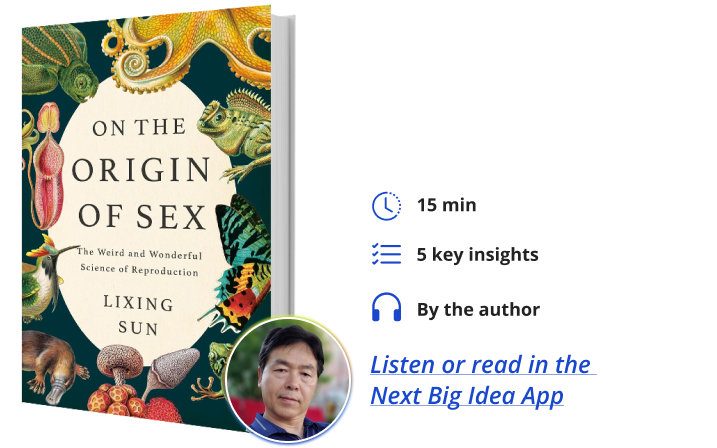
Below, Lixing Sun shares five key insights from his new book, On the Origin of Sex: The Weird and Wonderful Science of Reproduction.
Lixing is a Distinguished Research Professor at Central Washington University and a Radcliffe fellow at Harvard University.
What’s the Big Idea?
Most of what we think we know about sex is wrong. Sex is not primarily about making babies but about mixing genes, and once we see it that way, everything from biological sex to beauty and the diversity of life looks remarkably different.
Listen to the audio version of this Book Bite—read by Lixing himself—in the Next Big Idea App, or buy the book.

1. Sex isn’t about babies—it’s about mixing genes.
Most of us think we know what sex is for. It makes babies. End of story. But that’s only half right, and not even the interesting half.
If reproduction were the whole point, evolution had already nailed it billions of years ago. Single-celled organisms do it faster with far less effort. They just copy themselves. No partner. No courtship. No awkward morning after.
So why bother with sex? Because sex isn’t mainly about making babies. It’s about mixing genes. Think of your genome as a deck of cards. If you just copy it every generation, you keep dealing the same hand. The good cards stay stuck with the bad ones. Evolution can’t separate them.
Sex shuffles the deck. It breaks up old combinations and builds new ones. Good genes can escape bad neighborhoods. Harmful mutations can be flushed out. And every now and then, the shuffle produces a winning hand. That’s the real power of sex: not reproduction, but variation.
And variation is evolution’s raw material. It’s what allows life to adapt, outrun parasites, survive environmental change, and over time, generate the astonishing diversity of life, from microbes to large mammals. Babies are just the byproduct. The real game is reshuffling the genetic deck. And evolution is the dealer.
2. We’ve been misunderstanding biological sex.
Ask what determines biological sex and most people give the same answer: chromosomes, gonads, genitals—XX or XY, ovaries or testes, female or male. It sounds clean. Almost reassuring. But biology is rarely that tidy. Across nature, these traits don’t always line up. Some mammals don’t even have a Y chromosome. The platypus carries ten sex chromosomes. In the spotted hyena, females look strikingly male, even having a pseudo-penis. Female European moles develop ovotestes—part ovary, part testis. In numerous reptiles, sex is determined not by genes, but by temperature.
“Biology is rarely that tidy.”
So, what exactly is sex? The usual definitions focus on visible traits. But those are just surface features—outputs of an adaptive system that doesn’t always follow a single script. Biologists use a more fundamental definition: sex is about gamete size. Small gametes are sperm. Large ones are eggs. That’s the core divide. Everything else (chromosomes, hormones, anatomy) typically lines up with this. But “typically” is doing a lot of work. Because once development begins, things get complicated. Modern molecular biology shows that many dozens of interacting genes shape sexual development in mammals alone. Variation isn’t a rare exception. It’s built into the system.
So, the problem isn’t biology. It’s oversimplification in our understanding. Sex is simple in appearance, but astonishingly complex in how it unfolds. What we learned as a neat binary is a dynamic and surprisingly diverse biological process, one that science is still catching up to understand.
3. Nature invented many versions of sex.
Beneath the familiar sex labels lies a complex developmental system. Now comes the bigger surprise: even that system is just one version among many.
Across the living world, sex takes forms that barely resemble our textbook picture of male and female. Take fungi. Many don’t have males and females at all. Their gametes are the same size. Instead of two sexes, they have multiple proto sexes formally known as mating types. The common mushroom you buy from a grocery store has 18 mating types. The split-gill mushroom has more than 23,000. It’s less like two sexes and more like a vast compatibility network.
In other species, sex isn’t fixed; it’s fluid. Some fish change sex during their lifetime. The clownfish is a classic case: the dominant individual becomes female, and when she dies, a male steps up and transforms. Sex follows social opportunity.
“Across the living world, sex takes forms that barely resemble our textbook picture of male and female.”
Then there are organisms that treat sex as optional. Aphids and water fleas clone themselves when conditions are good—fast, efficient, no partner required. But when the environment turns harsh, they switch back to sex, reshuffling their genes to hedge their bets.
Seen this way, sex is not a fixed category. It’s a flexible strategy. And once you connect this to the core idea from before—that sex is about mixing genes—the diversity suddenly makes sense. Evolution isn’t committed to one tidy design. It experiments. It improvises. It builds whatever system suited to pass on genes given the conditions. So, sex is not one thing. It’s a whole toolbox—different ways life has invented to mix genes, adapt, and thrive.
4. You don’t have to reproduce to pass on your genes.
We tend to think evolution rewards one thing: having children. More offspring, more success. Simple. But evolution is not that narrow. Take social insects like bees, ants, and wasps. In a colony, most individuals never reproduce at all. They spend their entire lives helping the queen produce offspring. At first glance, it looks like an evolutionary dead end. It’s not because they share genes with the queen. By helping her reproduce, they are passing on copies of their own genes. This idea—called kin selection—broadens the logic of evolution. Success isn’t just about individuals. It’s about genes finding ways to persist.
Once you see this, many biological puzzles fall into place. Why some individuals forgo reproduction. Why cooperation among relatives is so common. And this doesn’t stop with insects; it’s in many social animals as well. In humans, not everyone has children. But people invest heavily in siblings, nieces, nephews, and extended families. Those efforts can still carry shared genes into the next generation. So, the real question isn’t just, “Did you reproduce?” It’s, “Did your genes make it forward?”
Passing on genes without direct reproduction opens the door to understanding why a wide range of traits, including intersex variation and same-sex preferences, can persist in nature. Not as anomalies, but as part of a broader system in which genes have multiple pathways to survive and spread.
5. Why beauty still rules us.
Why do beauty pageants exist? Why do people spend billions on cosmetic surgery? And why do looks shape so many opportunities? Part of the answer runs deep, back to evolution. In many species, one sex chooses, and the other competes to be chosen. The peacock grows an extravagant tail. Songbirds pour energy into elaborate performances. These displays are costly, even risky. But they work because they attract attention.
“In many species, one sex chooses, and the other competes to be chosen.”
Humans are no exception. We size up faces in seconds. And those snap judgments carry weight. Attractive people are often perceived as more capable, more trustworthy, and even more intelligent. They’re more likely to be hired, promoted, and paid more. Economists call this the beauty premium. The pattern has its own twists. For women, appearance often carries higher stakes. For men, height plays a similar role. Taller men, on average, are more likely to be seen as leaders and tend to earn more. This isn’t about ability. It’s about perception.
From an evolutionary view, these preferences are not random. They trace back to mate choice. Traits that signal health, status, or reproductive potential tend to be favored, and those biases can spill over into everyday decisions. But what began as biology is now amplified by culture. Media magnifies it. Industries monetize it. Technology edits and filters it. We end up in a feedback loop: biology sets the stage; culture turns up the volume.
Beauty feels natural. But it’s not neutral. It’s an ancient signal that has been reshaped, exaggerated, and broadcast in a modern world.
Enjoy our full library of Book Bites—read by the authors!—in the Next Big Idea App: