















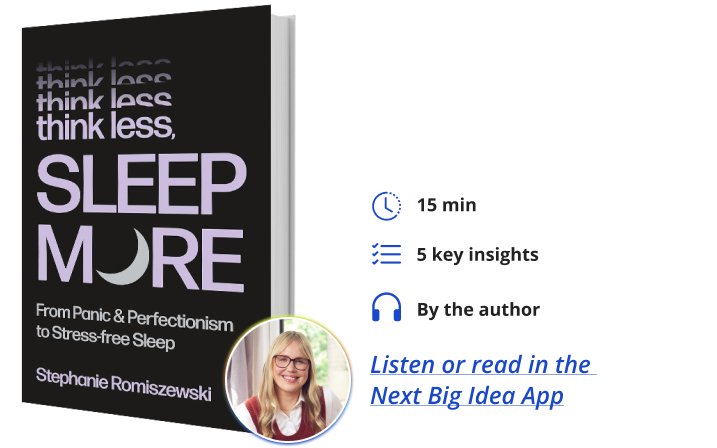
Below, Stephanie Romiszewski shares five key insights from her new book, Think Less, Sleep More: From Panic & Perfectionism to Stress-Free Sleep.
Stephanie is a sleep physiologist. She was the sleep expert on both Channel 4’s Secrets of Sleep series and the BBC’s Insomnia and me and has appeared on high profile podcasts, including Diary of a CEO with Steven Bartlett.
What’s the Big Idea?
Sleep isn’t a skill to master or a problem to solve. It’s a remarkably resilient biological process that works best when we stop trying to control it and start trusting it.
Listen to the audio version of this Book Bite—read by Stephanie herself—in the Next Big Idea App, or buy the book.

1. Sleep is a biological process, not a skill.
Sleep is not something you learn to do. Nobody teaches a baby how to sleep. Nobody practices sleeping. Sleep is a biological process, like breathing, digestion, or healing a cut on your finger.
Despite this, when people come to see me, they often feel as though they’ve somehow lost the ability to sleep. They tell me they are trying harder than ever, which tends to make it worse. Sleep is something your body already knows how to do. In fact, it is remarkably difficult to stop yourself sleeping indefinitely. The body will always try to find a way to sleep. It may not happen in the way you want, at the time you want, or for as long as you want, but the biological drive for sleep remains.
It can be helpful to stop viewing sleep as a performance. You are not trying to become good at sleeping. You’re trying to create the conditions that allow your sleep to become more predictable for your lifestyle.
“The body will always try to find a way to sleep.”
When people stop treating sleep as a skill they must master, they often feel an enormous sense of relief. For some, this mindset shift is enough to get them sleeping the way they want to again. Instead of asking, “How do I make myself sleep?” they begin asking, “What might be getting in the way of sleep?” That is usually a much more useful question.
2. Sleep anxiety is one of the biggest sleep problems we have created.
Many people assume that worrying about sleep is a natural consequence of not sleeping. What I see in clinic is often the opposite. The worry becomes part of the problem.
You might have a few disrupted nights because of stress, illness, a new baby, menopause, work pressures, or any number of normal life events. Initially, the sleep disruption is understandable. The difficulty comes afterward. They begin monitoring sleep closely. They start checking the clock. They calculate how many hours remain before morning. They become convinced that tomorrow will be ruined if they don’t fall asleep soon. Sleep slowly becomes something that needs to be controlled and protected.
The irony is that the more important sleep becomes, the harder it often is to achieve. The brain starts treating the bedroom as a place of alertness and monitoring rather than rest. Sleep becomes associated with pressure rather than safety.
At the same time, we are surrounded by messages telling us that every aspect of sleep needs optimizing. We are told to track it, improve it, and worry about it. Many people end up spending a lot of time thinking about sleep, spending money on sleep, and manipulating all sorts of other behaviors to sleep. What began as a desire to improve sleep can eventually create insomnia, anxiety, and a surprisingly fragile relationship with sleep and life itself.
3. Your morning matters more than your evening.
When people want better sleep, they almost always start by looking at bedtime. They ask about supplements, herbal teas, strict routines, sprays and gadgets, breathing exercises, or elaborate rituals. What often surprises them is that I spend much more time talking about mornings and asking them to liberate themselves from all this other noise.
Sleep is strongly influenced by two biological systems. One is sleep drive, which builds the longer we are awake. The other is circadian rhythm, our internal body clock. Both systems are heavily influenced by what happens after we wake up. Getting up at a reasonably consistent time, exposing ourselves to light, moving around, and beginning the day sends powerful signals to the brain about when it should be awake and when it should prepare for sleep later.
“Many of the foundations of good sleep are laid during the day rather than in the final 30 minutes before bed.”
I am not suggesting that mornings need to become another perfect routine. Quite the opposite. What I want people to understand is that many of the foundations of good sleep are laid during the day rather than in the final 30 minutes before bed. When we focus exclusively on bedtime, we have little influence over sleep quality, duration, or wake-ups. And when the evening rituals do not work, it only feeds into this idea that you have lost the ability to sleep, when really the advice might be what’s a little topsy-turvy. Sleep starts when we wake up.
4. A good sleeper is not someone who sleeps perfectly.
One of my favorite questions to ask is, “What do you think a good sleeper looks like?” The answers are usually very similar.
Someone who:
- Falls asleep quickly.
- Sleeps through the night.
- Never wakes up.
- Gets exactly the right amount of sleep every night.
- Wakes feeling refreshed.
The problem is that this person doesn’t exist. Even healthy sleepers wake up during the night. Even healthy sleepers have poor nights. Even healthy sleepers sometimes take longer to fall asleep. They don’t become alarmed by normal sleep experiences.
To me, a good sleeper is somebody who trusts sleep. Somebody who understands that sleep can vary from night to night without that meaning anything has gone wrong. They don’t assume tomorrow is ruined because they had a difficult night. They don’t feel compelled to compensate, fix, or analyze every fluctuation. Good sleepers tend to have a flexible relationship with sleep rather than a perfect one and they have fairly consistent sleep behaviors which focus on their morning routine.
This isn’t to undermine those who have sleep disorders, and indeed there is evidence-based treatment for those, but in order for us to try to avoid them and not fear sleep, it is helpful to understand normal sleep.
5. Sleep is flexible and adaptable.
Variation is built into sleep. Sleep changes across the week. It changes with age. It changes during pregnancy, parenthood, illness, stress, grief, travel, and major life events. You will not sleep the same at 50 as you did when you were 20. It changes because we are human beings living human lives. Yet many people expect sleep to be identical every night. When it isn’t, they assume something is wrong.
“The sleep system will alter itself to give you what you need.”
Variation is often evidence of a healthy and adaptable sleep system. Your sleep is constantly responding to your environment and your needs. If it didn’t do this, we would not be able to recover from illness and things like jet lag. Some nights you may need more deep sleep. Some nights you may need more dreaming sleep. Some nights may feel lighter or more fragmented. That doesn’t necessarily mean sleep has failed. The sleep system will alter itself to give you what you need.
You can strengthen your sleep baseline with a strong morning routine, but even this will not stop the normal variations of sleep. The more this is understood, the less likely sleep variation turns into chronic insomnia. One of the most reassuring things is that good sleep does not mean sleeping perfectly every night. It means having a sleep system that can adapt to life’s ups and downs.
Enjoy our full library of Book Bites—read by the authors!—in the Next Big Idea App: