









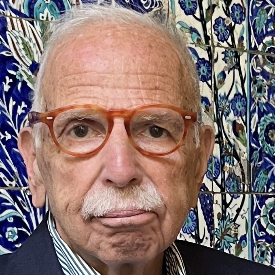
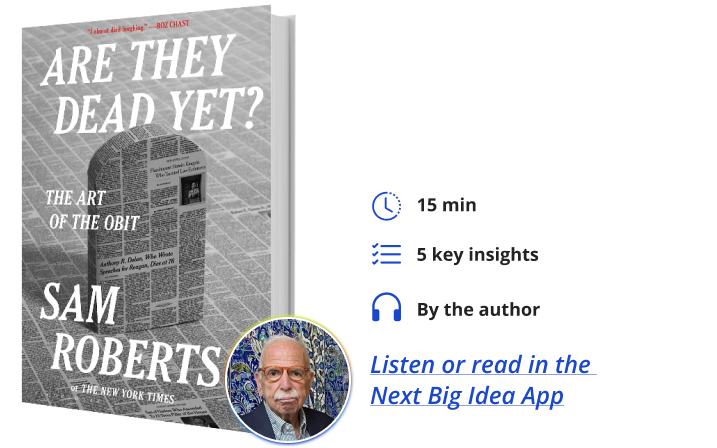
Below, Sam Roberts shares five key insights from his new book, Are They Dead Yet?: The Art of the Obit.
Sam is an obituary reporter and former urban affairs correspondent for the New York Times, where he has worked for decades and written nearly 1,500 obituaries. He hosts the New York Times “Close Up,” which he inaugurated in 1992, and the podcasts Only in New York, anthologized in a book of the same name, and The Caucus.
What’s the Big Idea?
Obituaries are really about life, not death. Writing obituaries is a serious form of biography and journalism. It captures what made a person significant, preserves people who might otherwise be forgotten, and helps readers reflect on their own lives and mortality.
Read this Book Bite in the Next Big Idea App, or buy the book.
1. Famous last words.
When interviewing friends and family to compose an obituary, there’s one question I’ve never asked: What were their last words? My suspicion is that most “last words” that have been immortalized are more likely to have been penultimate ones. Still, some so-called last words are too good to be disregarded or forgotten.
I’d like to think that Groucho Marx was grounded enough to have actually posed this closing line: “Die, my dear? Why, that’s the last thing I’d do!” Groucho was also credited with declaring on his deathbed, “This is no way to live.”
Or that George Bernard Shaw actually quipped, “Dying is easy, comedy is hard.”
My favorite was attributed to Oscar Wilde. His most quotable “last” words were said to have been spoken to friends a few weeks before he succumbed in a Paris hotel room: “My wallpaper and I are fighting a duel to the death. One or the other of us has got to go.”
If you had one foot in death’s door, what would your last words be?
2. What happens next.
Obituaries are mini-biographies about the lives of the nearly departed. To flesh out their resumes, I try to interview as many subjects as possible in advance, probing their pasts and searching for the so-called Rosebud moment that defined their lives—that epiphany that elevated them into subjects worthy of a Times obituary.
A lot of people believe in an afterlife. But another question I’ve never asked in all those interviews is what people really expect to happen after they’re declared dead. Answers about what comes next—if anything—are often based on the religious upbringing that governed how a person behaved during life.
“Another question I’ve never asked in all those interviews is what people really expect to happen after they’re declared dead.”
In the obituary of columnist Charles Krauthammer, I recalled him saying, “I don’t believe in God, but I fear him greatly.” Woody Allen famously views the concept of the afterlife through a lens of existential dread and dark humor. “I do not believe in an afterlife,” he once said, “although I am bringing a change of underwear.”
3. Overlooked.
Since 1851, when The Times first started publishing, many people who should have been memorialized in news obituaries were neglected or simply overlooked. Most women who were mentioned were described only in relation to their husbands. Many Black people and other minorities were immortalized chiefly because they were centenarians who had survived the indignities of slavery.
“If one is to believe only what one reads in The Times,” journalist Gay Talese wrote, “then the individuals with the highest fatality rate are chairmen of the board. Women and Negroes hardly ever seemed to die.”
No denying it: the obit pages gave them short shrift. A Times editor, Amy Padnani, was struck by those oversights and decided to rectify them retroactively. The result was the ongoing “Overlooked No More” feature in The Times. Among the missing from the original litany of Times obituaries: photographer Diane Arbus, poet Sylvia Plath, mathematician Alan Turing.
What Padnani accomplished, in her own words, was, “to expand history’s narrow lens” and to “flex the boundaries of our daily decisions on the Obituary Desk to make them more accurately mirror society.” To be valued, one first has to be noticed. Or, in the immortal words of Mae West: “It is better to be looked over than overlooked.”
4. The nearly departed.
Writing an advance obit—that is, of someone who is still alive—may seem a bit macabre. But as a Times colleague once explained, it’s really just the journalistic equivalent of buying your own cemetery plot: “If you wait until it’s too late, it’s too late.”
Most people agree to be interviewed for their own advance obituaries. While the interview is a tacit affirmation of their own mortality, it’s also something of a status symbol. The process demands real finesse from the writer, though. As another Times reporter put it: “There is no Emily Post for how you call someone up and say, in effect, ‘Hello, I’m a stranger. You don’t know me, but I’d like to ask you about some fairly revealing details of your life. And then when you die, because I know you will sooner or later, I’m going to put them where a million people can see them.’”
“Most people agree to be interviewed for their own advance obituaries.”
Reporters who write advance obituaries for a living can become subject to guilty consciences or, at least, ambivalence. As Gay Talese pointed out about one reporter, “Having written a fine advance obituary, his pride of authorship is such that he can barely wait for that person to drop dead so that he may see his masterpiece in print.”
I wrote an advance obituary of a news editor who was famous for his micromanagement and rulebook integrity. When I interviewed him, he recalled asking another advance obit writer to make an exception—to let him read his own advance obituary before he died. “Look,” the writer reminded the editor, “you know I can’t show it to you. You used to enforce that all the time. But I’ll tell you this much: When it appears, you’re gonna love it.” I ended the editor’s advance obituary with that quote.
5. Ghostwriting.
In novels, movies, and television, obituary writers tend to be portrayed as figures banished to the obit department, either because they are too young or too old, too incompetent, or too much of a maverick who has committed egregious errors that doomed them to the death beat. It’s a specious stereotype.
The job isn’t a dead end at all. It necessitates heavy research, empowers writers with fewer editorial fetters, and opens a window onto undiscovered or even previously unknown worlds. Obituaries are not about death at all, but are mini-biographies about the great, and in some cases, those who are gone but perhaps best forgotten.
Clarence Darrow once candidly acknowledged, “I have never killed a man, but I have read some obituary notices with great pleasure.” I’m pretty sure most of my colleagues have never killed anyone either, but have written some obituaries with great pleasure.
“The most avidly read obituaries are of those who died too soon and those who lasted beyond expectations. What everybody wants to know is: Why them? What was their secret? Or their fatal mistake? Could the same happen to me?” That question, at bottom, is why we read the obits at all—and why, for those of us who write them, it remains one of journalism’s most quietly rewarding beats.
Enjoy our full library of Book Bites—read by the authors!—in the Next Big Idea App: